Categories
Self-Hosted Developer Tools AI Agents LLM Infrastructure AI Agent Memory Context EngineeringStars
Forks
Watchers
Developer links
Statewave
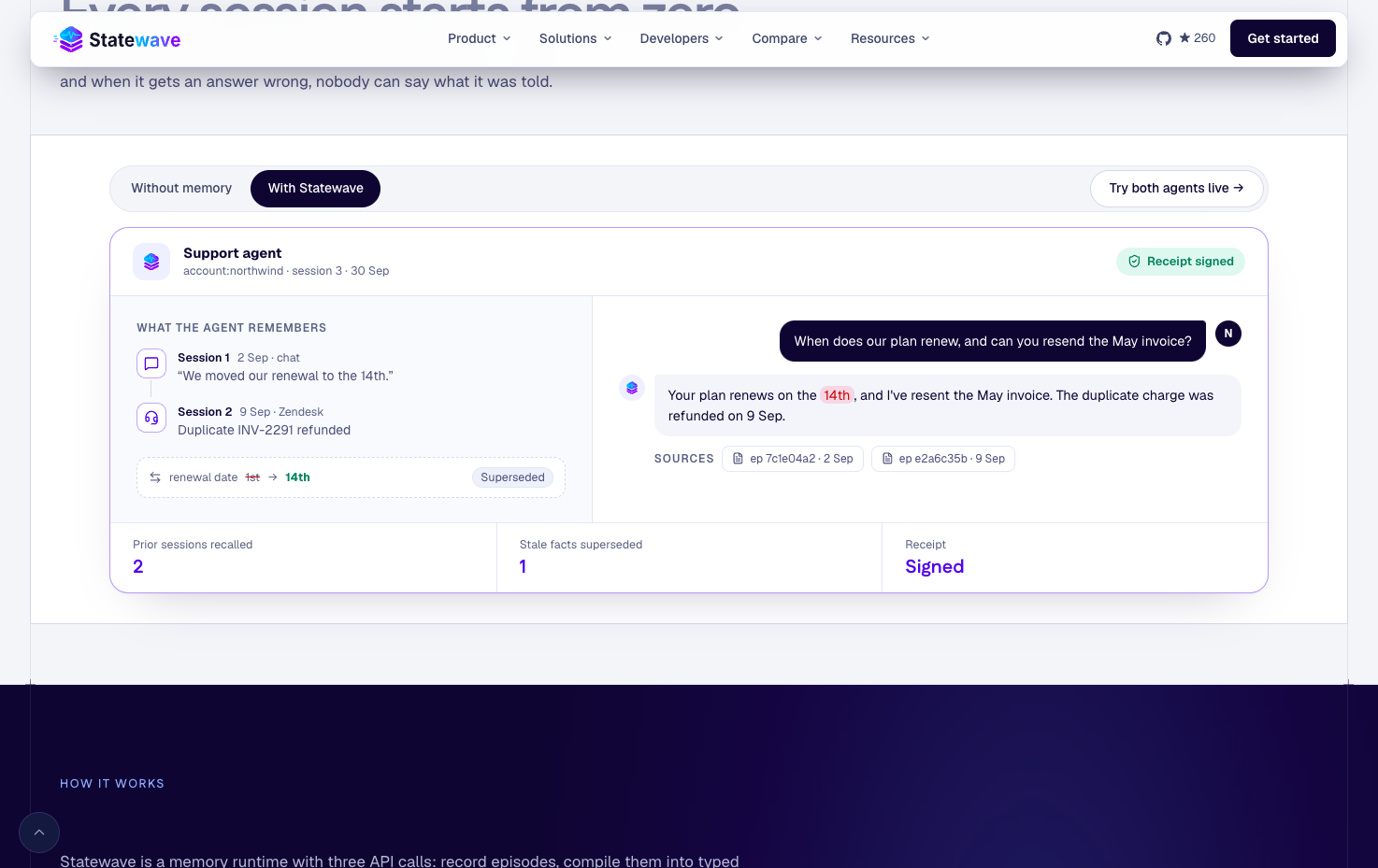
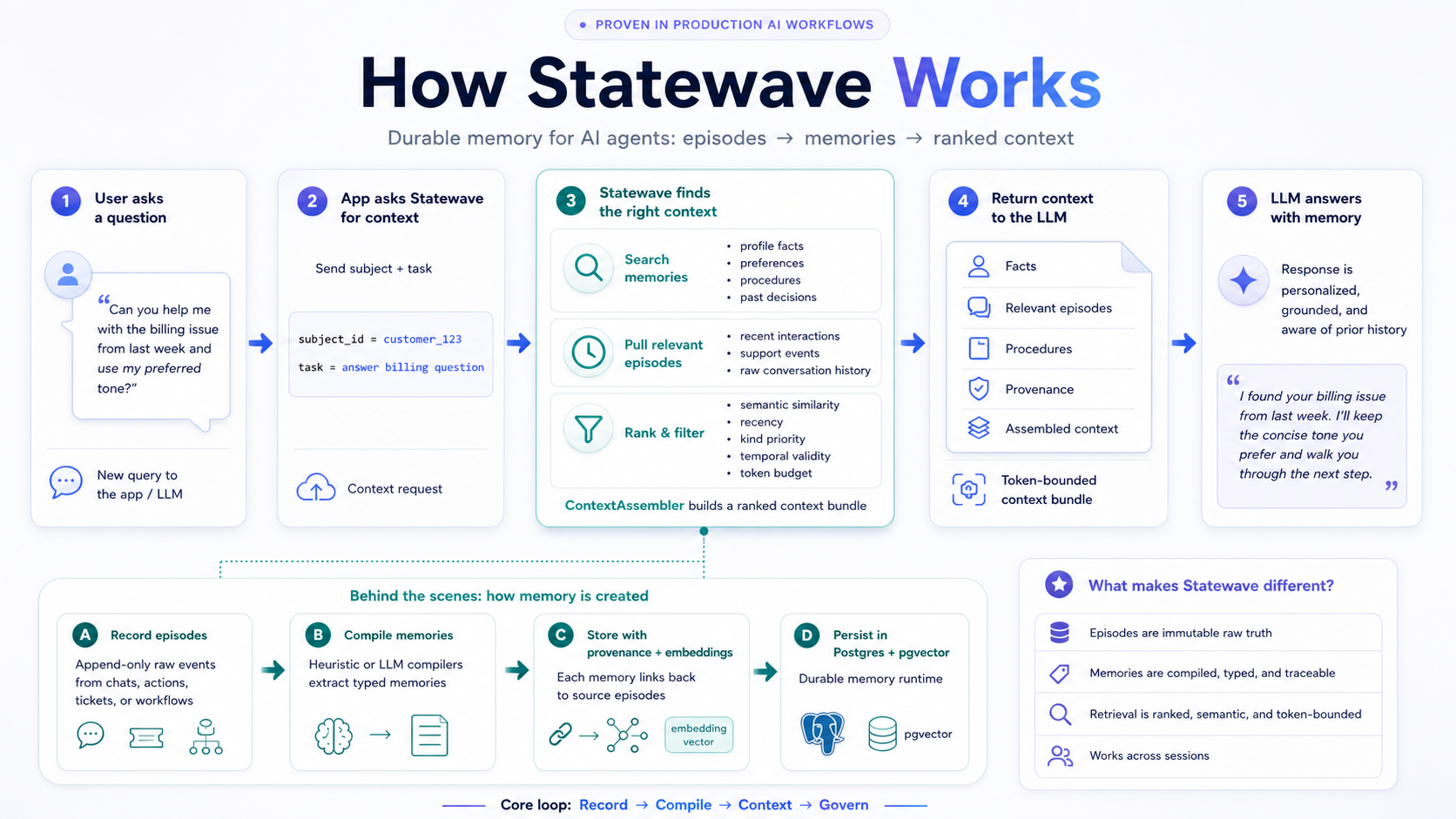
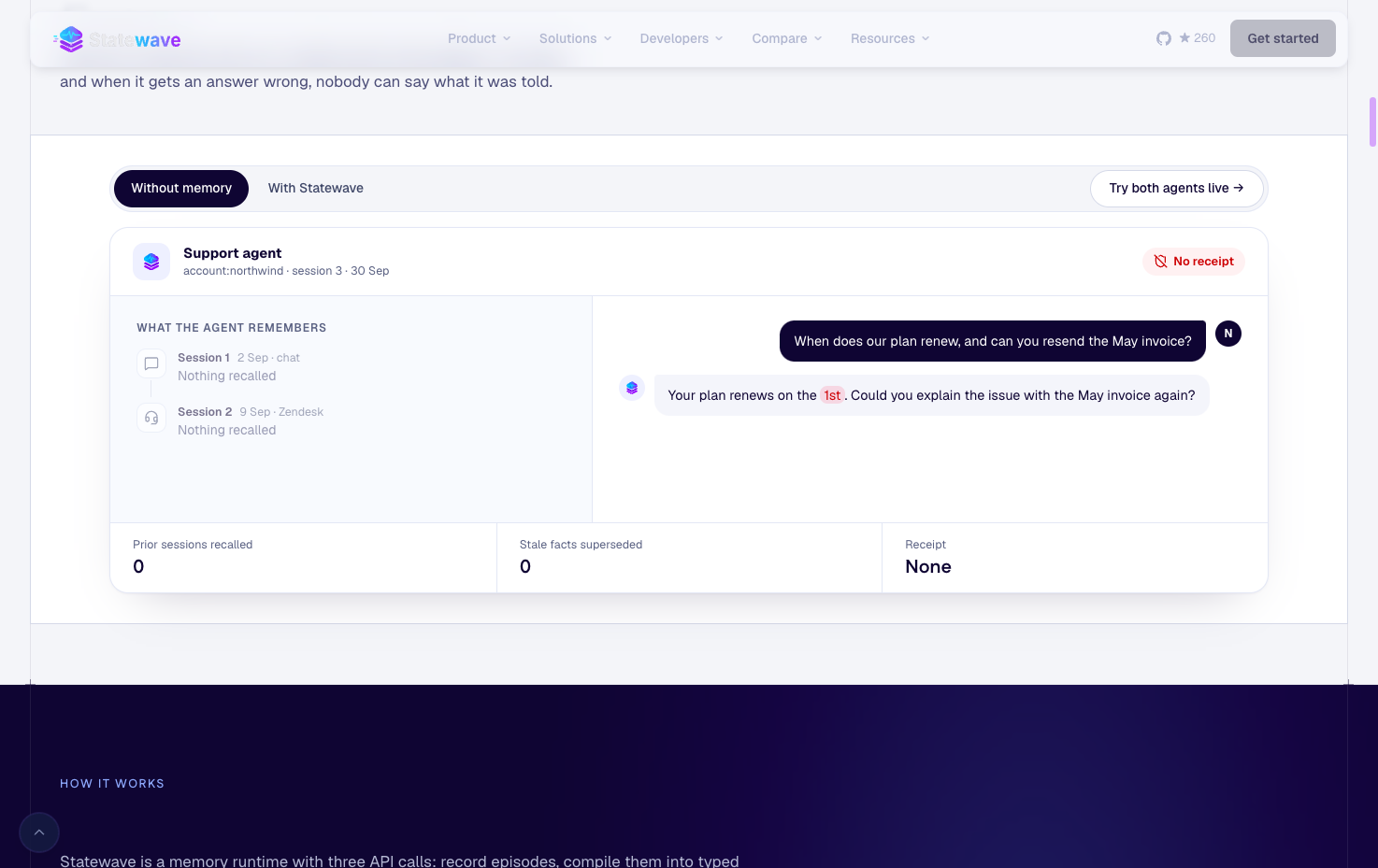
Statewave is the memory runtime that compiles what your AI agents experience into typed, provenance-tagged memories, so the same subject asked the same question receives the same context every time. Recording is append-only: your application writes events as episodes (chat, ticket, commit), and a compiler distills them into structured memories with confidence scores, each traceable to its source episodes. When an agent needs context, Statewave assembles a ranked bundle inside the token budget you set; the same request at the same moment returns identical bytes, so retrieval sampling noise never leaks into an answer. Every bundle leaves an HMAC-signed receipt that a replay endpoint can re-evaluate under the same rules. Memories carry sensitivity labels for personal data, financial details, and secrets, and YAML policies deny or redact them per tenant. One instance serves many products: tenants are isolated by header, pinned to a region for residency with cross-region requests refused, and erasable by subject on request. The default compiler runs fully local on regex heuristics with no API key, or point extraction at any of 100+ LiteLLM providers. Reach it over REST from any language, through typed Python and TypeScript SDKs, LangChain, CrewAI, and AutoGen integrations, or the built-in MCP server that lets Copilot, Claude, and Cursor share one memory. Support agents recognize returning customers across sessions, and coding agents keep project decisions between conversations. Running on a dedicated VPS on RepoCloud with guaranteed CPU, RAM, and SSD, full root SSH access, and a browser serial console. Apache 2.0 licensed.
Benefits
- Deterministic context, no retrieval noise
- Compiled memories assemble into ranked, token-bounded bundles where the same subject and task at the same moment always return identical bytes, eliminating the sampling drift of query-time retrieval.
- Provenance for every single memory
- Each memory traces back to its source episodes, and every assembled bundle leaves an immutable, ULID-addressable, HMAC-SHA256 signed receipt that a replay endpoint can re-evaluate under original rules.
- Governance inside the runtime
- Sensitivity labels for personal, financial, and secret data combine with declarative YAML deny and redact policies, per-tenant region pinning for residency, and delete-by-subject for erasure requests.
- Self-hosted, CPU-only, no GPU
- One Docker or Helm deployment on your own PostgreSQL with pgvector runs the whole runtime on CPU; the local heuristic compiler needs no API key and no external service.
Features
- Compile-then-use memory pipeline
- Events land as append-only episodes, compile once per subject change into typed memories with confidence scores, and assemble on demand into prompt-ready context bundles.
- Pluggable compiler backends
- Choose the fully local regex heuristic compiler with zero API keys, or LLM extraction through LiteLLM against OpenAI, Anthropic, Azure, Bedrock, Ollama, Gemini, and 100+ providers.
- Sensitivity policy engine
- Declarative YAML policies deny or redact memories tagged pii, financial, or secret, in log-only or enforce mode, with detector-suggested labels awaiting operator promotion.
- Multi-tenant region pinning
- Tenants are isolated by the X-Tenant-ID header with per-tenant configuration and policies; a tenant pinned to the EU is refused with HTTP 403 from processes elsewhere.
- MCP server and SDKs
- A built-in MCP server shares memory with Copilot, Claude, and Cursor, while typed Python and TypeScript SDKs and LangChain, CrewAI, and AutoGen integrations cover application code.
- Connectors for real-world events
- Connectors feed repositories, communities, documentation, support tools, email, and workflows into the episode stream, so agents build memory from operations instead of hand-written ingest jobs.