SaaS Alternative
Ansible Automation Platform Puppet Enterprise VMware Aria Automation Config Chef AutomateCategories
DevOps Configuration Management Infrastructure Automation System Administration Event-Driven Automation Remote ExecutionStars
Forks
Watchers
Developer links
SaltStack
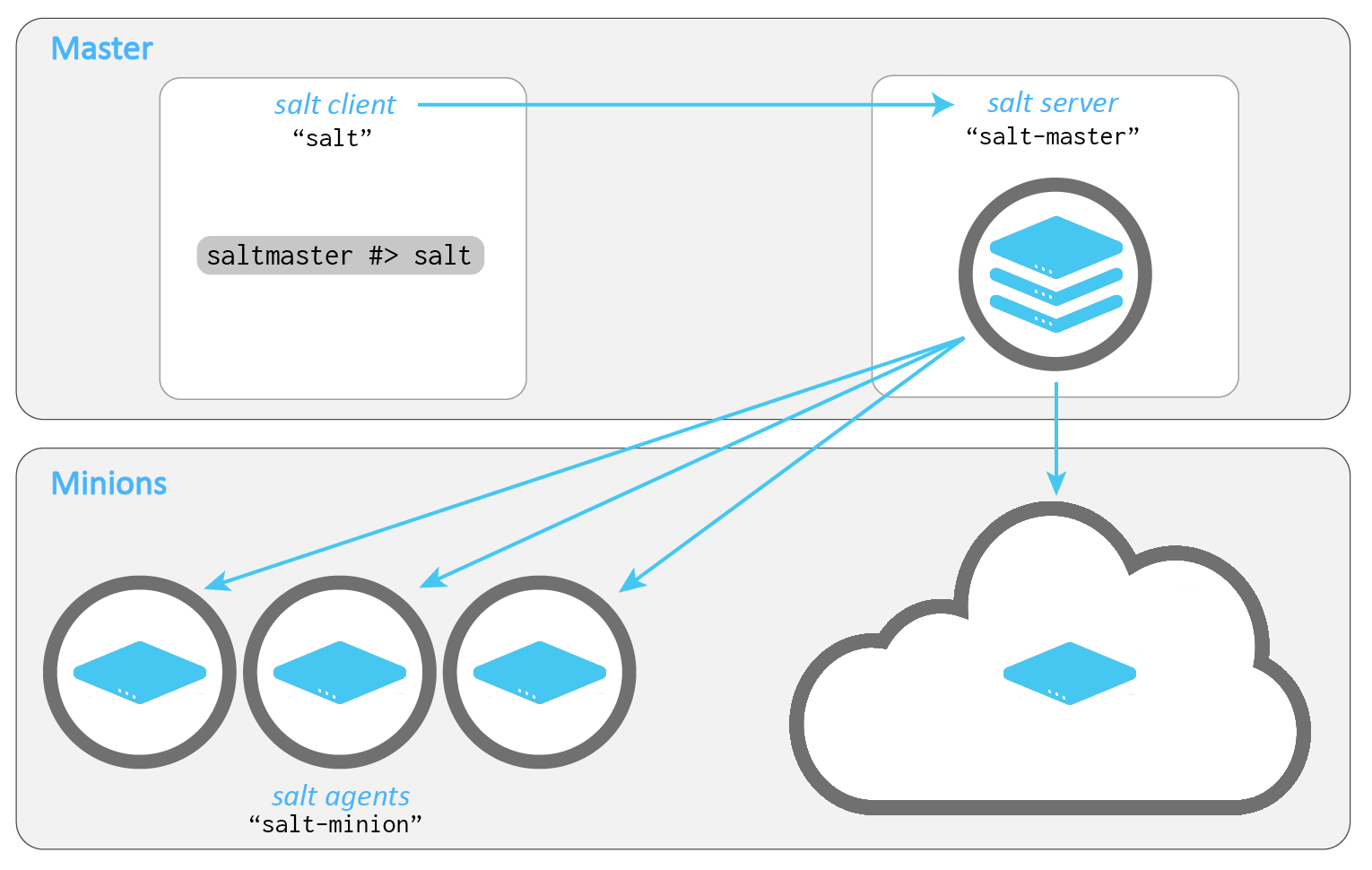
Type one command on the Salt master and ten thousand machines answer, because Salt publishes jobs to minions that subscribe, check whether the job targets them, and execute it in parallel before reporting results back. Configuration management describes the desired end state in YAML state files: which packages, files, services, and users should exist, and highstate runs converge every targeted minion toward that description with dependency ordering. Targeting goes far beyond hostnames, since grains describe each minion's operating system, hardware, and roles, and Pillar delivers per-minion secrets and settings rendered only for the machines that should receive them. Beacons watch services, load, disks, logins, and file changes on minions and emit events onto the bus, while reactors bind those events to prepared responses, so a failed service can restart itself and an administrator gets notified with the evidence attached. Orchestration runners coordinate multi-machine procedures in sequence, such as draining a load balancer pool, patching it, and returning it to service, and the master exposes HTTP APIs and pluggable returners that stream job results into your databases and dashboards. Machines that cannot run an agent are reached through Salt SSH, and Salt Resources target appliances and API endpoints that should be managed without a minion at all. Running on a dedicated VPS on RepoCloud with guaranteed CPU, RAM, and SSD, full root SSH access, and a browser serial console. Apache-2.0 licensed.
Benefits
- Parallel Execution At Fleet Scale
- The master publishes jobs over the ZeroMQ or TCP event bus and subscribed minions execute simultaneously, so a command or package install reaches thousands of systems in seconds rather than serial SSH loops.
- Desired State, Continuously Enforced
- Declarative YAML states declare packages, files, services, and users, and highstate converges each minion to that description with dependency graphs, letting configuration drift be detected and corrected on schedule.
- Infrastructure That Reacts Alone
- Beacons emit events for service failures, load spikes, and file changes, and reactors answer with prepared states, enabling automatic restarts, rollbacks, scaling steps, and administrator notifications without human wake-ups.
- Agents Where Possible, SSH Otherwise
- Minions provide persistent event-driven control, while Salt SSH manages machines that cannot host an agent and Salt Resources cover appliances and API endpoints, so few systems stay outside management.
Features
- Grains And Pillar Targeting
- Grains describe each minion's OS, hardware, and custom roles for compound targeting, while Pillar renders per-minion data and secrets on the master only for authorized systems.
- Orchestration Runners
- Runner modules execute on the master to coordinate ordered, multi-minion workflows with requisites, calling execution and state modules across the fleet as one procedure.
- Event Bus And Returners
- An open event system carries jobs, results, and beacon events, and pluggable returners write job outcomes to databases, message queues, and monitoring systems for audit.
- Salt Cloud Provisioning
- Salt Cloud creates and bootstraps virtual machines on public and private clouds with provider profiles, then manages them as minions from first boot onward.
- Master APIs And Syndic
- REST and Python APIs expose master functions to external tools, and syndic masters federate control so regional masters relay commands within very large or segmented estates.