Astron Agent
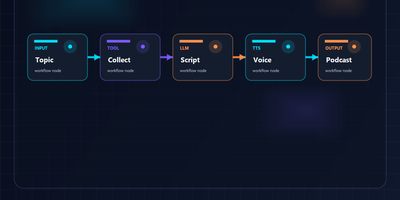
Recognized by the CNCF Landscape in the AI Agent – Workflow Orchestration category alongside Dify and Temporal, Astron Agent is iFLYTEK's fully open-source platform for building, deploying, and managing enterprise multi-agent systems — backed by 8,900+ GitHub stars and the production infrastructure behind one of China's largest AI companies. Unlike pip-install frameworks such as LangGraph, CrewAI, or AutoGen, Astron Agent ships as a complete microservices platform spanning 10+ services across Java, Python, Go, and TypeScript: a ReactFlow-based visual workflow builder for low-code agent orchestration, native integration with the Model Context Protocol (MCP) for tool calling, a built-in model management layer supporting iFLYTEK Spark, OpenAI, Anthropic, and on-premises MaaS deployments, and a multi-tenant Go authentication service powered by Casdoor. The standout differentiator is native RPA integration via the companion astron-rpa project (7,200+ stars), providing 300+ pre-built automation capabilities spanning browser, Office document, and enterprise system interaction — enabling agents to execute physical UI actions rather than only API calls. Infrastructure includes PostgreSQL for multi-tenant data isolation, MySQL for application metadata, Kafka for event streaming, Redis for caching, and MinIO for object storage, all orchestrated through Docker Compose with explicit health checks and dependency chains or production Kubernetes Helm charts. Running on a dedicated VPS on RepoCloud with guaranteed CPU, RAM, and SSD, full root SSH access, and a browser serial console. Apache 2.0 licensed.
Bionic
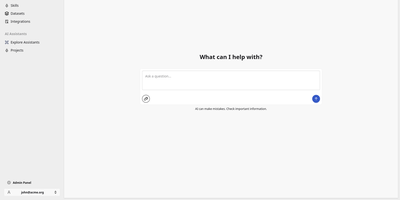
Bionic gives a company its own private AI workspace where models can read documents, use approved tools, run code, and hand back finished files. Staff open a chat, pick a model, and ask for work; the agent searches datasets, calls connected systems including Gmail, Google Drive, Salesforce, ServiceNow, and Jira, and saves spreadsheets, reports, and PDFs as artifacts. Skills package reusable instructions for jobs like release readiness, incident briefings, policy gap reviews, and RFP responses, so a good workflow gets written once and reused by everyone. Datasets collect security policies, product docs, handbooks, and support archives for grounded answers. Administrators manage API keys, watch token usage and request charts, set rate limits, configure providers, and divide people into teams with their own assistants. SSO, role-based access, and an audit trail keep the rollout governed. Developers can issue model and assistant keys and turn any OpenAPI specification into a new integration. Running on a dedicated VPS on RepoCloud with guaranteed CPU, RAM, and SSD, full root SSH access, and a browser serial console. Apache-2.0 licensed.
Manifold
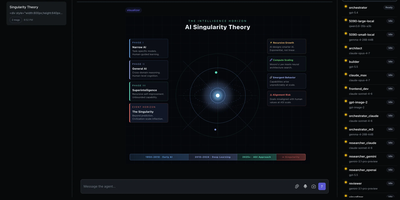
One workspace, a whole roster of AI specialists: Manifold is an agent platform for long-horizon objectives that run through chat, visual workflows, and scheduled tasks. Specialists carry their own model, prompt, and tool allow-list, group into teams, and collaborate across many turns in a chat view that renders HTML visualizations beside text. Models come from OpenAI, Google, Anthropic, or any server that speaks the OpenAI API, such as llama.cpp or vLLM, and image generation reaches OpenAI, Google, or local ComfyUI. The flow editor draws workflows on a canvas, exposes MCP tools as nodes, and turns a saved workflow into a tool that specialists and other flows can call. Pulse schedules specialist tasks at intervals, daily, or once at a chosen time and delivers results to Matrix rooms. Projects isolate agent workspaces to their own folders, load skills from each project's skills directory, and include a file browser with upload, download, and Markdown preview. A Playground versions prompts and datasets and runs experiments that show how a prompt change shifts behavior, while the overview dashboard charts token usage, traces, and logs. Sign-in through OIDC or OAuth2 is optional and adds user and admin roles. Running on a dedicated VPS on RepoCloud with guaranteed CPU, RAM, and SSD, full root SSH access, and a browser serial console. MIT licensed.
Conductor
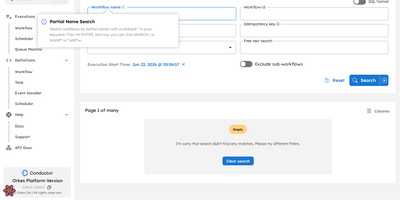
Originally built at Netflix to orchestrate microservices powering 230 million subscribers and now trusted in production at Tesla, LinkedIn, and J.P. Morgan, Conductor is the most battle-tested open-source workflow engine available — with 32,000 GitHub stars and horizontal scalability to billions of executions. The architecture cleanly separates orchestration from business logic: workflows are defined in declarative JSON while workers execute tasks in any of seven supported languages (Java, Python, Go, JavaScript, C#, Ruby, Rust) with zero framework constraints. Durable execution persists every state transition, enabling automatic retries, configurable timeouts, crash recovery, and instant replay from any failure point without re-executing completed tasks. Native AI agent orchestration supports 14+ LLM providers (Anthropic, OpenAI, Google Gemini, AWS Bedrock, Mistral, Cohere, HuggingFace, Ollama), MCP tool calling, function calling, human-in-the-loop approval gates, and vector database integration (Pinecone, pgvector, MongoDB Atlas) for RAG pipelines. Deploy with your choice of five persistence backends (PostgreSQL, Redis, MySQL, Cassandra, SQLite), six message brokers, and Elasticsearch or OpenSearch for workflow indexing — all configurable via Docker Compose files included in the repository. The built-in web UI provides workflow visualization, execution monitoring, task queue inspection, and manual intervention controls. Running on a dedicated VPS on RepoCloud with guaranteed CPU, RAM, and SSD, full root SSH access, and a browser serial console. Apache-2.0 licensed.
MateClaw
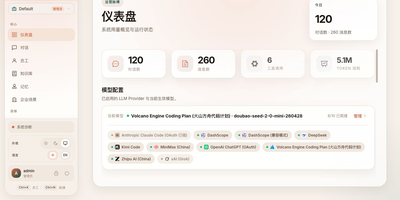
MateClaw delivers a multi-agent AI platform where digital employees run as persistent team members with roles, goals, and accumulated skills rather than stateless chat completions. The Spring Boot backend on Spring AI Alibaba provides ReAct iterative reasoning and Plan-and-Execute decomposition on a StateGraph runtime, with parallel delegation between employees and dynamic context pruning for multi-step tasks. Five career templates ship ready (Product Researcher, Customer Support, Knowledge Curator, Data Analyst, Executive Assistant) while custom employees inherit configurable backstories, pixel-art avatars, and dedicated tool bindings. The MCP integration supports stdio, SSE, and Streamable HTTP transports with per-employee tool isolation preventing capability bleed between agents. ACP bridges bring Claude Code, Codex, and other coding agents in as first-class employees. Workflow orchestration composes multiple employees and system actions into publishable linear DSL processes with seven step modes: sequential, fan_out, collect, conditional, await_approval, dispatch_channel, and write_memory. The trigger system wires cron schedules, webhooks, channel messages, employee lifecycle events, content matches, and workflow completions to automated flows. The Admin Runtime Console provides real-time visibility into running employees with token usage tracking and one-click force-recycle. Spring Boot Actuator monitoring, full audit trail, and per-channel error isolation deliver production-grade reliability. Running on a dedicated VPS on RepoCloud with guaranteed CPU, RAM, and SSD, full root SSH access, and a browser serial console. Apache-2.0 licensed.
CUGA
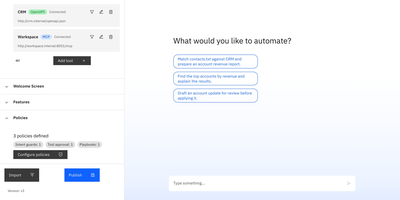
Turn a plain business request into a finished workflow, with a human sign-off on anything risky. CUGA is an agent harness you run on your own infrastructure, with a browser workspace where you build agents, test them beside a draft chat, and publish a versioned configuration when it behaves. Connect tools through MCP servers or OpenAPI specs, then write five kinds of policy: intent guards, playbooks, tool guides, tool approvals, and output formatters. A supervisor agent can route work to specialists that each carry their own tools and instructions. The chat workspace keeps conversation threads, uploaded files, and a knowledge panel for cited answers from company documents. Event Studio runs watchers on cron schedules, polling, or push triggers, with run history showing tools used and results. Memory records task guidance and user preferences, shows where each came from, and lets users switch it off or forget items, and administrators set retention rules. OIDC sign-in separates chat users from managers. Point it at any OpenAI-compatible endpoint, including a private inference server. Operations teams, internal tooling groups, and platform engineers can automate CRM reports, document review, and recurring briefs without sending data outside their boundary. Running on a dedicated VPS on RepoCloud with guaranteed CPU, RAM, and SSD, full root SSH access, and a browser serial console. Apache-2.0 licensed.
deco Studio
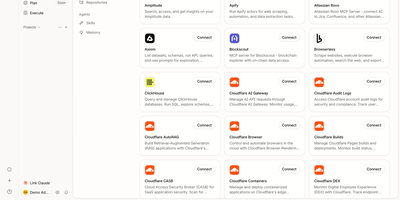
Roll out AI across a whole company without handing a single API key to anyone. deco Studio gives teams a shared chat workspace, and the admin keeps control of which models, tools, and data every agent can touch. Register MCP servers once from a catalog of ready-made connections, including Amplitude, Apify, Atlassian Rovo, ClickHouse, and a long list of Cloudflare services, then grant tool-level access by organization, role, or agent. Tokens stay in an encrypted vault, so teammates share capabilities and never credentials. Agents bundle instructions, skills, files, and approved tools, then publish as their own MCP endpoint that Cursor, Claude Desktop, or custom code can call. A built-in skills library ships with dozens of reusable playbooks, and Memory keeps facts the whole organization should remember. Model choice stays open through OpenRouter, Anthropic, OpenAI, Google Gemini, or any OpenAI-compatible server, and engineers can link a Claude Code or Codex session they already use. Projects group agents and connections around a goal, with Monitor dashboards for orders, visitors, logs, and deploys, and an Execute board for tasks and epics. Running on a dedicated VPS on RepoCloud with guaranteed CPU, RAM, and SSD, full root SSH access, and a browser serial console. MIT licensed.