DeepTutor
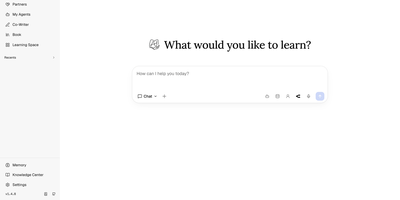
With 34,000+ GitHub stars and a v1.5 release driven by 36 merged community pull requests, DeepTutor from Hong Kong University's Data Science Lab delivers a full agent-native learning workspace that goes far beyond chatbot wrappers. Eight integrated surfaces — Chat, Deep Solve, Quiz Generation, Deep Research, Math Animator, Co-Writer, Book generation, and Mastery Practice — share a unified context so the objective follows the learner, not the tool. The platform's three-layer memory architecture (L1 working, L2 session, L3 long-term) makes personalization inspectable rather than opaque, letting users see exactly what the system remembers and why. Knowledge retrieval operates across five pluggable engines — LlamaIndex with FAISS vectors, PageIndex for page-level citations, GraphRAG for knowledge-graph traversal, LightRAG for local or server-offloaded retrieval, and linked Obsidian vaults — with document parsing via MinerU, Docling, markitdown, or PyMuPDF4LLM. Partners extend the tutoring brain to 15+ messaging platforms including Slack, Discord, Telegram, Matrix with E2EE, and Mattermost, each carrying private memory with branch, resume, and replay capabilities. Subagent integration brings Claude Code, Codex, Gemini, and Kimi directly into learning sessions. The system supports 30+ LLM providers from OpenAI and Anthropic to Ollama for fully local operation, with multi-user isolation, admin controls, and a full CLI interface. Running on a dedicated VPS on RepoCloud with guaranteed CPU, RAM, and SSD, full root SSH access, and a browser serial console. Apache 2.0 licensed.
Etude
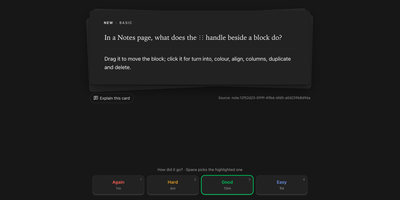
Because every flashcard is a small program, Etude can ask for a fresh calculation on each review, play a chord on a piano, pose a chess puzzle, or grade a proof by what you wrote. A card is graded by self rating, by a script, by AI that explains what you missed, or by a hybrid that hands the hard cases to the model. Math answers are compared by equivalence, so x(x+1) matches x^2+x. FSRS-6 schedules the reviews. Give a deck an exam date and every card is pulled in before the day. Anki .apkg decks import with their review history. The Market installs shared decks, card types, and themes, and an in-app editor with live preview lets you design your own. Notebook pages hold equations, runnable code, canvases, kanban boards, and a link graph. The Ask assistant builds decks from your notes or a PDF. Every action is also a CLI command with JSON output, so Claude Code or Codex can quiz you and flag weak topics, and an MCP server opens your collection and notes to them. AI grading stays off until you add an API key or sign in with ChatGPT, and any address other than localhost requires an access token. Running on a dedicated VPS on RepoCloud with guaranteed CPU, RAM, and SSD, full root SSH access, and a browser serial console. AGPL-3.0 licensed.