Open Monograph Press
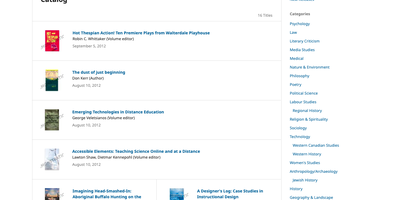
Monographs and edited volumes reach readers through a searchable catalog once Open Monograph Press (OMP) has carried them through its editorial workflow. Authors drag in chapter files, figures, and tables, and managing editors assign editors and track their assignments. Manuscripts move through Submission, Internal Review, External Review, Copyediting, and Production, with anonymous or open review rounds, due dates, automated reminders, and a flag for overdue reviews. Books publish in whatever formats a press needs: PDF, ePub, HTML, audio, video, datasets, or a printed edition with an ISBN. Files are set to Open Access or Direct Sales, and priced formats get a purchase button. Edited volumes list their chapters with separate contributors and downloadable files. Series with their own editors and nested subject categories organize the catalog, and featured and new-release flags decide which titles lead the home page. Readers search or browse by series or category on a responsive site that a press can restyle with a custom theme. Catalog entries carry ONIX metadata for books and chapters, DOIs, ORCID, and ROR affiliations, with OAI-PMH and Google Scholar support for discovery. Usage charts track catalog-entry and file views over time, a per-monograph table lists abstract, file, PDF, and HTML counts, and COUNTER R5 reports are built in. Configurable roles cover editors, copyeditors, and production assistants. Publication metadata is multilingual. Running on a dedicated VPS on RepoCloud with guaranteed CPU, RAM, and SSD, full root SSH access, and a browser serial console. GPL-3.0 licensed.
Typemill
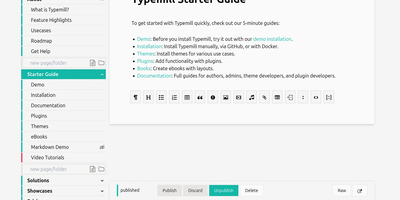
Documentation deserves better than a database nobody wants to maintain. Typemill is an open-source flat-file CMS for informational websites, manuals, knowledge bases, and handbooks: content lives as Markdown files in folders, so a site can be copied, versioned, backed up, and moved with ordinary file tools and no database server anywhere in the stack. Authors get a visual block editor for nontechnical writing and a raw Markdown editor when precision matters, with a navigation tree, drag-and-drop structure, media library, page metadata, and publish states in one workspace. The same source then publishes three ways: as a themed website, as a printable PDF manual, or as an EPUB eBook through the eBook studio, making single-source publishing real for teams tired of maintaining docs, PDFs, and handbooks as three diverging copies. Themes are built from HTML and Twig; plugins add search, analytics, diagrams, math, and integrations; and an optional AI assistant interface connects writing help to the editor. User management, restricted pages, redirects, and a REST API cover the operational side, and the whole application is small enough to run comfortably on modest shared-style hosting or a tiny server while still feeling instant. Running on a dedicated VPS on RepoCloud with guaranteed CPU, RAM, and SSD, full root SSH access, and a browser serial console. MIT licensed.