OpenAlgo
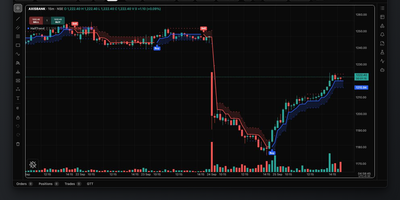
Trading alerts from TradingView, Amibroker, ChartInk, Excel, or a Python script turn into orders at your own broker through OpenAlgo, a self-hosted trading desk for Indian markets. One REST API handles orders, positions, holdings, funds, quotes, and market depth across more than 35 brokers, including Zerodha, Upstox, Angel One, Fyers, and Dhan, while a WebSocket feed streams live prices. Strategies can be wired together without code in Flow, a drag-and-drop canvas of data, indicator, condition, and order nodes with webhook triggers, or written in Python and scheduled with start and stop times in the built-in editor, each in an isolated process with live logs. The charting terminal places orders straight from the chart, with layouts of up to eight charts, over 100 indicators, drawing tools, and bar replay. Options traders get an option chain with live Greeks, OI tracker, max pain, straddle charts, a 3D volatility surface, a GEX dashboard, and a strategy builder with payoff diagrams. Analyzer mode runs any strategy against real market data with 1 crore rupees of sandbox capital. Semi-auto mode in the Action Center holds each order for your approval, and the AI agent charts, analyzes, and drafts strategies but pauses for sign-off on every order. Telegram alerts, a latency monitor, a P&L tracker, and Historify downloads with CSV and Parquet export cover daily operations. Running on a dedicated VPS on RepoCloud with guaranteed CPU, RAM, and SSD, full root SSH access, and a browser serial console. AGPL-3.0 licensed.
EMQX
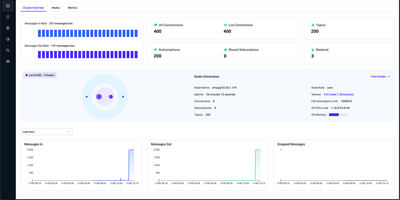
With over 16,500 GitHub stars and a track record powering connected vehicle fleets, smart city sensor networks, and industrial IoT deployments, EMQX is the MQTT messaging platform engineered to handle 100 million concurrent device connections in a single cluster while processing millions of messages per second with sub-millisecond latency. The protocol stack supports MQTT 5.0, 3.1.1, and 3.1 with full QoS 0/1/2 support, shared subscriptions, retained messages, and will messages, plus MQTT over QUIC for faster connection setup, reduced head-of-line blocking, and seamless connection migration on mobile networks. The gateway framework extends connectivity to MQTT-SN, CoAP, LwM2M, STOMP, and ExProto for bridging legacy industrial protocols. The SQL-based rule engine processes and transforms messages in real time with over 50 pre-built integrations including Kafka, PostgreSQL, MySQL, MongoDB, InfluxDB, TimescaleDB, ClickHouse, Redis, AWS Kinesis, GCP Pub/Sub, and Azure Event Hubs. The visual Flow Designer creates data processing pipelines without code. Built on Erlang/OTP with a masterless distributed architecture using Mria for state replication, the cluster separates Core nodes for data consistency and Replicant nodes for client-handling workloads. Authentication supports username/password, JWT, PSK, X.509 certificates, and LDAP with configurable ACL rules. The built-in dashboard provides real-time monitoring of connections, subscriptions, topics, message rates, and cluster health. Deployment runs via Docker, Kubernetes with the EMQX Operator, or native packages. Running on a dedicated VPS on RepoCloud with guaranteed CPU, RAM, and SSD, full root SSH access, and a browser serial console. BSL 1.1 licensed.
Fluvio
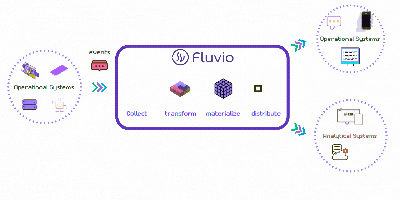
Fluvio is a distributed data streaming platform that moves records between your applications on partitioned topics and transforms them in flight with WebAssembly modules before they land anywhere. Producers publish to topics and consumers read at their own pace, with client libraries for Rust, Python, and JavaScript plus a full command line for producing and consuming interactively. SmartModules are reusable WebAssembly functions that filter, reshape, and enrich records inside the stream, so cleanup and routing logic runs once at the platform layer instead of inside every consumer. Stateful DataFlow builds continuous processing on top of the same streams, keeping state across records to aggregate, join, and react as data arrives. Inbound connectors collect from HTTP endpoints, webhooks, MQTT brokers, and Kafka clusters, and outbound connectors deliver to HTTP, SQL databases, and Kafka, with a development kit for building connectors to your own systems. A local cluster starts with one command for development, and the same platform deploys on Kubernetes for production streaming at the edge or in the cloud. Running on a dedicated VPS on RepoCloud with guaranteed CPU, RAM, and SSD, full root SSH access, and a browser serial console. Apache-2.0 licensed.
Redis
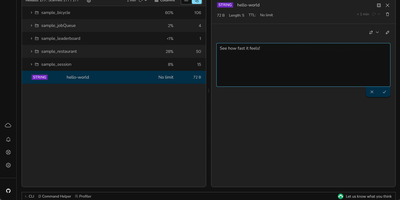
Processing billions of operations per second across companies like Twitter, GitHub, Snapchat, and Stack Overflow, Redis is the world's fastest and most widely deployed in-memory data store. Redis 8 unifies previously separate modules into a single distribution: RediSearch for full-text indexing with BM25 scoring and vector similarity search via HNSW and FLAT algorithms, RedisJSON for native JSON document storage with JSONPath queries, RedisTimeSeries for timestamped data with configurable downsampling compaction rules, and RedisBloom for probabilistic data structures including Bloom filters, cuckoo filters, count-min sketches, top-k, and t-digest. The core engine provides strings, lists, sets, sorted sets, hashes, streams, HyperLogLog, bitmaps, bitfields, geospatial indexes, and the new array data structure introduced in Redis 8.8. Pub/Sub delivers lightweight real-time messaging between publishers and subscribers, while Streams provide an append-only log with consumer groups for event sourcing and complex consumption patterns. Redis Cluster distributes data across nodes with automatic sharding using 16,384 hash slots, and Sentinel provides high availability with automatic failover monitoring. Lua scripting and Redis Functions enable server-side computation, and ACL-based security provides granular per-command, per-key access control. Official clients exist for Python, Node.js, Java, Go, .NET, Rust, and PHP. Running on a dedicated VPS on RepoCloud with guaranteed CPU, RAM, and SSD, full root SSH access, and a browser serial console. AGPLv3 licensed.
ejabberd
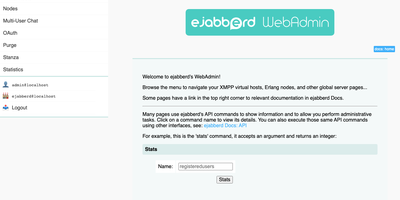
A single ejabberd node carries chat, device telemetry, voice calls, and federated messaging at once, because the same Erlang server speaks XMPP, MQTT, SIP, and Matrix over one authentication, storage, and clustering layer. Users get standards-based instant messaging with group chats, message archives, publish-subscribe, message carbons, push notifications, and OMEMO encryption, and your server federates with the global XMPP network out of the box. Devices publish and subscribe through the built-in MQTT broker on TCP or WebSocket transports, sharing accounts and access rules with your chat users instead of needing a second broker. Voice and video calls route through the integrated SIP gateway and STUN/TURN support, so WebRTC clients get signalling and media relay from the same deployment. Matrix support bridges federated rooms into the same infrastructure, letting two decentralised ecosystems interoperate without a separate bridge stack to babysit. Clustering with consistent hashing scales a deployment across nodes, and a single node is rated at two million concurrent sessions for very large communities. Operators manage everything from the web admin and command line, with SQL or Mnesia storage, LDAP authentication, and virtual hosting for multiple domains on one server. Running on a dedicated VPS on RepoCloud with guaranteed CPU, RAM, and SSD, full root SSH access, and a browser serial console. GPL-2.0 licensed.
Trade Journal
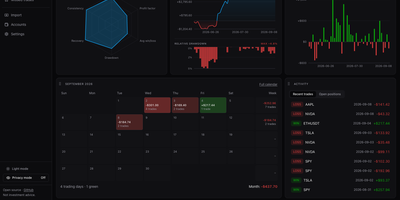
A trading journal you host yourself, Trade Journal rebuilds broker fills and statement exports into round-trip trades, a profit and loss calendar, and daily notes that show what actually works. Read-only sync covers more than twenty brokers and exchanges, including Alpaca, Binance, Coinbase, Kraken, and IBKR Flex. Statement import auto-detects TradingView, MetaTrader, NinjaTrader, Tradovate, and thinkorswim files, handles TradeZella and Tradervue CSV migrations, and maps columns for anything else. Trades can be matched first-in-first-out, last-in-first-out, or by weighted average, with partial fills, scale-ins, and futures multipliers handled. The dashboard offers gauges, cumulative and daily P&L, an Edge Score radar, and cards you can rearrange into named layouts, while Reports break results down by symbol, tag, mistake, playbook, weekday, and time of day. Each trade page charts entries and exits and can replay candles you load, with estimated MAE and MFE. Daily journal pages hold Markdown notes, templates, attachments, and voice dictation, and optional AI recaps use your own Anthropic or OpenAI key or a local Ollama model. Playbook checklists score rule adherence, a prop firm ledger tracks costs and payouts, and privacy mode masks every amount. Running on a dedicated VPS on RepoCloud with guaranteed CPU, RAM, and SSD, full root SSH access, and a browser serial console. MIT licensed.