
MCSManager
Hosting a Minecraft survival world, a Terraria server, and a Palworld host no longer means juggling SSH sessions and screen windows, because MCSManager puts every instance behind one web panel. A built-in marketplace installs game servers from ready-made templates, filtered by operating system and tagged with the Java version each one needs, while any Docker Hub image, uploaded ZIP archive, or plain process can run as an instance with its own start command, stop command, and live terminal. Docker instances get memory, CPU, port mapping, and volume settings, and each instance can auto start, auto restart, and run scheduled tasks. For Minecraft servers, the plugin and mod manager (Beta) searches Modrinth and CurseForge, and the file manager handles maps, configs, and uploads. Administrators create user accounts and assign instances to them, so friends or paying customers only see their own servers, which suits small hosting businesses that sell game servers. Extra machines join as nodes and connect to the same panel, and the drag-and-drop dashboard can be rearranged to taste. The interface supports many languages. Running on a dedicated VPS on RepoCloud with guaranteed CPU, RAM, and SSD, full root SSH access, and a browser serial console. Apache-2.0 licensed.
1Panel
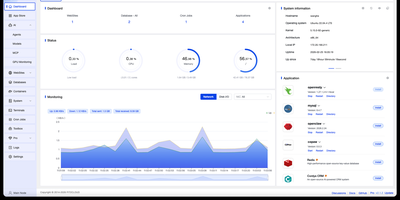
Backed by over 36,000 GitHub stars and 120 contributors with 123 releases since 2022, 1Panel has rapidly become the go-to open-source alternative to cPanel and Plesk for modern Linux server management. The platform delivers a clean Vue.js dashboard powered by a Go backend using the Gin framework, providing visual management of Docker containers, images, networks, and volumes without touching the command line. Its curated app marketplace offers one-click installation of 165+ trusted open-source applications including Nextcloud, Bitwarden, Umami analytics, WordPress, and NocoBase, each running in isolated containers for maximum security. Native AI capabilities set 1Panel apart from every competing panel: deploy Ollama LLMs directly from the dashboard, spin up OpenClaw personal agents, monitor GPU utilization, and manage AI models through a unified interface. Website management includes automatic domain binding, Let's Encrypt SSL certificate provisioning, and Nginx configuration with zero manual setup. Security runs deep with built-in firewall rules, fail2ban integration, container isolation, WAF protection, and comprehensive audit logging enabled from day one. Automated backups support AWS S3, Cloudflare R2, and local storage with one-click restore from any snapshot. The panel supports Debian, Ubuntu, CentOS, and Rocky Linux across x86_64, aarch64, armv7l, ppc64le, and s390x architectures. Running on a dedicated VPS on RepoCloud with guaranteed CPU, RAM, and SSD, full root SSH access, and a browser serial console. GPL-3.0 licensed.
Webmin
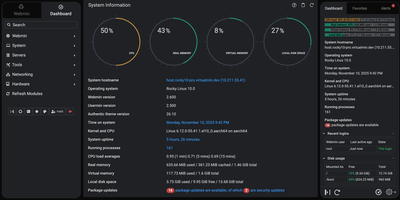
Skip the shell and the configuration file: Webmin handles user accounts, disk quotas, services, and server software on Linux and Unix machines from a browser tab. More than 100 standard modules sit under seven menus: Webmin, System, Servers, Tools, Networking, Hardware, and Cluster. System covers Users and Groups, Scheduled Cron Jobs, Running Processes, System Logs, Log File Rotation, Disk Quotas, Filesystem Backup, and systemd Bootup and Shutdown, plus Software Package Updates, which can hold selected packages on APT and DNF systems. Servers edits Apache, Nginx, BIND DNS, Postfix, Dovecot, MySQL and MariaDB, and PostgreSQL through forms. Networking brings an nftables firewall editor, Fail2Ban jails, and IPsec VPN settings. Tools adds File Manager, Custom Commands, and a Terminal that opens right in the browser. Hardware lists firmware, PCI, USB, storage, and sensor details. The dashboard keeps live CPU, memory, and disk gauges, stats history graphs, and a pending updates alert in view. Webmin Users limits each account to the modules it needs, while two-factor authentication, IP access control, and SSL settings guard the panel itself. Cluster modules reach other hosts registered in the Webmin Servers Index and run cron jobs, shell commands, and package installs on many servers at once. Running on a dedicated VPS on RepoCloud with guaranteed CPU, RAM, and SSD, full root SSH access, and a browser serial console. BSD-3-Clause licensed.
GameAP
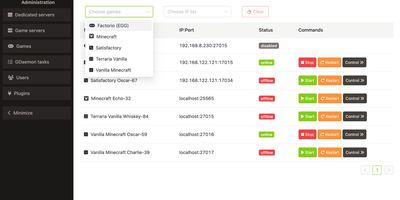
Start, stop, and restart Minecraft, Counter-Strike, Rust, FiveM, and other game servers from one browser panel instead of juggling SSH sessions. A live console streams server output and accepts RCON commands, so admins can kick players, change maps, and watch logs as they happen. The file manager edits configs, uploads and downloads files, searches inside a folder, shows checksums, and creates or extracts archives on the server itself. Scheduled tasks handle automatic restarts, updates, and backups at daily, hourly, or custom intervals. Roles and per-server permissions let a community hand out console, file, and player-management rights without sharing shell access, and single sign-on tickets let a billing system log customers straight in. Typed settings with validation and dropdown choices keep game parameters safe to edit, CPU and RAM limits cap each server, and Pterodactyl or Pelican eggs can be imported to reuse existing game definitions. One panel manages servers across many dedicated machines, plugins extend it, a documented REST API automates provisioning, and the interface speaks English, Russian, Spanish, and German. Running on a dedicated VPS on RepoCloud with guaranteed CPU, RAM, and SSD, full root SSH access, and a browser serial console. MIT licensed.
HestiaCP
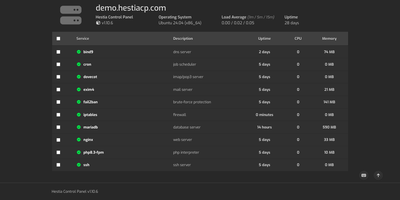
Hestia Control Panel turns a fresh Debian or Ubuntu server into a multi-user hosting platform, with websites, email, DNS zones, and databases managed from one dashboard. Web domains run on Nginx with PHP-FPM or on Apache, pick a PHP version from 5.6 through 8.5, and get FastCGI or proxy caching and per-domain Let's Encrypt certificates, wildcards included. Quick Install App sets up WordPress, Drupal, Joomla, Laravel, Nextcloud, and more from the panel or the command line. Mail domains run Exim and Dovecot with ClamAV, SpamAssassin, DKIM, and Roundcube or SnappyMail, and rate limits apply per user or mailbox. BIND serves your own nameservers with DNSSEC and DNS clusters, and MariaDB, MySQL, and PostgreSQL come with phpMyAdmin and phpPgAdmin. Packages set per-user quotas, accounts get chrooted SFTP or SSH access, and users can enable two-factor authentication and SSH keys. Fail2ban, iptables rules, and ipset lists block brute-force attacks and bad addresses. Backups go to local disk, FTP, SFTP, or any of 50-plus Rclone cloud providers and restore from Hestia or VestaCP archives. Scoped access keys open a REST API, the v-command line interface scripts user, domain, and backup tasks, and a file manager and service monitor ship in the panel. Running on a dedicated VPS on RepoCloud with guaranteed CPU, RAM, and SSD, full root SSH access, and a browser serial console. GPL-3.0 licensed.
Froxlor
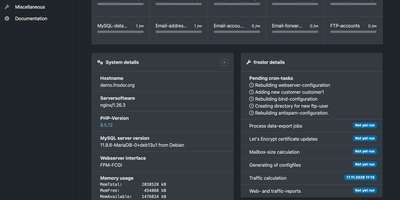
Froxlor lets an administrator host many customers on Debian and Ubuntu servers, with resellers, resource limits, and every service managed from one browser panel. Customers get their own panel for domains, subdomains, email, FTP accounts, and MySQL databases, and resellers receive a pool of resources to hand out. Domains can run on Apache 2.4 or Nginx, use a PHP-FPM configuration chosen per domain, and bind to specific IPv4 addresses, IPv6 addresses, or ports. Let's Encrypt certificates are issued and renewed from the panel, customers can store their own certificate per domain, and Nginx domains can enable HTTP/3. Email addresses, forwarders, and catchall mailboxes run on Postfix and Dovecot, and Rspamd spam filtering is tuned for each email account. Bind9 or PowerDNS serves the DNS zones, and ProFTPd provides FTP accounts with their own directories. Customers can add SSH keys for shell access, protect directories with passwords, set path options, and export their data. Traffic for HTTP, FTP, and mail is collected per customer and charted by month, and several MySQL servers can be assigned to customers. A JSON API with per-user keys, a console tool, and a CSV domain importer cover automation, and the interface can be themed. A configuration page shows ready-made service templates for the chosen distribution and exports the selection as JSON for use on another server. Running on a dedicated VPS on RepoCloud with guaranteed CPU, RAM, and SSD, full root SSH access, and a browser serial console. GPL-2.0-or-later licensed.
KPanel
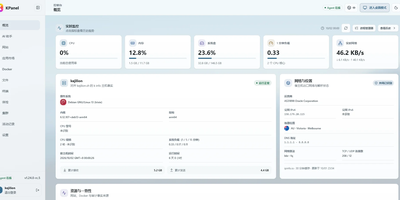
You run one server today and three by next quarter, and each one deserves the same workbench. KPanel is an open-source Linux server management panel with a desktop-style workspace, a classic sidebar mode, multi-host management, and an AI assistant. Open the overview. CPU, memory, disk, load, network, and processes update live, and historical charts answer what happened last night. Sites already on the machine stay where they are. You manage their real Nginx configuration, certificates, reverse proxies, load balancing, and PHP or static stacks in place. Docker gets the same treatment. Containers, images, volumes, logs, and Compose projects are all editable from the panel, and the app market shows real install state. Files and terminals follow you across hosts. Browse one machine, edit on another, run a quick command everywhere, or copy a directory between authorized panels. Lightweight nodes join without Docker. The fleet appears as a list, as cards, or on a globe with latency and service checks, and a public read-only page can show status to anyone who needs it. The assistant reads the state the panel already holds. It answers through fixed tools, asks before acting, and always asks before anything risky. Running on a dedicated VPS on RepoCloud with guaranteed CPU, RAM, and SSD, full root SSH access, and a browser serial console. AGPL-3.0 licensed.
Infinite OS
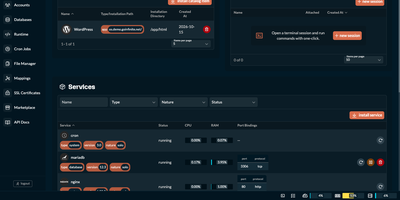
Infinite OS packs a complete hosting environment into a single Docker container, and you decide what it hosts after it starts. From the dashboard you add the runtimes, databases, domains, and applications that a normal image would have forced you to choose at build time. Open the Marketplace and WordPress, n8n, or dozens of other applications install in a few clicks, dependencies and services included, with a hostname and route created automatically. PHP, Node.js, Bun, Python, Ruby, and Java runtimes install on demand beside databases and workers, so one project runs its whole stack inside one environment. Public domains get free TLS certificates automatically, and changing the primary domain once updates the web server, PHP, and database records to match. The built-in web terminal needs no SSH setup, and a coding agent such as OpenCode can work there with the project files, runtimes, and databases within reach. A file manager, cron scheduler, PHP version switching, and per-route rate, bandwidth, and connection limits cover the daily work of running sites from the browser. Team accounts give each person their own login, and nearly every dashboard action has a matching CLI command and REST API call for scripting. Each project gets its own container with its own filesystem and services, so unrelated sites stay isolated while several lightweight environments share one machine. Running on a dedicated VPS on RepoCloud with guaranteed CPU, RAM, and SSD, full root SSH access, and a browser serial console. EPL 2.0 licensed.
Laranode
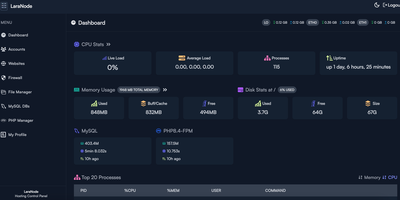
Built for self-hosted server deployments, Laranode transforms bare Linux installations into multi-tenant web hosting platforms with automated Let's Encrypt certificates and isolated PHP environments without recurring license fees. System administrators can provision isolated user accounts with dedicated document roots, configure custom domains, and deploy SSL certificates across all active websites in seconds. The integrated PHP manager enables per-site runtime isolation from legacy PHP 7.4 through cutting-edge PHP 8.5 releases, preventing version conflicts between separate production web applications. Operators can create MySQL databases, manage database users, inspect active connections, and adjust UFW firewall port access directly from the visual dashboard. An integrated browser-based file manager lets developers browse directories, edit configuration files, extract compressed archives, and modify file permissions without external FTP tools. Real-time telemetry monitors CPU utilization, memory consumption, disk capacity, and network traffic over customizable historical timeframes to catch bottlenecks early. Automated backup routines archive full accounts, individual websites, or specific databases to local storage, remote SFTP servers, or S3-compatible cloud object stores with point-in-time recovery verification. Running on a dedicated VPS on RepoCloud with guaranteed CPU, RAM, and SSD, full root SSH access, and a browser serial console. MIT licensed.
ServerOS
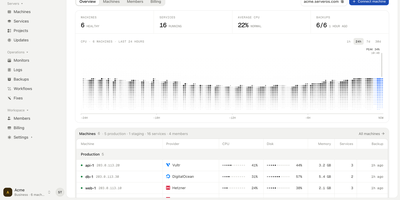
Connect a rented Linux server with one command, then run deploys, uptime checks, backups, and AI-proposed fixes for every machine from the ServerOS web panel. A small daemon on each machine dials out to the panel, leaving no inbound management port to open. The overview charts CPU, memory, and disk across the fleet, and waiting OS updates roll out a few machines at a time. Deploy from a GitHub repository or a .zip, redeploy on every push, and add domains with automatic HTTPS. Pull request previews give each change a running copy, and a staging copy of any project can be tested and then promoted. Install one-click databases and self-hosted apps, and group an app with its database and cache into a private-network project. Monitors check sites, APIs, and ports from outside, status pages carry incident updates, and every service's logs are searchable in one place. Backups go to an S3 bucket or another machine on a schedule, and workflows chain deploys, restarts, and alerts. Add your own Anthropic or OpenAI key and a Fixes agent reads logs, explains what broke, and proposes a repair that waits for a teammate's approval. Claude, ChatGPT, Codex, Cursor, or your own scripts and CI can work in your workspace over MCP and a REST API. Running on a dedicated VPS on RepoCloud with guaranteed CPU, RAM, and SSD, full root SSH access, and a browser serial console. AGPL-3.0 licensed.
VitoDeploy
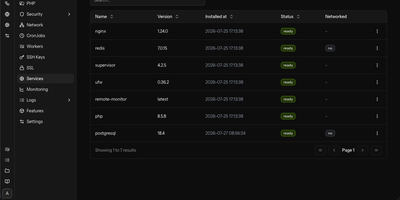
VitoDeploy replaces a pile of SSH sessions and shell scripts with one browser tab for provisioning servers and deploying websites, on a control panel you host yourself. Spin up a server on AWS, Akamai (Linode), DigitalOcean, Vultr, Hetzner, or Proxmox in a few clicks. Attach any Ubuntu machine you already own as a custom server. Add sites built with PHP, Laravel, or WordPress, or run Node.js and Bun apps behind a reverse proxy. Pull code from GitHub, GitLab, Gitea, or Bitbucket. Set environment variables and HTTP basic authentication. Issue Let's Encrypt, wildcard, or custom SSL certificates. Create MySQL, MariaDB, or PostgreSQL databases, manage their users, and send backups to Amazon S3, Wasabi, FTP, SFTP, Dropbox, or local disk. Manage firewall rules, cron jobs, Supervisor workers, Redis, and multiple PHP versions from the same screens. Watch CPU, memory, and disk use for each server, then open a live SSH shell without leaving the page. Agencies split clients into projects, invite teammates as Admins or Users, and send alerts to Slack, Discord, Telegram, or email. Workflows automate deployments, backups, and maintenance. Plugins, DNS record management, export and import of your setup, and a REST API round out the toolkit. The panel itself needs only 1 GB of RAM and 1 CPU core, then manages your other machines over SSH. Running on a dedicated VPS on RepoCloud with guaranteed CPU, RAM, and SSD, full root SSH access, and a browser serial console. AGPL-3.0 licensed.
ServerKit
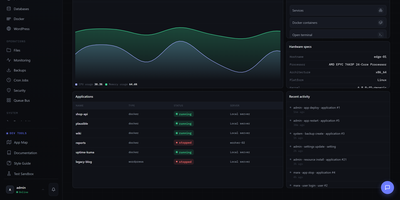
ServerKit delivers a server control panel that fits on a small VPS while managing everything from Docker containers to mail servers. The Python/Flask backend exposes 1,519 REST endpoints across 107 blueprints with full OpenAPI documentation at /api/v1/docs, while the React frontend spans 65 screens in a 1.75MB gzipped bundle served entirely from your own infrastructure. Docker management includes full container lifecycle control, Docker Compose project orchestration, real-time log streaming, and terminal access. Database panels cover MySQL/MariaDB and PostgreSQL with user management, browser-based query consoles, and automated backups to S3, Backblaze B2, or local storage. Nginx virtual host management automates Let's Encrypt certificate provisioning with hardened TLS 1.2+ configurations and Cloudflare-aware setups. The Go-based cross-platform agent enables multi-server fleet management with HMAC-SHA256 authentication over a WebSocket gateway, supporting Linux, Windows, and macOS across amd64 and ARM64 architectures. Fleet monitoring provides cross-server heatmaps, metric comparison charts, alert thresholds, anomaly detection, and capacity forecasting. A built-in marketplace distributes 106 one-click application templates using a declarative YAML schema with Docker Compose stacks. The extension system allows community plugins for Kubernetes management, Redis browsers, and WordPress site orchestration. Running on a dedicated VPS on RepoCloud with guaranteed CPU, RAM, and SSD, full root SSH access, and a browser serial console. MIT licensed.
FeatherPanel
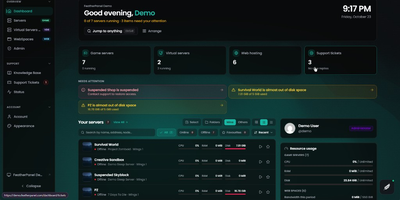
FeatherPanel is one control panel for game servers, Proxmox virtual machines, and web hosting, so a small host stops juggling three different admin tools to run its infrastructure. Game servers deploy from spells (the egg system Pterodactyl users will recognize, with egg imports supported) and open into a live websocket console with power actions, install logs, and CPU, memory, and disk graphs. The built-in file manager browses, edits, uploads, archives, and shares server files, while per-server databases, scheduled backups with retention limits, cron-style schedules, and lifecycle hooks automate the routine work around each server. Virtual machines and containers come from Proxmox nodes with browser VNC consoles, snapshots, ISO mounting, and reinstalls, and web hosting accounts get domains, SSL, databases, mailboxes, one-click WordPress and other apps, and Git deployment in the same UI. Customers help themselves through support tickets, a knowledgebase, and a public status page, while subusers receive fine-grained permissions instead of shared passwords. Plugins and themes from the marketplace extend the panel, a REST API and MCP server connect external tools and AI assistants, and any of the three hosting modules can be switched off when you only need part of the stack. Running on a dedicated VPS on RepoCloud with guaranteed CPU, RAM, and SSD, full root SSH access, and a browser serial console. AGPL-3.0 licensed.