Nautobot
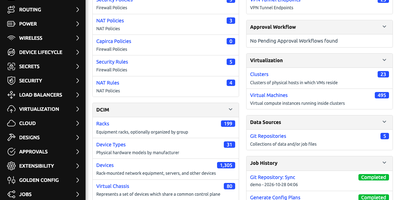
From the first rack to the last circuit, Nautobot is the open-source network source of truth that records what your network should look like and runs automation against it. Built-in models cover locations, racks, devices, interfaces, cables, VLANs, VRFs, IP prefixes, circuits, and contacts, so one searchable record replaces the spreadsheet and the wiki. Teams encode their own standards with custom fields, user-defined relationships, computed fields, and validation rules. Config contexts attach JSON or YAML data, such as syslog servers, to devices by location, role, platform, or tag. Jobs run your own automation code from the web UI, REST API, or command line, on a schedule, or through hooks when an object changes, with approvals and logs built in. Query the data over REST or GraphQL, and let the GraphiQL editor autocomplete a device and interface query you can save inside Nautobot. When an object is created, updated, or deleted, webhooks notify outside systems, with Jinja2-templated bodies and HMAC SHA-512 signatures. Git repositories can carry export templates, Jobs, and config contexts too, so YAML data and Jinja2 templates get pull request review before Nautobot syncs them. Open-source Apps add Golden Configuration for config backup, compliance, and remediation, Device Lifecycle for hardware tracking, SSoT for syncing other systems, and ChatOps. Object permissions and change logging keep a shared instance auditable. Running on a dedicated VPS on RepoCloud with guaranteed CPU, RAM, and SSD, full root SSH access, and a browser serial console. Apache-2.0 licensed.
Rackpad
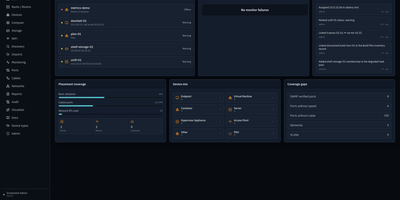
Every cable, switch port, VLAN, and rack unit in a homelab or small server room gets a documented place in Rackpad, a self-hosted inventory and operations workspace. Rack elevations show mounted gear, including paired half-width appliances. Switch-panel port maps and aggregate ports show what is patched where. Cables carry type, length, and color, editable in bulk. VLANs, subnets, DHCP scopes, reservations, and zones sit in one Networks workspace, with gateway and DNS protection and a mismatch review for IP assignments. Storage topology follows drives, bays, and pools that span several devices. Wi-Fi controllers, access points, hypervisor hosts, and virtual machines have pages of their own, and Proxmox and Hyper-V hosts can be imported after review. Discovery scans a subnet or any CIDR and stages every finding in an inbox. Per-device checks over ICMP, TCP, HTTP, HTTPS, and SNMP raise alerts by email, Discord, or Telegram. Everything feeds a movable topology map. Markdown runbooks attach to devices, and an audit log records every change. Admin, editor, and viewer roles control access, and OpenID Connect login is optional. Running on a dedicated VPS on RepoCloud with guaranteed CPU, RAM, and SSD, full root SSH access, and a browser serial console. MIT licensed.
Ralph
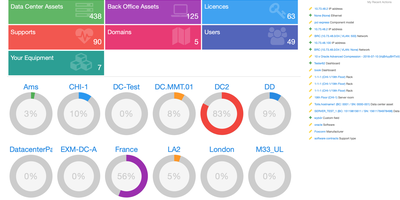
Ralph tracks thousands of assets across data centers and back offices through a unified CMDB, DCIM, and asset management platform, providing the same capabilities as ServiceNow, Device42, and Sunbird dcTrack without per-asset licensing fees. Used by Allegro in production and backed by over 2,500 GitHub stars, it is built on Python 3 with Django and Django REST Framework. Interactive data center floor plans support drag-and-drop rack placement, front and rear rack views showing U-level asset positioning, power consumption tracking per PDU, and ethernet and fiber connection mapping. The back office module manages laptops, desktops, printers, mobile phones, and accessories with user assignment tracking, warehouse inventory, stock-taking audits, and automated loan workflows. IP address management handles network environments with DHCP and DNS integration alongside network topology visualization. Software license tracking monitors per-user and per-core allocations with usage calculations, compliance reporting, and expiration alerts, while vendor support contracts track SLA agreements and warranty renewal dates. The transitions system automates asset lifecycle processes through configurable workflows that trigger HTTP webhooks, custom Python scripts, email notifications, and Puppet and Ansible configuration management integration. Custom fields extend the data model with text, numbers, dates, choices, and URLs per asset type, accessible via the REST API. Multi-tenant architecture organizes assets by regions, data centers, service environments, and business units. Deploy via Docker with the allegro/ralph image alongside MySQL and Redis. Running on a dedicated VPS on RepoCloud with guaranteed CPU, RAM, and SSD, full root SSH access, and a browser serial console. Apache 2.0 licensed.