ArchiveBox
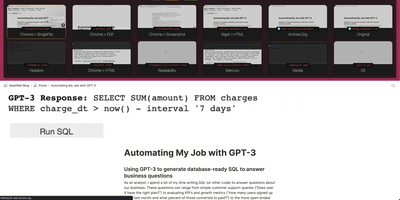
Backed by 27,700+ GitHub stars and actively developed with the v0.9.x architectural overhaul introducing an event-driven plugin ecosystem, ArchiveBox delivers the open-source self-hosted web archiving platform that preserves websites, bookmarks, social posts, media, source code, and research material in durable formats before link rot, platform shutdowns, and censorship erase them permanently. Feed it URLs one at a time or schedule automated imports from browser history, RSS feeds, Pocket, Pinboard, Instapaper, Wallabag, Shaarli, JSON, CSV, HTML bookmark exports, and browser extension captures. Each snapshot stores redundant copies as original HTML, rendered single-file HTML via SingleFile, full-page PDF, screenshot PNG, WARC archive, article text via Readability, favicons, HTTP headers, media files via yt-dlp, git repository clones, and structured metadata in SQLite. The Docker Compose deployment bundles Chrome, wget, curl, yt-dlp, SingleFile, and Readability parsers with automatic dependency management and isolation. Interact through the self-hosted web UI with search, tagging, and admin controls, the comprehensive CLI for batch operations, the REST API for programmatic access, or the Python API for custom integrations. The new abx-plugins system enables community extractors with per-plugin configuration, while the append-only-log architecture provides resumable crawls and audit trails. S3, B2, and Google Cloud storage backends sync archives to remote storage via rclone. Running on a dedicated VPS on RepoCloud with guaranteed CPU, RAM, and SSD, full root SSH access, and a browser serial console. MIT licensed.
Dataverse
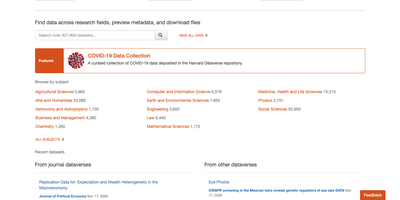
A shared drive full of spreadsheets is not a research data archive; Dataverse is repository software that gives each dataset a citable page, metadata, versions, and a permanent identifier. Universities, libraries, and research groups arrange holdings in nested collections, each with its own branding, featured subcollections, and search facets. Metadata comes from citation, geospatial, social science, astronomy, and life sciences blocks, and administrators add custom fields and controlled vocabularies without writing code. Publishing assigns a DOI through DataCite or Crossref, or a Handle or PermaLink, and each dataset shows a formatted citation with download counts and Make Data Count statistics. Tabular files in CSV, Excel, SPSS, Stata, R, and SAS formats are ingested with variable-level metadata. Previewers show images, text, spreadsheets, maps, and notebooks on the page. Every published change creates a new version, and a versions table lets readers move between them. Roles reach down to individual files, with restricted files and access requests, embargoes, guestbooks, terms of use, and anonymous preview links for peer reviewers. Records export as DDI, Dublin Core, DataCite, schema.org JSON-LD, and Croissant, and OAI-PMH lets installations harvest one another. Deposits can be automated through a REST API, SWORD, and client libraries for Python, R, and Java. Integrations reach Jupyter, Globus, DataLad, and OJS. Running on a dedicated VPS on RepoCloud with guaranteed CPU, RAM, and SSD, full root SSH access, and a browser serial console. Apache-2.0 licensed.

DSpace
With DSpace, a library or research office can give every thesis, journal article, and dataset its own permanent web address, a searchable metadata record, and files visitors download from the archive. Content sits in a tree of communities and collections, and each collection decides who may deposit and how many review steps follow; reviewers accept a submission or reject it with a note that sends it back to the author. Embargoes hold files back until a set date, access policies limit other files to chosen groups, and sign-in works through LDAP, Shibboleth, SAML, OpenID Connect, or ORCID. Search covers metadata and the extracted full text of uploaded files, facets narrow the results, and browse pages sort by title, issue date, author, or subject. Editors can correct a published item through the submission form. Administrators inspect an audit trail and rewrite homepage news from an admin form. Entity types for people, organizations, projects, journals, and datasets link each publication to the work behind it, and DOIs can be registered through Crossref. Optional settings let authors keep an email address private on their researcher profile and download their own restricted files. Usage reports count visits, downloads, and top countries per item. REST, OAI-PMH, SWORD, and Google Scholar metadata connect the archive to harvesters, deposit tools, and search engines. Running on a dedicated VPS on RepoCloud with guaranteed CPU, RAM, and SSD, full root SSH access, and a browser serial console. BSD-3-Clause licensed.

CollectiveAccess Providence
For a museum, archive, or research collection that must describe everything it holds in its own metadata terms, CollectiveAccess Providence offers a web-based catalogue that needs no custom programming. Objects, entities, places, collections, storage locations, and loans link through bi-directional relationships with configurable types such as creator, donor, or subject, and DACS, Dublin Core, and VRA Core come pre-loaded. Fields, entry screens, search displays, and reports are defined in the web interface or an XML installation profile with validation for dates, measurements, and URLs; images, video, audio, PDFs, and 3D scans open in browser viewers with pan and zoom. Mapping files import Excel, CSV, XML, and MARC data in bulk, exports cover OAI-PMH formats such as EAD and Dublin Core plus finding aids and reports, and Getty vocabularies and Library of Congress services supply controlled terms. Staff check items in and out like a library, follow location and provenance history over time, and share sets of records with collaborators. Access can be limited by user or group down to specific fields or record types, logins can use LDAP, and every edit is logged with a user and timestamp. MD5 fixity checks arrive by email, BagIt packages support preservation, an optional GraphQL API handles search, browse, and editing, and a separate companion, Pawtucket2, can publish the catalogue as a public website. Running on a dedicated VPS on RepoCloud with guaranteed CPU, RAM, and SSD, full root SSH access, and a browser serial console. GPL-3.0 licensed.