AbuseBox
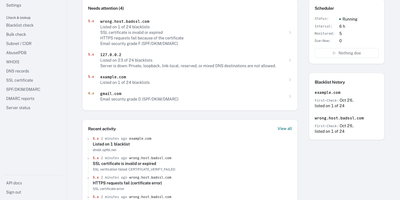
AbuseBox is a self-hosted monitor for the mail servers you operate, checking your IPs and domains against 24 DNS blacklists on a schedule and alerting you when a listing appears, disappears, or is about to matter. A listing is never just a red flag. AbuseBox decodes each list's return codes into a plain meaning and a severity, links the removal page, and folds the result into a risk score out of 100 for every asset, with each factor and its contribution shown. Before any verdict is trusted, the list itself is tested against its RFC test addresses, so a resolver being refused reads as No answer rather than clean. The same asset page grades SPF, DKIM, and DMARC from A to F, parses DMARC aggregate reports, and tracks certificate validity, domain expiry, DNS records, WHOIS details, and server reachability with response times. Assets arrive one at a time, in bulk lists of up to 300, or as an entire subnet, each with its own owner, check selection, and interval. The activity log records every change, history charts show the trend, and email, Slack, Discord, or webhook alerts carry the news. A public quick-check page answers one-off lookups without an account, and the REST API covers the rest. Running on a dedicated VPS on RepoCloud with guaranteed CPU, RAM, and SSD, full root SSH access, and a browser serial console. MIT licensed.
Parse DMARC
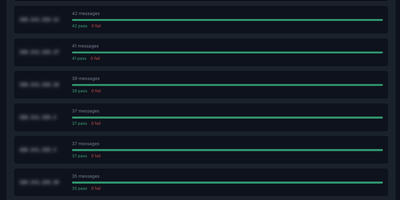
Parse DMARC reads the DMARC aggregate reports that Google, Microsoft, and Yahoo email about your domain every day and shows you, in one dashboard, who is sending mail as you and whether it passes authentication. It fetches the reports over IMAP, unpacks the gzip, zip, and XML attachments automatically, and charts your pass rate, message volume, and top sending sources at a glance. Any report opens down to its raw records, so when an unfamiliar IP starts sending as you, the evidence is one click away instead of buried in XML. Reports forwarded through Exchange or Outlook as message attachments are unwrapped too, and a local Maildir intake covers servers where the mailbox lives on the same host. A built-in generator writes your _dmarc TXT record from a form, so tightening your policy does not mean hand-writing DNS syntax from memory. Twenty-eight Prometheus metrics and a shipped Grafana dashboard move the same data into the monitoring stack you already run. An MCP server lets an AI assistant query your reports directly, asking which sources failed DKIM this week in plain language. Everything stores in a single SQLite file inside one static Go binary, with dark mode for late-night incident reviews. Running on a dedicated VPS on RepoCloud with guaranteed CPU, RAM, and SSD, full root SSH access, and a browser serial console. Apache-2.0 licensed.