CCX
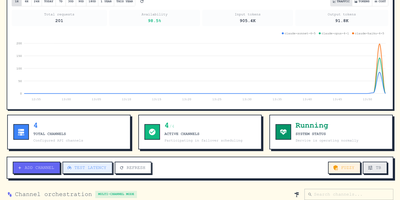
CCX gives every coding agent and chat client one stable address, and the real model providers can come and go behind it. Point Claude Code, Codex, or any SDK at the gateway and it forwards requests to the first healthy channel in a failover sequence, then moves down the list when an upstream returns errors. Each channel carries its own keys, model allowlist, proxy, and custom headers, and the Add Channel dialog detects a base URL and keys from pasted text. The admin console tracks requests, availability, tokens, and cost over ranges from one hour to a year, with a chart per model and a live success rate beside each channel. Drag a channel to change its priority, park it in the standby pool, or open its log to see the status, timing, and key of every call. Separate tabs cover Claude Messages, OpenAI Chat, Images, Vectors, Codex, and Gemini, and a dark theme and language switch are built in. Access is guarded by a proxy key and an optional admin key. Running on a dedicated VPS on RepoCloud with guaranteed CPU, RAM, and SSD, full root SSH access, and a browser serial console. MIT licensed.
Euron Open AI API Gateway
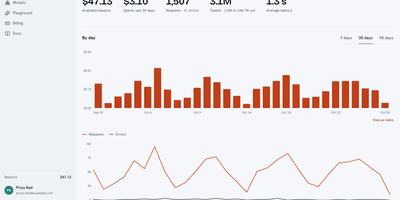
If you resell or share AI model access, Euron Open AI API Gateway turns scattered provider accounts into one key, one price list, and one prepaid balance. Point an OpenAI or Anthropic SDK at it, swap the base URL and key, and every chat model answers in either wire format, with streaming, tools, and images translated both ways. Operators connect OpenAI, Anthropic, Gemini, or hosts like Groq, OpenRouter, and a self-run vLLM, then set a margin by default, per model, account, or key; zero means at cost. Callers top up a USD balance through Stripe, or in rupees through Razorpay with UPI, cards, and netbanking at a rate locked per order. Before any provider is called, the worst-case price is reserved, so parallel requests cannot overspend. A refused request costs nothing. API keys carry a model allow-list, monthly budget, rate limits, and IP rules, and request bodies are logged only when the key's owner opts in. When a provider times out or returns a 429 or 5xx, the request moves to the next route while circuit breakers and health probes sideline the failing one. Developers get a usage log with tokens, latency, and the exact price of every request, plus a streaming playground. The admin console covers accounts, credit grants, rate-limit tiers, circuit health, revenue against provider cost, and an audit trail. Running on a dedicated VPS on RepoCloud with guaranteed CPU, RAM, and SSD, full root SSH access, and a browser serial console. MIT licensed.
Model Hotel
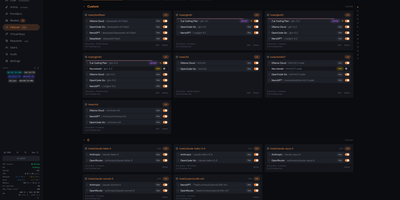
One OpenAI-compatible endpoint fronts every LLM provider you use, hosted or local, and fails over when a quota runs out or a provider goes down. Offer one model through two providers and a failover group forms by itself; the hotel/ prefix tries them all in your priority order. Anthropic, OpenAI, Google AI Studio, and OpenRouter sit beside Ollama, LM Studio, and TabbyAPI, plus any custom OpenAI-compatible API. Errors, timeouts, and rejected keys retry on the next provider, and a per-model circuit breaker benches repeat offenders. Models are discovered the moment a provider is added. Each client gets a virtual key with rate limits, a daily, weekly, or monthly dollar budget, and a list of allowed providers. Prompts and replies are never logged, and the request log records timing, tokens, cost, and gateway overhead for every call. A chat playground, a side-by-side compare grid, and blind bracket tournaments help you pick the best model. Claude Code, Codex CLI, and the OpenAI and Anthropic SDKs connect unchanged, alongside embeddings, rerank, image, and speech endpoints. Sign in with a passkey, an authenticator app, OpenID Connect, or GitHub, and give teammates named accounts with limited access. Prometheus metrics and Apprise alerts keep operators informed, and Traefik-balanced instances with an Android companion app cover high availability. Running on a dedicated VPS on RepoCloud with guaranteed CPU, RAM, and SSD, full root SSH access, and a browser serial console. MIT licensed.
Palimpsest Gateway
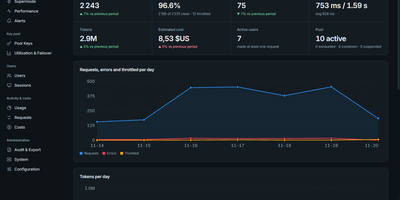
Swap one base URL and Palimpsest Gateway turns the LLM keys you own into a single OpenAI-compatible endpoint that fails over by itself. Apps keep their OpenAI client and use a gateway key of their own; provider keys stay encrypted and are never shown again. Teams that mix free and paid keys cap the free ones, leave the paid ones uncapped, and the gateway spends the free allowance first. When a key hits a rate limit, empty quota, outage or refusal, the same call moves to the next suitable key. Clients send only the new message, because the gateway keeps per-user session history and carries it through a failover. Asking for palimpsest/supermode picks the strongest model the pool can serve right now and skips any that cannot take the prompt, images or tools. A circuit breaker skips a provider in a real outage, and a concurrency gate caps in-flight requests per provider. Per-user daily caps and a pool low-water mark throttle demand before the keys run dry. Live Flow traces each request through the gateway, retries included, and key tests find the models an account can use. Spend appears against the per-model prices and monthly budget you enter, by day, model and user, with a projection. An audit trail, CSV exports and Prometheus metrics cover operations. The dashboard never shows message content. Running on a dedicated VPS on RepoCloud with guaranteed CPU, RAM, and SSD, full root SSH access, and a browser serial console. MIT licensed.