Lago
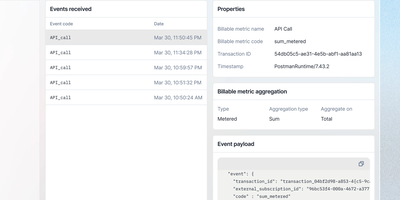
Trusted by Mistral AI, PayPal, Groq, and Synthesia with over 10,300 GitHub stars and Y Combinator backing, Lago is the open-source billing engine that handles usage-based, subscription-based, and hybrid pricing models through a single API-first platform — replacing the need to build custom billing logic or depend on opaque SaaS pricing infrastructure. Real-time event ingestion via ClickHouse processes billable events with deduplication and multiple aggregation methods including count, sum, unique count, max, and weighted sum, while graduated pricing tiers, package-based billing, and percentage-based fees model any pricing strategy from simple subscriptions to complex marketplace commission structures. Automated invoice generation calculates charges according to configurable billing cycles with grace periods, proration for mid-cycle changes, and credit note issuance for refunds and adjustments. Prepaid credits enable pay-in-advance models where customers purchase credit blocks and draw down as usage accumulates, while entitlements tie feature access directly to billing plans for automated provisioning and de-provisioning. Payment orchestration integrates natively with Stripe, Adyen, and GoCardless with automatic retry logic, dunning workflows for failed payments, and multi-gateway routing. Revenue analytics provide cross-stream visibility into MRR, usage trends, churn, and revenue drivers through dedicated API endpoints. The customer portal embeds into your application for self-service invoice access and usage monitoring. Running on a dedicated VPS on RepoCloud with guaranteed CPU, RAM, and SSD, full root SSH access, and a browser serial console. AGPL-3.0 licensed.
Meteroid
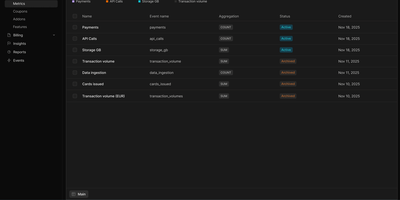
Meteroid delivers the billing infrastructure that SaaS companies need when Stripe Billing gets too rigid and building in-house gets too expensive. The Rust backend ingests usage events via REST API or Kafka with deduplication by event ID and customer ID, storing time-series data in ClickHouse for sub-second aggregation queries across billions of events. Billable metrics transform raw events — API calls, compute time, tokens, storage, transactions — into accurate charges using configurable aggregation functions, dimensions, and filters without pre-aggregation. The plan builder supports any pricing structure: flat rate, per-unit, tiered graduated, tiered volume, package, and hybrid combinations with multiple price components per plan. Versioned plans enable pricing changes without affecting existing subscribers through grandfathering, while experiments let you A/B test pricing with controlled rollouts. Subscription management handles the full lifecycle — creation, upgrades, downgrades, mid-cycle proration, scheduled changes, and cancellation with configurable grace periods. The TypeScript frontend provides a complete web dashboard for managing customers, plans, subscriptions, invoices, and revenue analytics with MRR tracking, churn analysis, and cohort insights. Automated invoice generation handles complex scenarios including usage-based line items, credits, discounts, and tax calculations with PDF rendering. Stripe Connect integration enables payment collection directly through the platform. Running on a dedicated VPS on RepoCloud with guaranteed CPU, RAM, and SSD, full root SSH access, and a browser serial console. AGPL-3.0 licensed.
Lotus
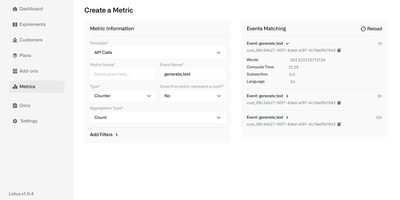
Lotus is an open-source pricing and billing engine that lets SaaS teams meter usage, design plans, and experiment with pricing without rebuilding their billing stack every time the model changes. You define how customers are charged: per seat, per API call, per gigabyte, in tiers, with prepaid credits, or as a bespoke enterprise arrangement negotiated over email. Plans are versioned and deployed like releases, so changing a price never means editing the plan that half your customers already signed. Usage events stream in from your product and are aggregated against each customer's plan, turning raw events into billable quantities your finance team can audit line by line. Before a new model goes live, you backtest it against historical usage to see exactly who would have paid what, and forecast the revenue before a single invoice changes. Experiments compare pricing variants on real customers, so the packaging debate ends with numbers instead of opinions. The control panel sits on top of your existing quote-to-cash stack, pulling from your payment, CRM, and data systems rather than demanding a rip-and-replace migration. Engineers integrate through the API: send events, read balances, and let Lotus handle the proration math when plans change mid-cycle. Running on a dedicated VPS on RepoCloud with guaranteed CPU, RAM, and SSD, full root SSH access, and a browser serial console. MIT licensed.