DocIntel
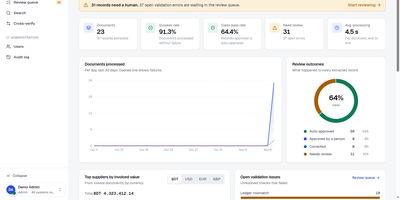
Drop in a pile of invoices, receipts, scans, or ledgers and DocIntel hands back validated, searchable records, asking a person only about the doubtful ones. It reads PDFs, phone photos, TIFF scans, Excel sheets, and CSV files. Scans get deskewed, denoised, and upscaled before OCR. A 1,000-page PDF is split into individual invoices in seconds. Every extracted value must be found on the page, or it is stored as null instead of guessed. A rule engine reads each document, and an optional model from Anthropic, Gemini, Groq, OpenAI, or Ollama adds a second opinion that flags disagreements. Totals, taxes, line items, dates, and duplicate files are checked for consistency. Invoices can be cross-verified against a ledger in another PDF or an Excel file, with field-level differences. The review screen shows the source page beside the fields and highlights where each value was found. Inline corrections trigger re-validation and keep a full history. Search works by keyword, by meaning, or both, with filters and export to CSV, Excel, or JSON. Viewer, reviewer, and admin roles control who can upload, approve, or delete, and an audit log records every action. Administrators can switch the AI model, key, and OCR engine from the settings page without a restart. Running on a dedicated VPS on RepoCloud with guaranteed CPU, RAM, and SSD, full root SSH access, and a browser serial console. MIT licensed.
ai-triage
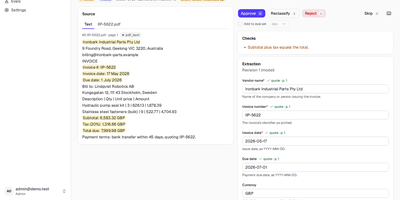
ai-triage reads every email and attachment in a shared inbox, pulls out the fields you care about with a quote behind each value, and sends anything uncertain to a person. Documents arrive through read-only Gmail sync, Postmark forwarding, an upload page, or a REST API that accepts PDFs, Word files, images, and .eml messages. A model classifies each document and extracts fields against a JSON Schema, then plain code checks the quotes exist, required fields are present, invoice totals add up, and the sender is authenticated. Auto-approval is earned per document type, switched on only after you measure accuracy on labeled data and freeze a threshold. Reviewers see the source with quotes highlighted beside an editable form with failed checks marked, and keyboard shortcuts approve, reclassify, or reject. Approved results reach your system as signed webhooks with an idempotency key, delivered at least once and retried with backoff. Evals run the production pipeline over labeled dev, calibration, and test splits, with threshold sweeps, reliability tables, and run-to-run diffs. Your own document types are defined in the UI, from starters like purchase order, receipt, credit note, and insurance claim. Any of Claude, OpenAI, DeepSeek, OpenRouter, or a local model can do the reading, and optional OCR covers scans and photos. Workspaces separate teams, with Google sign-in, invitations, and TOTP two-factor for admins. Running on a dedicated VPS on RepoCloud with guaranteed CPU, RAM, and SSD, full root SSH access, and a browser serial console. MIT licensed.