FastGPT
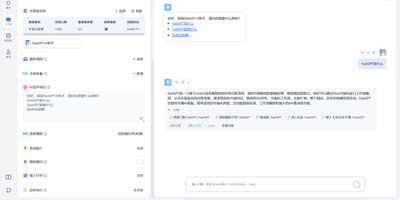
FastGPT lets you build production AI agents and knowledge base chatbots through a visual drag-and-drop workflow editor, connecting any LLM provider to your documents with retrieval-augmented generation that cites sources and reduces hallucination. The workflow canvas chains LLM calls, conditional branching, HTTP requests, code sandbox execution, and plugin nodes into complex conversation flows and agent skill pipelines without writing backend code. The knowledge base engine ingests documents in ten formats (TXT, Markdown, HTML, PDF, DOCX, PPTX, CSV, XLSX, URL scraping, and CSV batch import) then applies automatic chunking, hybrid vector retrieval with semantic reranking, and QA-pair splitting to deliver accurate, citation-backed answers. FastGPT connects to virtually any LLM provider through its AI Proxy aggregation layer: OpenAI GPT-4o, Anthropic Claude, Google Gemini, DeepSeek, Qwen, ERNIE Bot, and models hosted via Ollama all work through a unified OpenAI-compatible API. Bidirectional MCP support enables agents to call external tools and expose their own capabilities to other systems. Completed applications can be shared via login-free links, embedded as iframe widgets, or integrated with WeCom, Lark, DingTalk, and WeChat Official Accounts through the published REST API. Application operation logs, conversation annotation, and per-model usage analytics provide full lifecycle governance for compliance-sensitive deployments. Running on a dedicated VPS on RepoCloud with guaranteed CPU, RAM, and SSD, full root SSH access, and a browser serial console. FastGPT Open Source License (Apache 2.0 based) licensed.
EdgeQuake
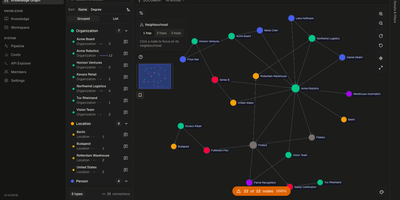
A folder of documents stops being a pile of files once EdgeQuake extracts a knowledge graph you can explore and question. Upload text, PDFs, or markdown and the pipeline extracts people, organizations, places, and the relationships between them, then shows progress and entity counts for every file. The graph viewer draws the network with color-coded entity types, a searchable entity list, and a details panel that lists descriptions, properties, and linked entities. Ask a question in the query chat and pick a retrieval mode, from keyword lookups to hybrid and global themes, and each answer arrives with numbered sources and a button that highlights the matching nodes on the graph. Workspaces keep projects separate, and each can assign a different model to extraction, answering, keywords, summaries, and embeddings. A cost dashboard breaks token use and spend down by stage with a monthly budget bar. A members page, an API explorer, and Swagger docs round out administration. Running on a dedicated VPS on RepoCloud with guaranteed CPU, RAM, and SSD, full root SSH access, and a browser serial console. Apache-2.0 licensed.
BISHENG
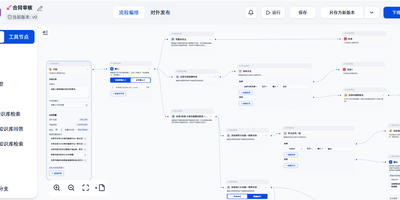
Document review, fixed-layout report generation, and multi-step research that ends in a PPT, Excel, or Word file all run inside BISHENG, a self-hosted workspace for enterprise AI applications. Review and report flows are drawn on a visual canvas where a circle becomes a loop, side-by-side nodes run in parallel, and a multi-item selection runs as a batch. A running flow can stop for a person to give input, confirm, or make changes, and chat and automation share one flow type. Research goes to Task Mode: give it a goal plus any files, knowledge bases, tools, and skills, and it writes a checklist, hands research to parallel sub-agents, and returns a report with clickable citation markers. Teams sharing documents use Knowledge Spaces, with folders, tags, keyword search, AI Q&A that shows its sources, and permissions down to a single file for people, departments, or user groups. For a daily news briefing, Channels turn WeChat official accounts and websites into topic feeds and save articles as knowledge in one click. Admins connect OpenAI-compatible APIs, Azure OpenAI, Anthropic, Qwen, DeepSeek, and local Ollama models, then govern access with approvals, audit logs, SSO, and LDAP. Private document parsing reads printed text, handwriting, tables, layouts, and seals, and a service-account Open API lets other systems call applications and knowledge bases. Running on a dedicated VPS on RepoCloud with guaranteed CPU, RAM, and SSD, full root SSH access, and a browser serial console. Apache 2.0 licensed.
Synapse AI
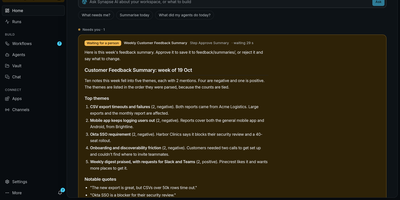
Hand a repeating job to Synapse AI and it drafts readable steps, runs them the same way every time, and stops to ask before anything goes out. Each workflow is a graph of steps that can call agents, tools, scripts, and different language models from over a dozen providers, local or cloud. An AI builder drafts the graph from a description, and a visual editor handles hand adjustments. Human approval steps pause a run until someone says yes, in the web interface or from Slack, Discord, Telegram, Teams, or WhatsApp. Cron and interval schedules start jobs automatically, and a run viewer shows the path, timing, tokens, and cost of every step. Any REST endpoint, Python script, webhook, or MCP server becomes a tool agents can call, and a shared vault stores files between runs. A template gallery offers ready-made workflows for research, reporting, and content, and an embeddable chat widget puts a knowledge-grounded assistant on your own site. A versioned REST API enqueues, streams, and cancels runs from your products. Running on a dedicated VPS on RepoCloud with guaranteed CPU, RAM, and SSD, full root SSH access, and a browser serial console. AGPL-3.0 licensed.