GPUStack
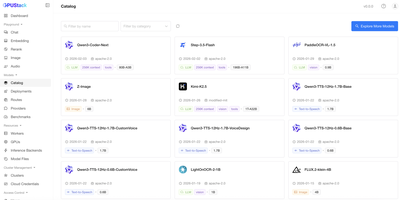
GPUStack is a control plane that turns a pile of GPU servers into a model-serving platform, where you pick a model from a catalog and the system decides which machine, engine, and settings run it. Deploy language, embedding, reranker, speech, and image models from the Catalog page, then watch each replica move from downloading to Running on the Deployments screen. A built-in Playground offers chat, side-by-side model comparison, embedding and rerank testing, audio, and image generation and editing, so a model gets judged before it is wired into an app. Add GPU workers with a generated Docker command, register a Kubernetes cluster, or provision cloud machines, and manage several clusters from one server. Create API keys for teammates, apply access control, and read token, GPU-hour, and storage usage by user, key, or model. Auto Tune benchmarking searches for the highest throughput that still meets your latency targets. GPU Instances hand out SSH-accessible machines for fine-tuning and interactive work. Single sign-on works through OIDC or SAML. Running on a dedicated VPS on RepoCloud with guaranteed CPU, RAM, and SSD, full root SSH access, and a browser serial console. Apache 2.0 licensed.
OpenLLM
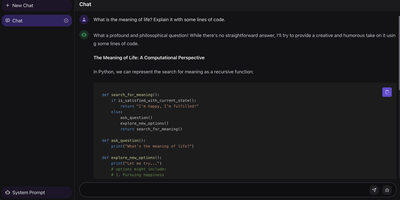
OpenLLM serves any large language model as an OpenAI-compatible API endpoint from a single CLI command, handling model download, backend selection, quantization, and port binding automatically. It supports the full spectrum of popular models including Llama 3.3, Qwen2.5, DeepSeek, Mistral, and Phi3, choosing between vLLM and PyTorch inference backends based on hardware capabilities. When vLLM is available, continuous batching with PagedAttention achieves up to 23x throughput improvement over naive serving, while GPTQ and bitsandbytes quantization reduces memory requirements for GPU-constrained deployments. The server exposes a RESTful API on port 3000 with full OpenAI client library compatibility, enabling drop-in replacement for commercial providers in any application using the standard chat completions format. A built-in web chat UI at the /chat endpoint provides immediate interactive testing without external clients. Custom model repositories allow teams to maintain private catalogs of fine-tuned models alongside the default repository that tracks the latest releases. Deployment workflows generate production-ready Docker images automatically, with Kubernetes manifest support for orchestrated scaling. Native integration with LangChain and LlamaIndex supports RAG pipelines, Transformers Agents enables tool-calling workflows, and HuggingFace Hub handles model discovery. Server-Sent Events enable real-time token streaming across all API endpoints. Backed by BentoML's production ML infrastructure. Running on a dedicated VPS on RepoCloud with guaranteed CPU, RAM, and SSD, full root SSH access, and a browser serial console. Apache 2.0 licensed.
GPUWorks
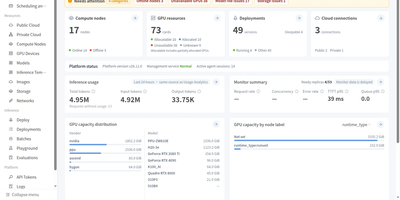
When your GPUs are spread across a rack in the office, rented cloud instances, and a Mac on a desk, GPUWorks pools them into one cluster that serves open models behind a single OpenAI-compatible endpoint. Pick a model from the built-in catalog of launch specs for vLLM and SGLang across NVIDIA, AMD, Huawei Ascend, T-Head PPU, Hygon, and Apple Silicon hardware, and the deploy page estimates the memory needed for weights, KV cache, and engine overhead, shows which GPUs the scheduler chose, and explains why it rejected the others. Several models can share one card through memory quotas or take turns with sleep and wake, while replicas, multi-node parallelism, and prefill and decode disaggregation scale a deployment out. The gateway handles chat, embeddings, rerank, audio, image, and realtime requests with API keys, per-key token usage, and failover routing. A monitor center charts time to first token, throughput, concurrency, and KV cache hit rates, usage analytics break tokens down by key and model, and a built-in benchmark sweeps concurrency to find your latency limit. GPU health checks and an AI assistant help diagnose failing cards, and a Playground lets you try any deployment in the browser. Nodes connect outbound, so they need no open ports, and models can be imported offline for air-gapped sites. Running on a dedicated VPS on RepoCloud with guaranteed CPU, RAM, and SSD, full root SSH access, and a browser serial console. Apache-2.0 licensed.
ODS
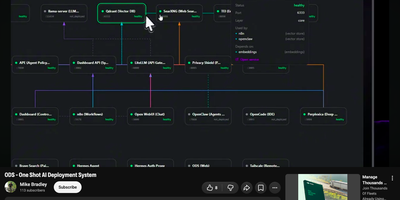
ODS turns a GPU machine or server you already own into a complete private AI stack with a single install command, replacing a shelf of separate tools with one system that serves models, chat, agents, automation, and search from your own hardware. The installer reads your GPU, VRAM, memory, and disk, then downloads a GGUF model matched to that hardware tier, and a compact bootstrap model starts answering within minutes while the full model finishes downloading. From the web dashboard you watch every service's health, ports, and resource use, restart what misbehaves, and check storage and updates without touching a terminal. You chat with local models in Open WebUI, hand background work to the Hermes and Portal agents, and build automations in n8n that connect the stack to more than 400 other apps. Documents you add become searchable knowledge through Qdrant vector storage, so answers cite your files instead of the model's memory. SearXNG and Perplexica answer web questions without trackers or accounts, Whisper transcribes speech, Kokoro reads text aloud, and ComfyUI generates images, all on the same box. Every bundled service is an extension you can enable, disable, or replace, and a Privacy Shield scrubs personal data before anything reaches an optional cloud model through the LiteLLM gateway. Running on a dedicated VPS on RepoCloud with guaranteed CPU, RAM, and SSD, full root SSH access, and a browser serial console. Apache-2.0 licensed.
Paddler
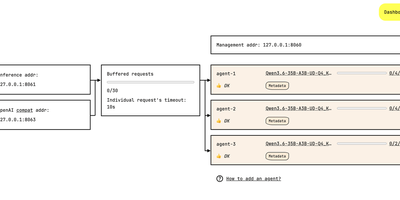
One binary. A fleet of machines. One calm endpoint for inference. Paddler balances large language model traffic across whatever hardware you already own, instead of renting tokens by the million. The balancer exposes an inference service, a management service, and a web admin panel from a single self-contained program. Agents on separate machines generate tokens and embeddings through slots, each carrying its own context and KV cache. Inference runs on the built-in llama.cpp engine, CPU or GPU. Need a different model? Swap it dynamically, no rebuild, no redeploy. Capacity follows demand: agents join the fleet when traffic grows and leave when it fades, and request buffering holds early work in a queue so scaling up from zero hosts drops nothing. Operators watch fleet health through observability metrics, configure models, chat templates, and inference parameters in the admin panel, and test prompts graphically before users ever see a change. A desktop edition drafts office workstations into service beside the rack servers. For medical, financial, or otherwise sensitive prompts, everything stays inside your own network, and predictable hardware replaces per-token pricing exposure. Running on a dedicated VPS on RepoCloud with guaranteed CPU, RAM, and SSD, full root SSH access, and a browser serial console. Apache License 2.0 licensed.