
Serviette
Your documents change every day, and your RAG answers should change with them: Serviette keeps a chat and REST API continuously in sync with the files you point it at, no re-indexing jobs to remember. Point it at a local folder, Google Drive, S3 or MinIO bucket, SharePoint library, or even an FTP or WebDAV share, and edits, additions, and deletions flow into the index in real time. One YAML file, or the interactive wizard, chooses among eight vector databases, from embedded DuckDB with zero setup to pgvector, Qdrant, Milvus, Chroma, Weaviate, Pinecone, or MongoDB Atlas. Text, Office files, PDFs with tables, and scanned images are parsed and answerable by default, with audio and video joining when you add the keys. Embeddings can run fully locally with no credentials, and keyless answers simply quote the retrieved passages with their sources. The indexer and the stateless server scale independently, the server shards across workers with one config line, and both a ChatGPT-style web chat and a versioned /api/v1 retrieval API answer on the same port. A free license key from Pathway activates the engine, and benchmarks cover corpora up to 50 GB of text. Running on a dedicated VPS on RepoCloud with guaranteed CPU, RAM, and SSD, full root SSH access, and a browser serial console. MIT licensed.
Subtitle Translator
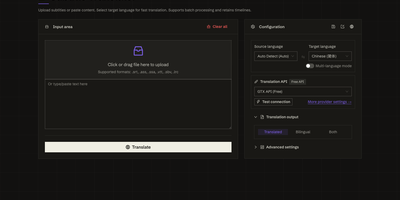
A whole season of subtitles can be translated in a single drop, with every timecode left exactly where it was. Subtitle Translator strips cue numbers and timing out of each file, sends only the dialogue to the translation engine, and puts everything back afterward, so a model never gets the chance to scramble a timeline. Pick any of 120+ target languages, or turn on multi-language mode to export several at once. Engines range from DeepL, Google, and Azure to dozens of LLM providers, gateways, and any OpenAI-compatible endpoint, including a local Ollama or LM Studio model. Context-aware mode feeds surrounding lines to the model for steadier dialogue and consistent character voices, and a glossary keeps names and product terms fixed across episodes. Bilingual output stacks original and translation in one file, either as plain SRT or as ASS with separate styles for each line. SRT, VTT, ASS, and LRC convert between each other during translation. Translated lines are cached, so a rate-limit pause or a closed tab only costs the missing lines. A text extractor strips timing for summaries and scripts. The interface itself is available in 18 languages, and companion tools handle Markdown, JSON locale files, and plain text. A back catalog of course videos or fan-subbed episodes becomes a weekend job instead of a month-long slog. Running on a dedicated VPS on RepoCloud with guaranteed CPU, RAM, and SSD, full root SSH access, and a browser serial console. MIT licensed.
Leon
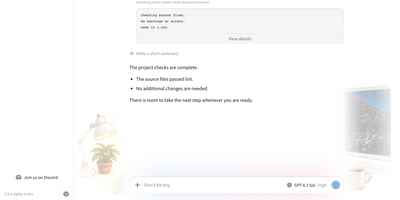
Leon is a personal AI assistant that lives on your own server, remembers what matters to you, and finishes real tasks with tools instead of just chatting. Ask for something in the browser web app and Leon plans the work, runs tools in isolated workers, checks the results, recovers from failures, and writes a short summary. Agent mode handles open-ended requests, controlled mode follows predictable native skills, and smart mode picks the better route for each task. Layered memory keeps durable facts and preferences, daily summaries, and recent discussion context, and Leon can search earlier conversations when exact details matter. Answers can arrive as interactive charts with region toggles, forms, and calculators instead of walls of text, and generated files become downloadable artifacts. Setup cards guide you through connecting services such as Spotify, owner-installed MCP servers add more tools, and a browser tool and computer use handle web pages and desktop applications. Pick models per profile, from a local llama.cpp model to OpenAI, Anthropic, DeepSeek, Groq, or OpenRouter. Profiles keep config, secrets, sessions, and memory separate, so one server can serve several people, with optional token authentication for remote clients. Workspaces group conversations under a shared brief, and Leon Satellite lets a remote Leon use enabled tools on your own device. Running on a dedicated VPS on RepoCloud with guaranteed CPU, RAM, and SSD, full root SSH access, and a browser serial console. MIT licensed.
ZeroClaw
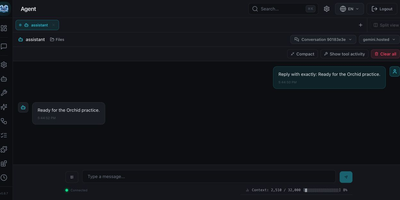
ZeroClaw puts one personal AI agent on every messaging app you already use, answering from your own server with your own model keys. A single instance binds Discord, Telegram, Matrix, Slack, WhatsApp, Signal, email, and webhooks at once, so you can start a conversation on your phone and finish it at your desk without losing context. You choose the brain behind it: Anthropic, OpenAI, a local Ollama model, or any OpenAI-compatible endpoint, with fallback chains that keep the agent answering when one provider has a bad day. The agent acts through tools that run shell commands, drive a browser, call HTTP APIs, and talk to custom MCP servers you plug in. A web dashboard gives you chat, a memory browser, a configuration editor, cron job management, and a tool inspector from any browser. Long-term memory lives in SQLite on your disk with embedding-based recall, so past conversations stay searchable and private. Supervised autonomy is the default posture: medium-risk actions pause for your approval, high-risk actions are blocked outright, and operating system sandboxes plus cryptographic receipts keep every tool call bounded and auditable. Event-driven standard operating procedures react to MQTT messages, webhooks, schedules, and hardware events, and named agents let different personalities guard different channels. Registered as a system service, it stays online around the clock. Running on a dedicated VPS on RepoCloud with guaranteed CPU, RAM, and SSD, full root SSH access, and a browser serial console. MIT or Apache-2.0 licensed.
Open Agent Builder
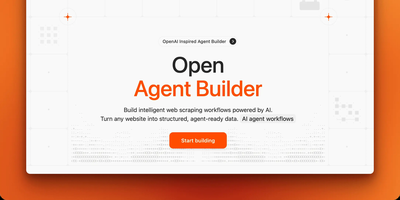
Open Agent Builder delivers a visual canvas for orchestrating AI agent workflows without writing Python scripts or managing complex codebases. The React Flow-powered drag-and-drop interface supports seven node types — Agent, Scraper, Transform, If/Else, Loop, User Approval, and MCP Tool — each configurable with provider-specific settings for Anthropic Claude (Haiku 4.5 and Sonnet 4.5), OpenAI GPT-5, Groq, or any OpenAI-compatible endpoint. The LangGraph orchestration engine handles state management, conditional routing, and human-in-the-loop approval gates while Firecrawl integration converts any website into structured, LLM-ready data through scrape, crawl, and map operations. E2B sandboxed code execution powers Transform nodes for secure data manipulation without risking host system integrity. Real-time streaming updates show execution progress node-by-node as workflows run, with Convex providing reactive database synchronization for workflow state and execution history. The TypeScript-first architecture (96.8% TypeScript) built on Next.js 16 App Router with Tailwind CSS delivers a responsive interface across devices. Clerk handles multi-user authentication with JWT integration for secure workspace isolation. Deploy via npm install and environment configuration with Firecrawl, Convex, and Clerk API keys. Running on a dedicated VPS on RepoCloud with guaranteed CPU, RAM, and SSD, full root SSH access, and a browser serial console. MIT licensed.
MimirQ
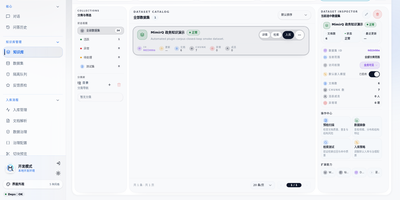
When a knowledge base gives a wrong answer, MimirQ shows which stage let it down. Documents move through a pipeline that teams can open at every step: parsing, cleaning, chunking, indexing, retrieval, reranking, and cited answers. A dataset catalog tracks documents, chunks, and ingestion status, and an execution monitor charts throughput, retries, parser queues, and run logs. The governance workbench previews each file, scores quality, and supports cleaning and labeling before chunks are cut by headings, records, or parent-child structure. Retrieval blends keyword and vector search with reranking, and every reply lists its source evidence with feedback scoring. A graph view maps entities, events, and relationships on one canvas for exploration. Golden-set evaluation stores standard questions and answers, runs them against the current pipeline, and reports recall and ranking metrics, so a release can be blocked when quality slips. Settings pages manage model providers, parsers, and retrieval options, and a Dify-compatible external knowledge API lets existing workflows call it. Role-based access and document permissions keep restricted material hidden from the wrong users. Running on a dedicated VPS on RepoCloud with guaranteed CPU, RAM, and SSD, full root SSH access, and a browser serial console. Apache-2.0 licensed.
ThoughtDAG
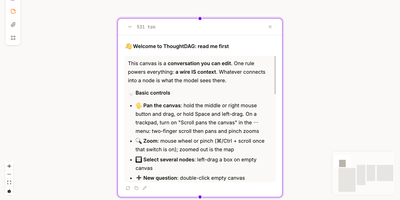
ThoughtDAG turns a long AI conversation from a scroll you cannot rearrange into a map you can edit, branch, and reconnect. Every question and answer becomes a node on an infinite canvas, and the wires between nodes are not decoration: they decide exactly what context the model sees next. Follow a promising thread, park a side question on its own branch, or cut a wire when an early assumption starts poisoning later answers, all without deleting the work that led there. Zoom out to read the shape of an investigation, then zoom back in to full answers, attachments, and highlighted passages. Drop in documents and files as material nodes, ask questions from them, and preview precisely what will be sent before a model runs. Past coding agent sessions can be opened as read-only graph mirrors, so a discussion that started in a terminal can be inspected, cited, and continued on the canvas. Memory lives in readable dossiers that collect decisions and open questions per topic, with sources attached, and relevant dossiers join new questions when you ask. Export a backup, a Markdown context chain, or a thought map that shares the structure of your thinking without dumping the whole transcript. Running on a dedicated VPS on RepoCloud with guaranteed CPU, RAM, and SSD, full root SSH access, and a browser serial console. MIT licensed.
SubLane
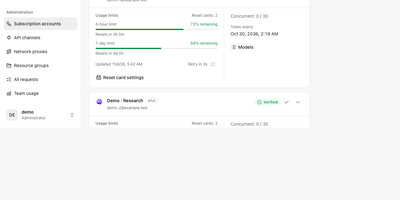
Five teammates sharing three AI subscriptions usually means a password in a group chat; SubLane replaces that with a gateway you host, where accounts are pooled and every person gets a managed key. Connect Codex, Claude, Antigravity, and Grok Build subscriptions once, by browser OAuth or credential import, and the gateway snapshots each account's quota windows and allowances so routing knows who still has room. Add API channels for OpenAI-compatible services alongside the subscriptions, then group everything into resource pools with model allowlists, conversation affinity, concurrency controls, and cooldown recovery for accounts that hit a limit. Each member receives a personal key scoped to one group, with its own expiry, rate and concurrency limits, and an allowance measured in tokens, internal dollars, or estimated quota share; keys can be paused or revoked without touching anyone else. Whatever the client speaks, the gateway answers: OpenAI Responses and Chat Completions, Claude Messages, and Gemini formats flow over HTTP, SSE, or WebSocket, independent of which subscription actually serves the request. Administrators watch per-member and per-model usage charts, activity heatmaps, and request diagnostics, bind a fixed outbound proxy to any account, and apply workspace content rules before dispatch. It all runs as one Go process with SQLite and an embedded dashboard, backed up and restored from the interface. Running on a dedicated VPS on RepoCloud with guaranteed CPU, RAM, and SSD, full root SSH access, and a browser serial console. AGPL-3.0 licensed.
llmfit
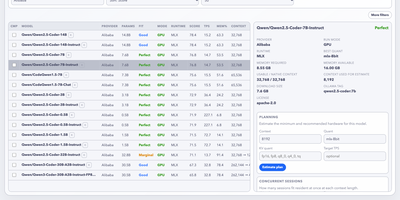
llmfit tells you which open LLMs will actually run on your machine, and how fast, before you download a single gigabyte. Guessing wrong means a huge download that crawls or never loads, so it reads your CPU, RAM, and GPU and scores thousands of models on memory fit, estimated tokens per second, quality, and context length. Start llmfit serve and a browser dashboard opens on port 8787, with a sortable fit table, filters for runtime, use case, and provider, and a detail panel that names the best quantization, the memory required, and the download size. Thinking of renting a bigger box? Type a RAM, VRAM, and core count and every score recalculates for that imaginary machine. The planner estimates minimum and recommended hardware for a chosen context and quantization, shows how many concurrent sessions fit at each context length, and sizes the SSD for a whole library of models. Tick a few rows to compare them side by side. Scripts can pull system info and ranked models from JSON endpoints, and cluster mode checks whether a model splits across several Ray nodes before you launch vLLM. The bench command measures real speed against Ollama, llama.cpp, MLX, or LM Studio, and the interface offers ten themes and a Chinese translation. Running on a dedicated VPS on RepoCloud with guaranteed CPU, RAM, and SSD, full root SSH access, and a browser serial console. MIT licensed.
OvertChat
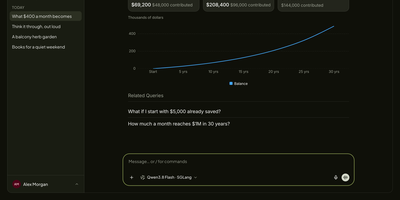
Your household gets one private chat front door for the models you already run, local or hosted, with voice, search, and coding agents included from the same server. Point it at Ollama, vLLM, llama.cpp, SGLang, or LM Studio, then add OpenAI, Anthropic, Gemini, DeepSeek, Bedrock, or OpenRouter beside them. Models that support tools can answer with charts, tables, forms, and follow-up buttons instead of plain paragraphs. Ask for a live conversation and speak, hear the reply, cut in mid-sentence, and keep going; Parakeet handles recognition and Kokoro speaks back on CPU or GPU. Documents open beside the chat for drafting and revising Markdown, code, web pages, SVG, and Mermaid diagrams. Attach spreadsheets, PDFs, images, Word, Excel, CSV, or source files and run Python on them in an offline sandbox that returns charts, cleaned data, or finished documents. Search the web through bundled SearXNG or Brave, read pages with inline citations, connect MCP servers, and set thinking controls per local model. Replies keep streaming after you close the tab, full-text search finds old answers, and read-only links share a conversation. Coding agents run on your machines or over SSH and stay reachable from browser, desktop, Android, or iOS. Running on a dedicated VPS on RepoCloud with guaranteed CPU, RAM, and SSD, full root SSH access, and a browser serial console. MIT licensed.
CLIProxyAPI
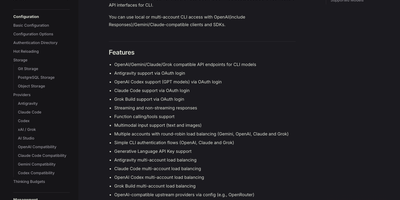
CLIProxyAPI turns AI coding subscriptions you already hold into one standard API endpoint that any OpenAI, Gemini, or Claude compatible client can call. Connect Codex, Claude Code, Grok Build, and Gemini accounts through simple OAuth sign in flows, then point your editor, agent, or script at a single base URL instead of juggling separate tools. Add several accounts per provider and the proxy spreads requests across them with round robin load balancing, so a busy team can pool capacity instead of pressing against one account's limits. Streaming, non streaming, and WebSocket responses are supported where the provider allows them, which keeps interactive coding sessions responsive. Function calling and tool use pass through, so agents can still run commands, edit files, and call external tools through the unified endpoint. Multimodal requests combine text and images, covering screenshot driven debugging and visual questions. Gemini API keys, AI Studio accounts, and hosted Gemini access sit alongside subscription accounts, and OpenAI compatible upstreams such as OpenRouter can be added in configuration. A management API exposes control endpoints for companion dashboards, while a reusable Go SDK lets developers embed the proxy inside their own services. Running on a dedicated VPS on RepoCloud with guaranteed CPU, RAM, and SSD, full root SSH access, and a browser serial console. MIT licensed.
Hindsight
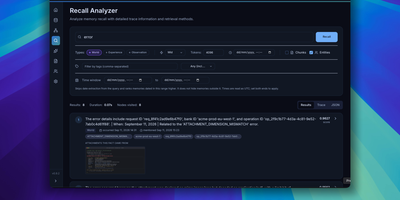
Memory that survives the session: Hindsight extracts facts, entities, and timestamps from everything an AI agent retains, then lets the agent search or reason over it later. Adding it to an existing LLM client takes a two-line wrapper, and more than 60 integrations cover Claude Code, Cursor, LangGraph, CrewAI, and n8n. Every bank also exposes its own MCP endpoint. Retain sends text, images, or files through an LLM that extracts facts, timestamps, entities, and relationships. Recall runs semantic, keyword, graph, and temporal searches in parallel, merges them with reciprocal rank fusion, reranks with a cross-encoder, and trims to a token budget. Reflect reasons across memories for questions that need synthesis, shaped by per-bank skepticism, literalism, and empathy traits. In the background, related facts consolidate into observations that keep exact quotes and proof counts and are refined, never silently overwritten. Mental models and wiki-style knowledge pages hold standing answers that rewrite themselves as the bank learns. Each user, agent, or project gets an isolated bank with no cross-bank leakage, and Memory Defense redacts or blocks secrets and PII against 45 patterns. The Control Plane adds a Recall Analyzer with traces, a memory constellation graph, and a knowledge page editor. Extraction and reasoning can run on 25+ LLM providers, including local Ollama and llama.cpp. Running on a dedicated VPS on RepoCloud with guaranteed CPU, RAM, and SSD, full root SSH access, and a browser serial console. MIT licensed.
AI Chatbot Framework
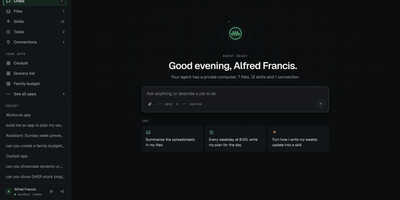
Ask for a job in plain words and an agent with its own private computer does it: it reads files, runs commands, calls connected apps, and reports back in the chat. Every user gets a persistent sandbox workspace, so one person's files and commands never touch another's. Type a new message mid-run and the agent picks it up without stopping, or press Stop at any time. For bigger jobs the agent starts sub-agents that work side by side, each on a model of its choice, and the chat shows what each one is doing. Skills teach it repeatable methods in the open Agent Skills format; upload a zip, write one by hand, or let the agent write its own, and use them from a slash menu. The Connections page links Linear, Notion, Jira, Stripe, and other apps through one-click OAuth sign-in, or any MCP server by address. Scheduled tasks run on a repeating or one-time schedule, and each run becomes a readable chat. Small personal apps like a to-do cockpit or budget view appear in the sidebar, and charts, plans, and forms can render right inside answers. A files browser, an artifacts panel, a command menu, light and dark themes, and a phone layout round out the interface. Running on a dedicated VPS on RepoCloud with guaranteed CPU, RAM, and SSD, full root SSH access, and a browser serial console. MIT licensed.
Omnara
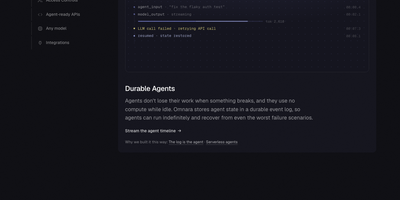
Running AI agents in production takes more than a model call: Omnara supplies the durable runtime, tools, approvals, and complete event history around any model, on your own machines. You define an agent once in a small YAML file: instructions, a model from OpenAI, Anthropic, OpenRouter, Bedrock, LiteLLM, Ollama, or your own endpoint, and the machines it may use. Launch agents from the REST API, the TypeScript SDK, the command line, or the dashboard, then stream every event live or receive it as a webhook while the agent works. Agents run shell commands and edit files on sandboxes from twelve providers, or on your own laptops, VMs, and containers through a daemon that connects outward, so no inbound ports or SSH keys are exposed. Every step is written to Postgres as an event log, which means an agent survives crashes, restarts, and disconnected machines and resumes exactly where it stopped. Tool permissions can run immediately, ask a person first, or block outright, and agents can start subagents, follow cron schedules, and keep shared memory files between conversations. Teams meet the agents where they already talk: mention the bot in Slack or Discord, or let a GitHub pull request trigger a review, with questions and approvals handled in the thread. Running on a dedicated VPS on RepoCloud with guaranteed CPU, RAM, and SSD, full root SSH access, and a browser serial console. Apache-2.0 licensed.
AgentFlux
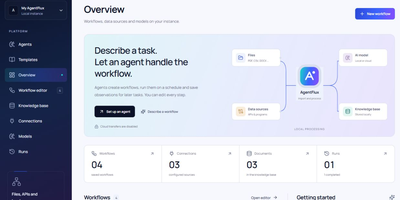
Describe the task in plain words, pick the sources and model it may use, and an agent plans the workflow before running it. That is the core loop: agents build editable visual workflows from a task description, execute them on demand or on a schedule, and keep everything traceable. Prefer building by hand and the canvas offers 17 preconfigured steps, branching, undo and redo, JSON import and export, plus eight starter templates. Feed it real work by importing PDF, DOCX, XLSX, CSV, JSON, and text files, or by connecting folders, HTTP endpoints, and approved local programs. Upload a screen recording and it identifies the actions with timestamps, turning a demonstrated process into an editable workflow you can refine. Model calls go to the endpoint you choose: Ollama, LM Studio, vLLM, or any OpenAI-compatible service, local or cloud with your own credentials. Every run can be inspected step by step, cancelled mid-flight, and exported as JSON, CSV, or Markdown reports. Observations from completed runs land in a knowledge and learnings store, where you review them and promote the useful ones into reusable skills for the next task. The Docker release bundles the application with FFmpeg and local Whisper support, and your documents stay on your own machine. Running on a dedicated VPS on RepoCloud with guaranteed CPU, RAM, and SSD, full root SSH access, and a browser serial console. Apache License 2.0 licensed.
llamactl
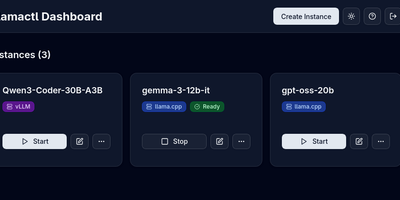
One dashboard and one API address for every local model you run, across llama.cpp, vLLM and MLX: that is llamactl. Create an instance in the web UI, pick a backend, and the server assigns ports and API keys, starts the model, and shows its health next to every other instance you run. Models download straight from HuggingFace inside the dashboard, in GGUF for llama.cpp or Safetensors for vLLM, so stocking a new model never means juggling command lines and file paths. Your applications keep talking to familiar endpoints, because llamactl exposes OpenAI chat completions and Anthropic messages routes and sends each request to the model named in the call. A llama.cpp router instance can serve several models from one process and load them on demand, and idle instances stop on a timer or make room through LRU eviction when the GPU gets crowded. Groups cap how many heavy models run at once, backends can live in Docker containers with GPU access, and instances on other machines appear in the same central dashboard with automatic routing. API keys minted in the UI guard both inference and management calls. Running on a dedicated VPS on RepoCloud with guaranteed CPU, RAM, and SSD, full root SSH access, and a browser serial console. MIT licensed.
AGenUI Studio
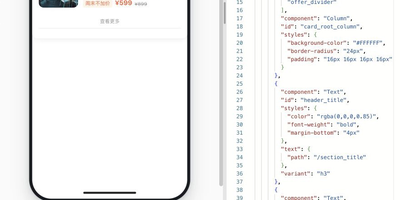
AGenUI Studio turns a written description into a working interface card: an AI agent generates the UI, binds it to your APIs and data, and packages it so it runs anywhere, no Studio required. Bring your own model by entering any OpenAI-compatible or Anthropic Messages endpoint and key in the console settings, and generation proceeds contract-first, steered by design rules you publish as versioned Markdown revisions. You preview each card live as it is generated, then refine it over multiple turns while every component, binding, and action you did not target stays protected from accidental edits. The console also manages the supporting cast: a local knowledge base, API definitions, and reusable operators, all starting from bundled demo data you can swap for real services whenever you are ready. When a card is finished, download it as a self-contained Runtime Package carrying its data sources, bindings, actions, and operators, and execute it with the bundled Card Runtime inside your own application, or register a delivery target and publish straight from the workbench over a callback or a message queue. Applications subscribe to native run events over HTTP and SSE, and production deployments can replace the local defaults piece by piece, MySQL for storage, Redis for hot state, MCP services for knowledge and data, while the packages keep the same contracts. Running on a dedicated VPS on RepoCloud with guaranteed CPU, RAM, and SSD, full root SSH access, and a browser serial console. Apache-2.0 licensed.