Lemmy
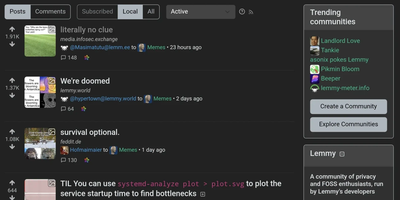
Powering over 496 instances with more than 35,000 monthly active users and 26,500 communities, Lemmy has established itself as the leading open-source, federated link aggregation platform in the Fediverse. Built entirely in Rust for memory-safe, high-performance server operation, Lemmy enables anyone to run their own Reddit-style community that automatically connects with every other Lemmy instance — and compatible ActivityPub platforms like Mastodon, PieFed, and Kbin — through standardized federation protocols. Users create and subscribe to topic-based communities, submit posts containing text, links, or images, engage through threaded comment discussions, and shape content visibility through upvote/downvote mechanisms. Instance administrators retain full control over moderation policy, federation allowlists and blocklists, site appearance, and user registration settings, while community moderators can sticky posts, lock threads, ban users, and maintain public moderation logs for transparency. The platform supports private messaging between users, email notifications, RSS and Atom feed generation for every community, comprehensive internationalization with dozens of language packs, custom emoji support, and both light and dark themes through a clean mobile-responsive interface. Deployment is straightforward with official Docker Compose configurations and Ansible playbooks, backed by a PostgreSQL database with pict-rs for image hosting. Lemmy's Rust backend consistently benchmarks among the most efficient Fediverse server implementations, enabling small VPS instances to serve thousands of users. Running on a dedicated VPS on RepoCloud with guaranteed CPU, RAM, and SSD, full root SSH access, and a browser serial console. AGPL-3.0 licensed.
Lobsters
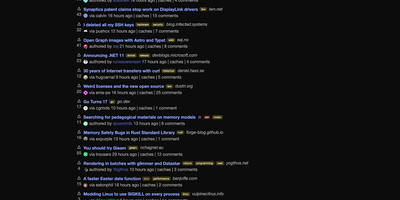
Lobsters is a link-sharing and discussion site you can run for your own community, with the threaded conversations and tight topic focus of the original lobste.rs. Members submit links or text posts, pick tags from a fixed list, and vote stories up the front page. Every tag has its own feed, and readers hide the tags they never want to see, with logged-out visitors keeping their filters in a browser cookie. Comments nest into threads that collapse with one click, and each story shows archive links so readers can still open a page after the original disappears. Moderation stays in the open: a public log records banned users, deleted stories, and tag changes with the reason for each action, and filters narrow it by moderator and by type. Growth stays manageable because new members arrive by invitation, the full invitation tree is public, and accounts in their first 70 days appear in green with limits on flagging and self-promotion. Flags carry an explanation so disagreement is not punished, and verified hats label comments from people speaking for a project or company. Use it for a developer forum, an internal engineering link board, a club for a niche craft, or a small group that wants good discussion without a personalized feed. Running on a dedicated VPS on RepoCloud with guaranteed CPU, RAM, and SSD, full root SSH access, and a browser serial console. BSD-3-Clause licensed.
Mbin
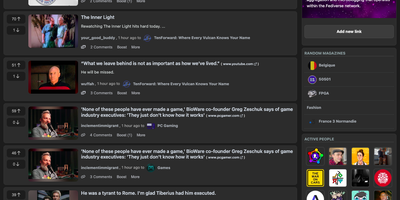
Mbin is a federated community platform that mixes magazine-based link aggregation and threaded discussion with short-form microblogging, so one self-hosted instance works as both a Reddit-style forum and a Mastodon-style social feed. Members create magazines around topics, then post links, articles, photos, and videos into them, vote submissions up or down, boost the best ones to their followers, and argue the details in threaded comment trees. The microblog stream sits beside the magazines for quick status posts, and a combined view blends both content types into a single feed you can sort by hot, new, active, or most commented. Because the whole platform speaks ActivityPub, your magazines and users federate with Mastodon, Lemmy, Pixelfed, Pleroma, and PeerTube, and follows, replies, and votes travel across instance boundaries in both directions. Magazine owners appoint moderators, pin threads, and handle reports, while instance admins control registration, federation allow and block lists, and which remote servers the instance talks to. Readers shape their own view with subscriptions to magazines, people, and tags, plus personal blocks for users, magazines, and entire instances. A documented REST API with OAuth 2.0 access lets mobile clients, bots, and integrations read and publish content, and Service-type accounts are supported for automated posters. Running on a dedicated VPS on RepoCloud with guaranteed CPU, RAM, and SSD, full root SSH access, and a browser serial console. AGPL-3.0 licensed.