Tracktor
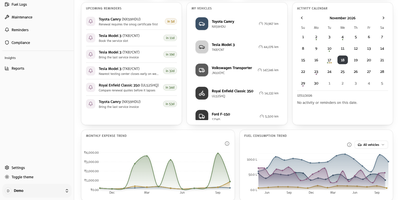
Tracktor turns a drawer full of fuel receipts, insurance PDFs, and half-remembered service dates into one self-hosted garage dashboard for every vehicle you own. Each vehicle gets its own entry with a fuel type, and every fill-up you log feeds mileage and cost charts in km/L, mpg, or L/100km, with units for CNG and LPG. The maintenance log keeps a full service record per vehicle, shows what is due next, and exports to PDF when a buyer or mechanic asks for proof. Compliance records such as insurance and pollution (PUCC) certificates are tracked beside it, and reminders can arrive in the app or through email, webhook, or Gotify delivery before a policy lapses or a service falls due. Expense and report views total what each vehicle really costs to run, while a fleet-wide dashboard of rearrangeable widgets summarizes the whole garage at a glance. Feature toggles hide any module you do not use, the interface is translated into Hindi, Spanish, French, German, Arabic, Russian, and more, and a Vintage theme changes the look. Households with several vehicles can keep every record in one private place instead of scattered across apps, spreadsheets, and glove boxes. Running on a dedicated VPS on RepoCloud with guaranteed CPU, RAM, and SSD, full root SSH access, and a browser serial console. MIT licensed.
Ferret
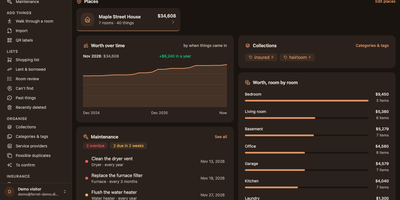
From the tent in the garage to the warranty on the fridge, Ferret keeps one searchable home inventory that your household runs on its own server. Properties, rooms, and boxes hold things with photos, receipts, manuals, serial numbers, and prices, and a quick add accepts a photo, a barcode scan, or a picture of a whole room to sort through. Printed QR labels on boxes and shelves open the list of what is inside. Warranties count down to the last day with a claim shortcut, return windows warn before they close, and maintenance repeats by date or by use, with reminders and how-to videos. Stock levels feed a shopping list, a lending log remembers who borrowed the saw, and a replacement forecast estimates what wears out and when. An insurance report totals value by room and category, exports PDF and spreadsheet files, and can be shared by link. Households have owners, admins, members, and read-only viewers, with invitations and single sign-on. Optional AI reads receipts, suggests details from photos, and answers questions in plain words, while a built-in MCP server lets Claude search, add, and update items with a key that can be read-only. Running on a dedicated VPS on RepoCloud with guaranteed CPU, RAM, and SSD, full root SSH access, and a browser serial console. MIT licensed.
DumbAssets
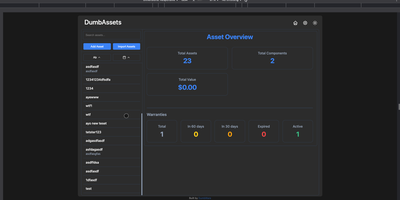
DumbAssets delivers a deliberately simple physical asset tracker that does exactly one thing well — keeping tabs on everything you own, from server racks down to individual HDDs, with hierarchical component nesting that mirrors real-world organization. The Node.js backend stores all data in JSON files within a single /data directory, making backups trivial with one folder copy while the PWA-enabled frontend provides responsive access from any device with light and dark theme persistence. Assets track model numbers, serial numbers, purchase dates, warranty expiration dates, and custom descriptions while sub-components nest infinitely — attach a Dell R730 to your server rack, then attach individual drives, CPUs, and NICs to that server with separate warranty and maintenance schedules for each. The Apprise notification engine fires configurable alerts for warranty expirations and maintenance events with direct links back to the specific asset in the web interface. Photo uploads attach visual records to any asset, receipt storage keeps purchase documentation alongside the item it covers, and a flexible tagging system enables cross-cutting organization beyond the hierarchy. PIN authentication with brute-force protection secures the interface, while search covers names, models, serials, and descriptions with sorting by warranty status, tags, components, or alphabetical order. Deploy with a single Docker command mapping port 3000 and one data volume. Running on a dedicated VPS on RepoCloud with guaranteed CPU, RAM, and SSD, full root SSH access, and a browser serial console. GPL v3 licensed.