GPUStack
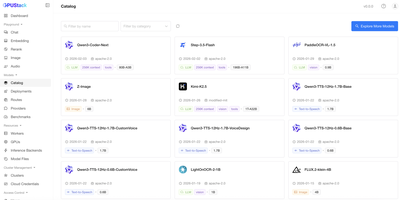
GPUStack is a control plane that turns a pile of GPU servers into a model-serving platform, where you pick a model from a catalog and the system decides which machine, engine, and settings run it. Deploy language, embedding, reranker, speech, and image models from the Catalog page, then watch each replica move from downloading to Running on the Deployments screen. A built-in Playground offers chat, side-by-side model comparison, embedding and rerank testing, audio, and image generation and editing, so a model gets judged before it is wired into an app. Add GPU workers with a generated Docker command, register a Kubernetes cluster, or provision cloud machines, and manage several clusters from one server. Create API keys for teammates, apply access control, and read token, GPU-hour, and storage usage by user, key, or model. Auto Tune benchmarking searches for the highest throughput that still meets your latency targets. GPU Instances hand out SSH-accessible machines for fine-tuning and interactive work. Single sign-on works through OIDC or SAML. Running on a dedicated VPS on RepoCloud with guaranteed CPU, RAM, and SSD, full root SSH access, and a browser serial console. Apache 2.0 licensed.
OpenLLM
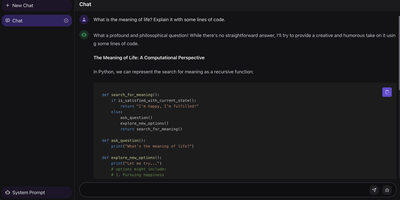
OpenLLM serves any large language model as an OpenAI-compatible API endpoint from a single CLI command, handling model download, backend selection, quantization, and port binding automatically. It supports the full spectrum of popular models including Llama 3.3, Qwen2.5, DeepSeek, Mistral, and Phi3, choosing between vLLM and PyTorch inference backends based on hardware capabilities. When vLLM is available, continuous batching with PagedAttention achieves up to 23x throughput improvement over naive serving, while GPTQ and bitsandbytes quantization reduces memory requirements for GPU-constrained deployments. The server exposes a RESTful API on port 3000 with full OpenAI client library compatibility, enabling drop-in replacement for commercial providers in any application using the standard chat completions format. A built-in web chat UI at the /chat endpoint provides immediate interactive testing without external clients. Custom model repositories allow teams to maintain private catalogs of fine-tuned models alongside the default repository that tracks the latest releases. Deployment workflows generate production-ready Docker images automatically, with Kubernetes manifest support for orchestrated scaling. Native integration with LangChain and LlamaIndex supports RAG pipelines, Transformers Agents enables tool-calling workflows, and HuggingFace Hub handles model discovery. Server-Sent Events enable real-time token streaming across all API endpoints. Backed by BentoML's production ML infrastructure. Running on a dedicated VPS on RepoCloud with guaranteed CPU, RAM, and SSD, full root SSH access, and a browser serial console. Apache 2.0 licensed.