Coral by Subgentic
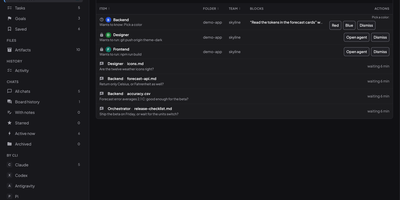
No more hunting through terminal tabs for the coding agent that stalled on a permission prompt, because Coral queues every question, approval, and file review in one Inbox. Claude Code, Codex, and Antigravity run side by side as one team, each in its own terminal session, sharing a message board and a task queue where dependencies wait on outcomes and required artifacts. Goals carry a checkable Done when line, and review gates hold dependent tasks until a reviewer approves. Files an agent produces open in a versioned viewer where you comment on passages, mark up images with a pen, arrow, or box, compare version two against version one, then approve, approve with a note, or request changes. A changed-files panel shows each agent's diff beside its chat, and optional git worktrees keep the main checkout clean. Idle agents sleep and wake when a message arrives, and whole teams can sleep through a restart. Scheduled jobs and multi-step workflows run regression suites and audits on a cron, resource queues keep concurrent agents off the same build rig, and analytics break token spend down by provider, model, thinking level, team, and task. A QR-paired phone client approves prompts on the go, and a self-hosted hub follows agents across computers. Running on a dedicated VPS on RepoCloud with guaranteed CPU, RAM, and SSD, full root SSH access, and a browser serial console. Apache-2.0 licensed.
Xiryn
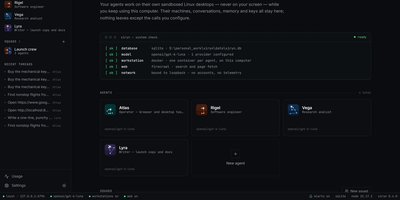
Picture a small staff of AI agents clocking in on your own server, each with a name, a specialty, its own model, and a private Linux desktop it can click around in. Every agent works inside a disposable Docker workstation with a shell, persistent files, and a Chromium browser, so it can research the web, write and run code, and finish multi-step tasks without touching your own files. You watch an agent click and type in real time, and when a login, payment, or one-time code needs a human, you take over the desktop, then hand it back with a note and let it continue. Pair a Telegram bot by scanning a QR code and you can assign work, answer questions, and receive results from your phone, with no public URL or port forwarding. Routines turn recurring requests into schedules, so a morning briefing, a price watch, or a weekly report runs by itself and reports back when it is done. Each agent can use a different model, from OpenAI, Anthropic, Google, xAI, Groq, Mistral, or DeepSeek to a local Ollama endpoint, and every reply shows its cost while a monthly budget pauses paid models automatically. Agents remember what matters about you across every thread, and logins or cards you save sit in an encrypted vault the agents themselves never see. Running on a dedicated VPS on RepoCloud with guaranteed CPU, RAM, and SSD, full root SSH access, and a browser serial console. MIT licensed.
Evonic
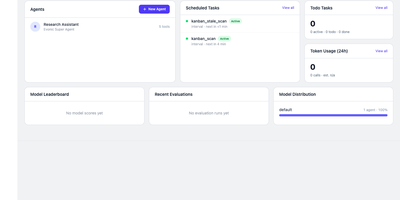
AI agents that delegate to each other, remember past conversations, and stay inside your safety rules all live in one self-hosted platform called Evonic. Every agent in Evonic has its own identity, model, tools, knowledge base, channels, and skills, and a guided first-run wizard creates the first one in minutes against OpenRouter, Together AI, Ollama, DeepSeek, llama.cpp, or any custom OpenAI-compatible endpoint. Agents message and delegate to each other, run commands in a Docker, Podman, or bubblewrap sandbox, and execute on a local folder, an SSH server, or a tunnel device that needs no public IP. A built-in Kanban board hands tasks to agents, a scheduler fires cron jobs and reminders, and Telegram, WhatsApp, and Discord channels put agents where users already chat. Markdown knowledge bases with wiki-links form an interactive graph, a memory engine recalls facts across sessions, and an organizer sub-agent extracts entities and merges duplicates. Safety layers inspect actions for mass deletion or remote code execution and escalate to a human, and an injection guard blocks prompt manipulation. Evaluation dashboards score models across domains, a token monitor tracks usage per agent and model, and bundled skills, 12 plugins, backup and restore, and themed light and dark modes round it out. Running on a dedicated VPS on RepoCloud with guaranteed CPU, RAM, and SSD, full root SSH access, and a browser serial console. AGPL-3.0 licensed.
Automatos AI
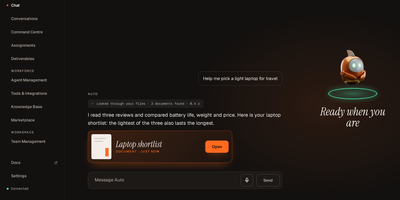
Command a whole team of AI agents from one chat box and collect finished reports, code, and content on a server you control. Say what you need and Auto routes the request to the right agent, tool, or Playbook, streams its thinking, shows every tool call, and files a ticket for another agent when the job needs one. Each agent has its own model, persona, skills, and success metrics, and the Command Centre shows the board, live status, calendar, and questions waiting for you. Playbooks turn repeatable work into multi-step automations, and Missions coordinate several agents on one goal. The marketplace installs ready-made agents, skills, and packages, and Composio connects more than a thousand outside apps once you add your own key. Models come from OpenRouter, direct provider keys, NVIDIA's free hosted models, or your own Claude Code sessions paired as agents. Knowledge bases index your documents into a searchable graph, analytics break spend down by provider and agent, and installable themes redraw the interface with voice control built in. Nothing here is locked behind a paywall, the local edition has no login so put it behind your own gate, and the whole stack starts from one Docker Compose command. Running on a dedicated VPS on RepoCloud with guaranteed CPU, RAM, and SSD, full root SSH access, and a browser serial console. Apache-2.0 licensed.
Agent-Me
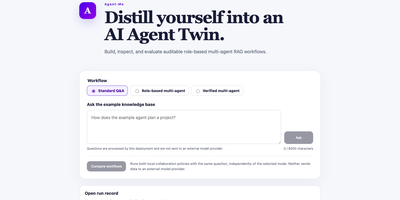
Build an AI twin that has to show its homework. Agent-Me answers questions from a folder of Markdown notes you control, and every reply arrives with the exact source excerpts behind it. Pick Standard Q&A for a direct grounded answer, Role-based multi-agent to watch a planner, researcher, critic, and writer hand work to each other, or Verified multi-agent to add a final check on citation paths and answer metadata. When the notes do not contain an answer, the critic blocks the draft and the app says so instead of inventing one. Press Compare workflows to run the baseline and verified pipelines on the same question and read the results side by side. Download a sanitized run record for any collaboration, then open it later in the browser to review the trace without re-running anything. The interface speaks nine languages, and the default mode never calls an outside model, so private notes stay on your server. Swap in your own documents and test supported, unsupported, and adversarial questions to see exactly where an assistant stays grounded. Running on a dedicated VPS on RepoCloud with guaranteed CPU, RAM, and SSD, full root SSH access, and a browser serial console. MIT licensed.
Eidon
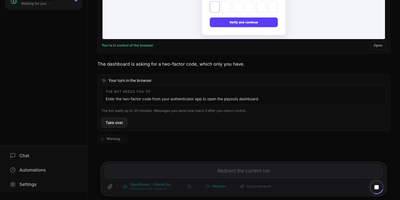
Beyond a plain chat for quick questions, Eidon gives you a team of AI agents, each with its own browser, workspace, and memory, and a Chief of Staff that routes your requests. Ask for anything and it answers, hands the job to a specialist, or creates a new agent for it, and agents message each other and report back. Open an agent's live browser view and watch it work. At a sign-in, a two-factor code, a CAPTCHA, or a payment it stops and waits for you, and you hand control back with a note. Passwords come from an encrypted vault and are typed into the page, never passed to the model. Shell commands and MCP tools run only after you allow them once, always, or never, and emails and Slack messages arrive as drafts to edit. Chat lets you rewind, branch, edit, or regenerate any message, queue follow-ups while a reply streams, and share a read-only link. Deep research drafts an editable plan of up to twelve steps and returns a cited report. Memories wait for your approval. Automations run on an interval, daily, weekly, or once, and alert you through ntfy, Pushover, webhooks, or web push. Connect OpenAI-compatible or Anthropic providers, MCP servers, web search, image generation, and voice dictation, with a private account for each person. Running on a dedicated VPS on RepoCloud with guaranteed CPU, RAM, and SSD, full root SSH access, and a browser serial console. AGPL-3.0 licensed.
Solo Agent
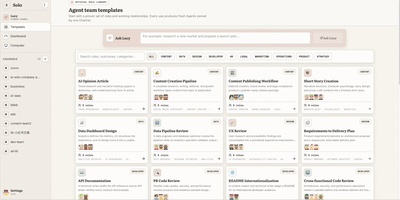
Give an outcome to Lucy, the built-in steward, and she assembles a fresh team of role-based agents inside a channel, with separate sessions and memory for each one. An official template library covers content, data, design, developer, legal, marketing, operations, product, and strategy workflows, from API documentation teams to pull request reviewers. Messages turn into Kanban tasks that agents claim, split into subtasks, submit for review, and close, and each task keeps its thread attached. A channel team graph shows who assigns work to whom, and Thinking mode branches a discussion into focused lines of reasoning that return conclusions to the parent. Agent Live tracks working, idle, and timed-out agents with a transcript viewer for every session, and an Insight dashboard charts messages, runs, tasks, and token usage over time. Finished work becomes artifacts you can review, regenerate, and publish. Pair a laptop or server as a Computer with a one-time command, and an inbox gathers mentions and replies. Running on a dedicated VPS on RepoCloud with guaranteed CPU, RAM, and SSD, full root SSH access, and a browser serial console. MIT licensed.
OpenCorvus
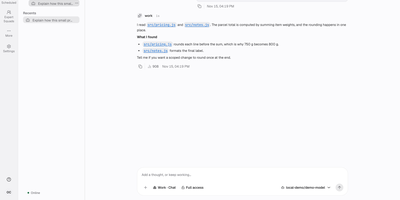
Long agent tasks tend to stall, lose context, or return something nobody can verify, and OpenCorvus is built to prevent all three. OpenCorvus organizes long, complex tasks into Missions worked by Expert Squads, where research, implementation, and independent review each have a named owner and hand off written artifacts. Task state and context are retained, so a stopped run can be recovered rather than restarted, and tool calls, results, and review evidence stay in a record you can inspect. Pick a squad from the bundled catalog of more than a hundred, or let the Dynamic squad compose task-specific experts for you. Connect any of roughly ninety model providers, add MCP servers and skills, schedule recurring work like a weekday brief, and receive tasks from chat channels like Slack, Telegram, Discord, and WhatsApp. A persistent project memory keeps notes the agents reuse across conversations. Start the headless server in a repository, open the workbench in your browser, or create Tasks through the HTTP API and follow their events as they stream. Running on a dedicated VPS on RepoCloud with guaranteed CPU, RAM, and SSD, full root SSH access, and a browser serial console. MIT licensed.
Huf
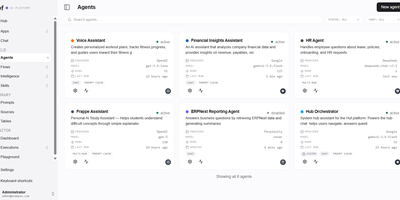
Give your team one console to build agents, ground them in real data, and reach them through email, Telegram, Slack, and WhatsApp: Huf is a self-hosted multi-agent AI platform running on servers you operate. Create agents visually, assign each one a provider and model, and watch runs, last activity, and status from a grid that shows every agent at a glance; the same console manages prompts, skills, flows, data tables, and knowledge sources. Connect agents to Gmail and email, Telegram, Slack, WhatsApp, and custom HTTP webhooks, and inbound messages trigger runs whose replies route back to the original channel automatically. Agents read, create, update, and delete any Frappe document, work ERPNext data, and call external systems through Model Context Protocol servers with managed OAuth credentials. Code-heavy tasks run in hardened execution profiles: a local Python environment, an isolated venv, direct SSH, a Frappe SSH connection, or a Docker container, each gated by role-based permissions for agents, tools, data tables, and MCP servers. Teams package prompt templates, tools, and MCP configurations into shareable skills and Huf Apps, run models from cloud providers, or keep everything local with Ollama, LM Studio, or any OpenAI-compatible endpoint. Running on a dedicated VPS on RepoCloud with guaranteed CPU, RAM, and SSD, full root SSH access, and a browser serial console. AGPL-3.0 licensed.
Retinue
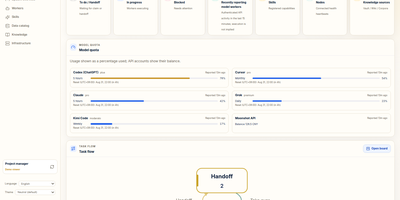
Retinue shows who is doing what across a fleet of AI agents, on a shared board where every task is a card with exactly one holder, a written acceptance check, and a receipt chain that cannot be rewritten. Operators publish cards, agents claim them through MCP or a token-scoped HTTP API, report progress, and hand off, and an agent that is not the holder gets a refusal when it tries to write. The Home dashboard counts what is waiting, running, and blocked, charts task flow and dispatch, and shows quota gauges for Claude, Codex, Cursor, Grok, and Kimi subscriptions. A collaboration workspace draws delegation graphs, device and model timelines, module contributions, and message conversations for any selected task. Operations pages report token usage by worker, and a data health page flags stale reports and duplicate identities. Read-only importers pull session data from Claude Code and Codex, and optional Lark, Feishu, and Telegram bridges turn chat messages into intents. The interface switches between English and Simplified Chinese. Running on a dedicated VPS on RepoCloud with guaranteed CPU, RAM, and SSD, full root SSH access, and a browser serial console. AGPL-3.0 licensed.