Backstage
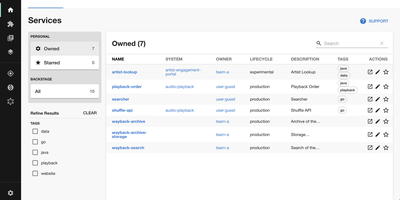
Adopted by over 3,400 companies and backed by 34,000 GitHub stars, Backstage is the open-source developer portal framework created by Spotify and now hosted by the Cloud Native Computing Foundation. The centralized Software Catalog registers every service, library, data pipeline, website, and ML model in your organization using YAML metadata files stored alongside code in GitHub, GitHub Enterprise, or GitLab, tracking ownership, lifecycle status, and dependency relationships across your entire ecosystem. Software Templates provide self-service infrastructure provisioning where developers fill out a form and Backstage automatically scaffolds new repositories, CI/CD pipelines, and cloud resources following your organization's standardized best practices. TechDocs renders Markdown documentation directly alongside the services it describes using a docs-like-code approach powered by MkDocs, with the TechDocs Addon Framework for extending the reading experience. The Search Platform indexes content across the catalog, TechDocs, Confluence, and Stack Overflow through configurable search backends. Kubernetes monitoring built specifically for service owners rather than cluster admins displays pod health, logs, and deployment status across any cloud provider or managed Kubernetes service. The plugin ecosystem includes over 230 open-source integrations covering CI/CD systems like GitHub Actions and GitLab Pipelines, monitoring platforms like Datadog and Grafana, cloud providers including AWS and Azure, plus specialized plugins for security scanning, cost management, API documentation, PagerDuty incident management, and Lighthouse website auditing. Running on a dedicated VPS on RepoCloud with guaranteed CPU, RAM, and SSD, full root SSH access, and a browser serial console. Apache-2.0 licensed.
Flowctl
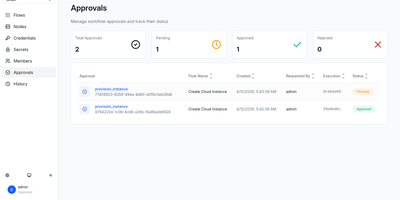
Flowctl turns repetitive ops work, such as granting SSH access, restarting a service, or provisioning a server, into self-service forms that anyone on the team can run without holding credentials. Each workflow is a YAML or HUML file with typed inputs, validation rules, and a list of actions. Actions run in order or as a dependency graph, so independent branches execute in parallel. Every action runs in a Docker container, as a shell script, or as another flow, and scripts can target remote servers over SSH, several at once. Sensitive steps pause until a reviewer approves or rejects them. Output from one action feeds the next, files pass along as artifacts, and failed actions can be retried. Cron schedules with time zones and labels run flows unattended, while logs stream live in the browser. Email, Slack, Mattermost, and webhook notifications announce success, failure, waiting, or cancellation. Teams get isolated namespaces with user, operator, reviewer, and admin roles, OIDC single sign-on, and encrypted storage for SSH keys and secrets. A built-in flow editor means nobody has to hand-write files, and custom executors can be added as Go plugins. Running on a dedicated VPS on RepoCloud with guaranteed CPU, RAM, and SSD, full root SSH access, and a browser serial console. Apache-2.0 licensed.
OpenChoreo
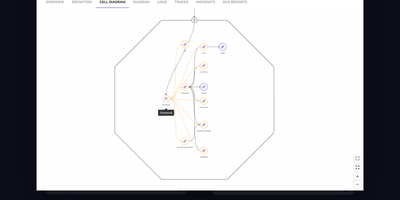
OpenChoreo gives developers a complete open-source internal developer platform for Kubernetes: a self-service portal to build, deploy, and run applications without wrestling raw cluster YAML. In the portal you create a component from source code or a container image, expose it through endpoints, and promote it across environments with a few clicks. Platform engineers define the golden paths behind that simplicity: component types, traits, and workflows set the rules for how workloads are built, secured, and connected. The control plane translates each declaration into the Kubernetes resources it needs, then keeps the portal in sync with what is actually running. Built-in CI builds from source with Buildpacks and Argo Workflows, and GitOps delivery keeps every environment reconciled with the declared state. Metrics, logs, and traces surface in the same portal, organized by component and environment instead of pod names and namespaces. Role-based access control, project isolation, and traffic policies draw the boundaries between teams, and platform analytics show how the platform itself is being used. Existing Backstage portals can adopt OpenChoreo as plugins, and developers can also work through the CLI, GitOps files, or AI agents. Running on a dedicated VPS on RepoCloud with guaranteed CPU, RAM, and SSD, full root SSH access, and a browser serial console. Apache-2.0 licensed.
MCP Gateway & Registry
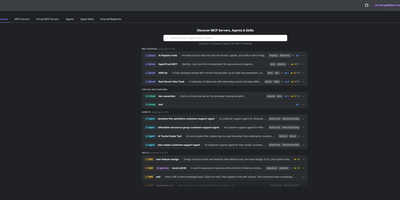
Every team wiring its own MCP servers by hand ends up with credentials scattered across dotfiles and no list of what exists; MCP Gateway and Registry replaces that with one governed front door. Register an MCP server, an A2A agent, a reusable skill, or a custom entity type once, and the Discover page lists it with tags, ratings, and search by natural language. Coding assistants and agents connect to a single authenticated gateway backed by Keycloak, Entra ID, Okta, Auth0, or Cognito, with scopes that decide who may call which tool. Virtual servers bundle tools from several backends behind one endpoint. Connected Accounts brokers third-party logins for Slack, Atlassian, and GitHub so tokens stay off laptops. Every registration is security scanned, and an admission gate holds unsafe items for review. The settings area offers audit log filtering with JSONL and CSV export, federation with outside registries, per-group rate limits, and a searchable configuration viewer. OpenTelemetry metrics and health checks are built in. Running on a dedicated VPS on RepoCloud with guaranteed CPU, RAM, and SSD, full root SSH access, and a browser serial console. Apache-2.0 licensed.