Nacos
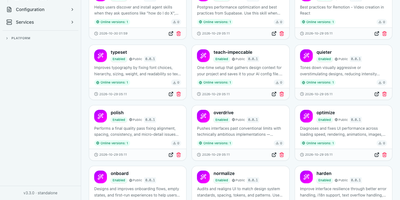
Every microservice has to find the others and learn its own settings, and Nacos is the discovery and configuration platform that answers both needs from a single server. Producers register instances with names, addresses, weights, and metadata, and consumers look services up or subscribe to changes, so a fresh instance receives traffic without hand-edited load balancer rules. Health checks drop dead instances from discovery results, while weight controls in the console shift traffic gradually during a rollout or drain a node before maintenance. Configuration lives apart from code: publish properties and YAML under a Data ID and Group, split environments with namespaces, and subscribed clients apply changes within seconds. History keeps every published version, so a typo is recoverable: rollback republishes an earlier value, and listener queries show which clients picked the change up. Gray releases push a new value to a chosen slice of instances first, so a risky flag reaches a fraction of the fleet before the rest. The registry covers AI building blocks too: MCP servers register their tools, prompts and skills carry versions and visibility, and agents publish discovery cards that gateways look up like any service. Spring Cloud, Dubbo, and Kubernetes workloads plug in through SDKs for Java, Go, Python, and other languages; run one standalone node for development or a Raft-backed cluster for production. Running on a dedicated VPS on RepoCloud with guaranteed CPU, RAM, and SSD, full root SSH access, and a browser serial console. Apache-2.0 licensed.
HashiCorp Consul
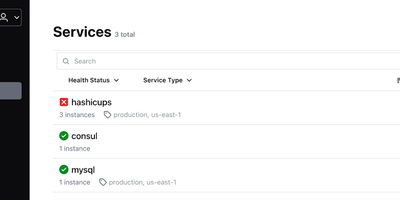
With nearly 30,000 GitHub stars and deployment across organizations including Criteo, Pandora, and Barclays, HashiCorp Consul is the industry-standard platform for service discovery, service mesh, and distributed configuration across dynamic multi-cloud and multi-datacenter infrastructure. Services register themselves and become discoverable via a built-in DNS interface on port 8600 or an HTTP API on port 8500, with health checks ensuring only healthy instances receive traffic through automatic catalog deregistration and service-level circuit breaking. The service mesh capabilities use Envoy sidecar proxies with Transparent Proxy mode to establish automatic mTLS encryption for all service-to-service communication, while identity-based intentions define fine-grained authorization rules controlling which services can communicate. The integrated API Gateway manages north-south traffic into the mesh with configurable routing rules, TLS termination, and header-based matching policies. Consul's distributed key-value store provides hierarchical configuration storage accessible via CLI, HTTP API, and the built-in web UI, with blocking queries enabling watch-based configuration updates without polling. Multi-datacenter federation connects Consul clusters across regions through WAN gossip and RPC forwarding, enabling cross-datacenter service discovery and failover with configurable prepared queries. The Raft consensus protocol provides strong consistency for the service catalog and KV store, with anti-entropy mechanisms ensuring agent state converges with the server catalog. Consul integrates natively with Kubernetes via Helm charts with automatic sidecar injection, Nomad for workload orchestration, Vault for secrets management, and Terraform for infrastructure provisioning. Running on a dedicated VPS on RepoCloud with guaranteed CPU, RAM, and SSD, full root SSH access, and a browser serial console. BUSL 1.1 licensed.
portracker
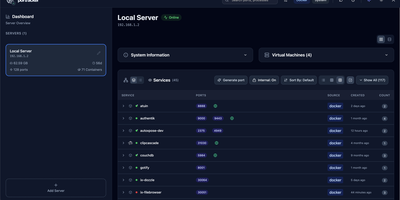
No spreadsheet has to track which service owns which port, because portracker discovers every service and port on your servers and keeps the list current from a self-hosted dashboard. Begin with a single port, shown with its owning service, its source (Docker or the host system), and its address, with internal container ports told apart from ports published to the host. Step back and ports gather into services: expandable cards carrying an icon, a health dot, and a port count, in list, grid, or table layouts, where a Why this status popover names the failing component and the rule that fired. Step back again and each server gets its own panel with hostname, OS, CPU, memory, and uptime, plus TrueNAS apps, VMs, and LXC containers once an API key is added. Step back once more and the whole fleet appears, because other portracker instances can be linked as peers, a VM's instance can be nested under its host, and every server can be searched at once. Along the way, rename services, hide the noisy ones, attach notes, act on a selection in bulk, or press Generate port for an unused number before deploying something new. Optional sign-in with a first-run setup wizard, an autoxpose link that shows public URLs and SSL status, light and dark themes, and keyboard shortcuts finish the picture. Running on a dedicated VPS on RepoCloud with guaranteed CPU, RAM, and SSD, full root SSH access, and a browser serial console. MIT licensed.
Compass
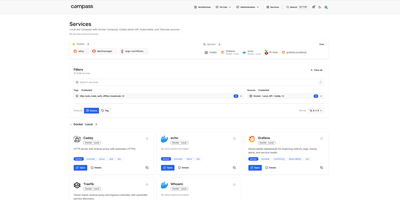
Every homelab outgrows the browser bookmark folder, and Compass answers by building the front page for you, discovering your services automatically instead of asking you to maintain cards by hand. Point it at Docker, Kubernetes, Tailscale, Headscale, NetBird, DNS records, a JSON API, or a plain static list, and it renders everything it finds as a searchable directory with icons, descriptions, and tags filled in from a catalog when a source leaves them blank. Each card shows whether the service is actually up, using the Prometheus or Gatus monitor you already run, and pinned and recent services keep daily tools one click away. Opening a service reveals its connection details, source metadata, extra links such as runbooks and health endpoints, and panels you embed from Grafana. Markdown pages live beside the directory, so architecture notes and on-call runbooks sit in the same navigation, with live service cards and charts embedded directly inside the prose. A debug view shows per-source health, what each source returned, and why a service you expected is missing, while group-based access decides which sources each person can see. Running on a dedicated VPS on RepoCloud with guaranteed CPU, RAM, and SSD, full root SSH access, and a browser serial console. Apache License 2.0 licensed.
etcd
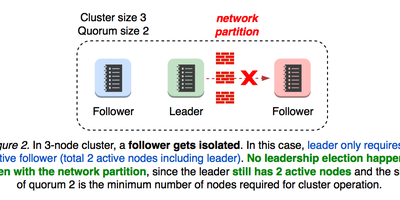
With over 52,000 GitHub stars and its role as the foundation of every Kubernetes cluster worldwide, etcd is the distributed key-value store that handles the most critical data in modern infrastructure — cluster state, configuration, service discovery, and distributed coordination. Built in Go and graduated from the CNCF, etcd uses the Raft consensus algorithm to maintain a strongly-consistent, highly-available replicated log across a cluster of machines, gracefully handling leader elections during network partitions and tolerating machine failure including the leader node. The gRPC API provides atomic key-value operations including put, get, delete, and transactions with multi-key compare-and-swap semantics, enabling distributed locking, leader election, and configuration management without external coordination. Watch operations stream real-time change notifications for specific keys or key ranges, powering reactive architectures that respond immediately to configuration updates. Version 3.7 introduces RangeStream for streaming large result sets in chunks, keys-only range requests for faster metadata queries, and bootstraps entirely from v3store after eliminating the legacy v2 store dependency. Automatic TLS encryption with optional client certificate authentication secures all cluster communication, while role-based access control restricts key access per user. The embedded bbolt B+ tree storage engine provides consistent reads and writes with configurable compaction policies. Benchmarked at 10,000 writes per second per instance with linearizable reads, etcd supports clusters of 3, 5, or 7 members for fault tolerance. Running on a dedicated VPS on RepoCloud with guaranteed CPU, RAM, and SSD, full root SSH access, and a browser serial console. Apache 2.0 licensed.