RisingWave
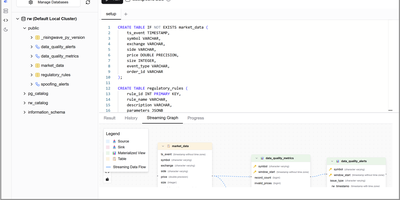
With over 9,100 GitHub stars and production deployments powering real-time analytics at companies like SHOPLINE where it reduced API latency by 76.7%, RisingWave is the PostgreSQL-compatible streaming database that collapses the traditional Debezium-plus-Kafka-plus-Flink-plus-serving-database stack into a single Rust-powered system. The platform continuously ingests data from PostgreSQL and MySQL via native CDC connectors that eliminate Debezium middleware, consumes Kafka, Redpanda, Pulsar, and Kinesis topics, accepts webhook events from SaaS applications, and batch-loads historical data from S3 and data warehouses. Standard SQL defines sources, materialized views, and sinks — no new DSL, no Java, and no custom API — while the PostgreSQL wire protocol means psql, DBeaver, pgAdmin, Grafana, Metabase, Superset, Tableau, and every PostgreSQL client library works without modification. Materialized views are incrementally maintained as events arrive, delivering point lookups in single-digit milliseconds without recomputing aggregates from scratch. For long-term retention, RisingWave writes to Apache Iceberg tables with a hosted REST catalog and automated table maintenance including compaction, small-file optimization, and snapshot cleanup, with data queryable by Spark, Trino, DuckDB, and DataFusion. The disaggregated compute-storage architecture uses S3-based state management for elastic scaling, instant failure recovery measured in seconds rather than the minutes-to-hours typical of RocksDB-based systems, and cost-efficient storage tiering. An MCP server enables AI agents to query and operate RisingWave directly. Running on a dedicated VPS on RepoCloud with guaranteed CPU, RAM, and SSD, full root SSH access, and a browser serial console. Apache 2.0 licensed.
Apache SeaTunnel
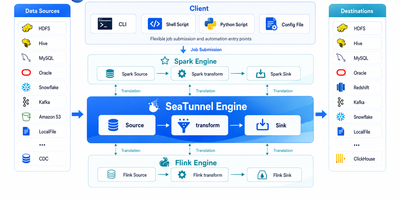
Apache SeaTunnel is a distributed integration platform that runs batch, streaming, and change-data-capture pipelines between databases, message queues, data lakes, lakehouses, and SaaS applications without hand-rolled scripts. Pipelines are declared once in a configuration file and executed on your choice of the native Zeta engine, Apache Flink, or Apache Spark, so the same job definition travels across engines without connector rewrites. Real-time CDC captures row changes from major databases with a snapshot-first handoff that never locks the source, while checkpoint-backed recovery restarts jobs from the last completed checkpoint with exactly-once semantics. When an upstream table gains a column, schema evolution propagates the change downstream automatically instead of pausing the pipeline for manual surgery. Roughly two hundred connectors cover relational databases, Kafka, object storage, search indexes, vector stores, and business apps, and the multi-table routing keeps every record on the right destination path. Engineers can dry-run configurations against sampled data before a full launch, isolate failures per table, and route bad records to dead-letter queues. Release 3.0.0 adds AI-assisted configuration generation from natural language, Python sources and transforms, and document parsing with text chunking for RAG preparation. Running on a dedicated VPS on RepoCloud with guaranteed CPU, RAM, and SSD, full root SSH access, and a browser serial console. Apache-2.0 licensed.
Fluvio
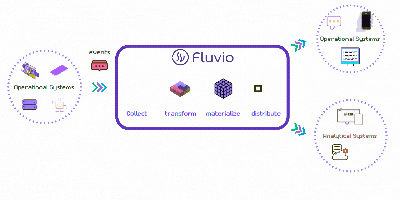
Fluvio is a distributed data streaming platform that moves records between your applications on partitioned topics and transforms them in flight with WebAssembly modules before they land anywhere. Producers publish to topics and consumers read at their own pace, with client libraries for Rust, Python, and JavaScript plus a full command line for producing and consuming interactively. SmartModules are reusable WebAssembly functions that filter, reshape, and enrich records inside the stream, so cleanup and routing logic runs once at the platform layer instead of inside every consumer. Stateful DataFlow builds continuous processing on top of the same streams, keeping state across records to aggregate, join, and react as data arrives. Inbound connectors collect from HTTP endpoints, webhooks, MQTT brokers, and Kafka clusters, and outbound connectors deliver to HTTP, SQL databases, and Kafka, with a development kit for building connectors to your own systems. A local cluster starts with one command for development, and the same platform deploys on Kubernetes for production streaming at the edge or in the cloud. Running on a dedicated VPS on RepoCloud with guaranteed CPU, RAM, and SSD, full root SSH access, and a browser serial console. Apache-2.0 licensed.
Apache Kafka
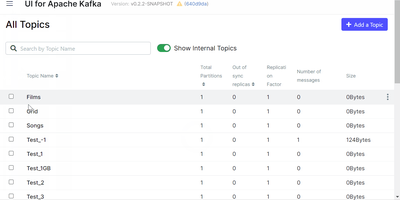
Used by over 80% of Fortune 100 companies including LinkedIn, Netflix, Uber, and Goldman Sachs, Apache Kafka processes trillions of messages per day as the world's most widely deployed distributed event streaming platform. Since version 4.0 released in March 2025, Kafka operates exclusively with KRaft consensus, replacing Apache ZooKeeper entirely with an internal Raft-based metadata quorum managed by controller nodes, reducing operational complexity and eliminating external coordination dependencies. Topics are organized as append-only partitioned commit logs with configurable replication factors across brokers, delivering network-limited throughput with end-to-end latencies as low as 2 milliseconds. Kafka Streams provides a client library for building stateful stream processing applications with exactly-once semantics, windowed aggregations, joins across streams and tables, and interactive queries against local state stores. Kafka Connect integrates with hundreds of systems including PostgreSQL, MySQL, Elasticsearch, Amazon S3, MongoDB, HDFS, and JMS through a standardized connector framework with distributed worker mode and automatic offset management. Share Groups introduced in version 4.2 deliver queue-style consumption semantics alongside traditional consumer groups, enabling Kafka to serve both pub-sub and point-to-point messaging patterns natively. The Schema Registry enforces Avro, Protobuf, and JSON Schema compatibility rules across producers and consumers, preventing schema evolution from breaking downstream applications. Tiered Storage offloads older log segments to object storage like S3 while maintaining transparent consumer access, dramatically reducing local broker storage costs for long-retention topics. Running on a dedicated VPS on RepoCloud with guaranteed CPU, RAM, and SSD, full root SSH access, and a browser serial console. Apache 2.0 licensed.
Apache StreamPipes
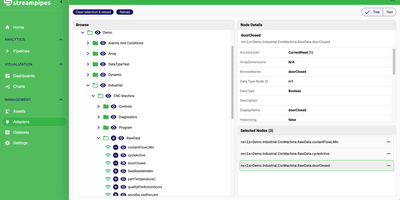
On the factory floor, the data already exists; it is just locked inside machines, PLCs, and protocols nobody on the analytics team speaks. StreamPipes unlocks it with guided adapters for OPC UA (including a web-based node browser), MQTT, Kafka, Pulsar, REST services, and industrial controllers, turning each source into a live stream in minutes. Domain experts then drag those streams into the pipeline editor, chain processors and sinks on a canvas, and watch connection validation check schema compatibility as they build, with live preview showing real values before anything is saved. Pipelines filter, enrich, aggregate, and route machine data, raise alerts, and write results to the built-in time-series data lake, where the data explorer charts history and spots trends. Finished pipelines run under an overview that starts, stops, and bulk-manages them, while detail views expose logs, metrics, status, and the pipeline as code. Live dashboards carry the same data to shop-floor screens and operations centers, organized around assets so a line, a cell, or a single machine becomes the navigation unit. Developers extend everything with custom adapters, processors, and sinks built on the Java SDK and deployed as microservices, or drive the platform from Python, Go, and Java clients. Running on a dedicated VPS on RepoCloud with guaranteed CPU, RAM, and SSD, full root SSH access, and a browser serial console. Apache-2.0 licensed.