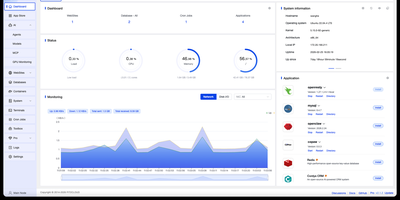
1Panel
Backed by over 36,000 GitHub stars and 120 contributors with 123 releases since 2022, 1Panel has rapidly become the go-to open-source alternative to cPanel and Plesk for modern Linux server management. The platform delivers a clean Vue.js dashboard powered by a Go backend using the Gin framework, providing visual management of Docker containers, images, networks, and volumes without touching the command line. Its curated app marketplace offers one-click installation of 165+ trusted open-source applications including Nextcloud, Bitwarden, Umami analytics, WordPress, and NocoBase, each running in isolated containers for maximum security. Native AI capabilities set 1Panel apart from every competing panel: deploy Ollama LLMs directly from the dashboard, spin up OpenClaw personal agents, monitor GPU utilization, and manage AI models through a unified interface. Website management includes automatic domain binding, Let's Encrypt SSL certificate provisioning, and Nginx configuration with zero manual setup. Security runs deep with built-in firewall rules, fail2ban integration, container isolation, WAF protection, and comprehensive audit logging enabled from day one. Automated backups support AWS S3, Cloudflare R2, and local storage with one-click restore from any snapshot. The panel supports Debian, Ubuntu, CentOS, and Rocky Linux across x86_64, aarch64, armv7l, ppc64le, and s390x architectures. Running on a dedicated VPS on RepoCloud with guaranteed CPU, RAM, and SSD, full root SSH access, and a browser serial console. GPL-3.0 licensed.
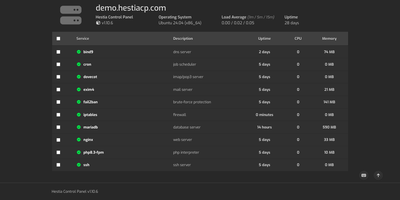
HestiaCP
Hestia Control Panel turns a fresh Debian or Ubuntu server into a multi-user hosting platform, with websites, email, DNS zones, and databases managed from one dashboard. Web domains run on Nginx with PHP-FPM or on Apache, pick a PHP version from 5.6 through 8.5, and get FastCGI or proxy caching and per-domain Let's Encrypt certificates, wildcards included. Quick Install App sets up WordPress, Drupal, Joomla, Laravel, Nextcloud, and more from the panel or the command line. Mail domains run Exim and Dovecot with ClamAV, SpamAssassin, DKIM, and Roundcube or SnappyMail, and rate limits apply per user or mailbox. BIND serves your own nameservers with DNSSEC and DNS clusters, and MariaDB, MySQL, and PostgreSQL come with phpMyAdmin and phpPgAdmin. Packages set per-user quotas, accounts get chrooted SFTP or SSH access, and users can enable two-factor authentication and SSH keys. Fail2ban, iptables rules, and ipset lists block brute-force attacks and bad addresses. Backups go to local disk, FTP, SFTP, or any of 50-plus Rclone cloud providers and restore from Hestia or VestaCP archives. Scoped access keys open a REST API, the v-command line interface scripts user, domain, and backup tasks, and a file manager and service monitor ship in the panel. Running on a dedicated VPS on RepoCloud with guaranteed CPU, RAM, and SSD, full root SSH access, and a browser serial console. GPL-3.0 licensed.
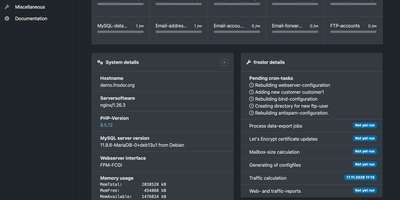
Froxlor
Froxlor lets an administrator host many customers on Debian and Ubuntu servers, with resellers, resource limits, and every service managed from one browser panel. Customers get their own panel for domains, subdomains, email, FTP accounts, and MySQL databases, and resellers receive a pool of resources to hand out. Domains can run on Apache 2.4 or Nginx, use a PHP-FPM configuration chosen per domain, and bind to specific IPv4 addresses, IPv6 addresses, or ports. Let's Encrypt certificates are issued and renewed from the panel, customers can store their own certificate per domain, and Nginx domains can enable HTTP/3. Email addresses, forwarders, and catchall mailboxes run on Postfix and Dovecot, and Rspamd spam filtering is tuned for each email account. Bind9 or PowerDNS serves the DNS zones, and ProFTPd provides FTP accounts with their own directories. Customers can add SSH keys for shell access, protect directories with passwords, set path options, and export their data. Traffic for HTTP, FTP, and mail is collected per customer and charted by month, and several MySQL servers can be assigned to customers. A JSON API with per-user keys, a console tool, and a CSV domain importer cover automation, and the interface can be themed. A configuration page shows ready-made service templates for the chosen distribution and exports the selection as JSON for use on another server. Running on a dedicated VPS on RepoCloud with guaranteed CPU, RAM, and SSD, full root SSH access, and a browser serial console. GPL-2.0-or-later licensed.
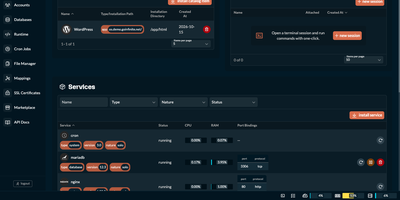
Infinite OS
Infinite OS packs a complete hosting environment into a single Docker container, and you decide what it hosts after it starts. From the dashboard you add the runtimes, databases, domains, and applications that a normal image would have forced you to choose at build time. Open the Marketplace and WordPress, n8n, or dozens of other applications install in a few clicks, dependencies and services included, with a hostname and route created automatically. PHP, Node.js, Bun, Python, Ruby, and Java runtimes install on demand beside databases and workers, so one project runs its whole stack inside one environment. Public domains get free TLS certificates automatically, and changing the primary domain once updates the web server, PHP, and database records to match. The built-in web terminal needs no SSH setup, and a coding agent such as OpenCode can work there with the project files, runtimes, and databases within reach. A file manager, cron scheduler, PHP version switching, and per-route rate, bandwidth, and connection limits cover the daily work of running sites from the browser. Team accounts give each person their own login, and nearly every dashboard action has a matching CLI command and REST API call for scripting. Each project gets its own container with its own filesystem and services, so unrelated sites stay isolated while several lightweight environments share one machine. Running on a dedicated VPS on RepoCloud with guaranteed CPU, RAM, and SSD, full root SSH access, and a browser serial console. EPL 2.0 licensed.
Laranode
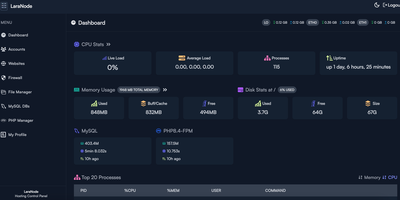
Built for self-hosted server deployments, Laranode transforms bare Linux installations into multi-tenant web hosting platforms with automated Let's Encrypt certificates and isolated PHP environments without recurring license fees. System administrators can provision isolated user accounts with dedicated document roots, configure custom domains, and deploy SSL certificates across all active websites in seconds. The integrated PHP manager enables per-site runtime isolation from legacy PHP 7.4 through cutting-edge PHP 8.5 releases, preventing version conflicts between separate production web applications. Operators can create MySQL databases, manage database users, inspect active connections, and adjust UFW firewall port access directly from the visual dashboard. An integrated browser-based file manager lets developers browse directories, edit configuration files, extract compressed archives, and modify file permissions without external FTP tools. Real-time telemetry monitors CPU utilization, memory consumption, disk capacity, and network traffic over customizable historical timeframes to catch bottlenecks early. Automated backup routines archive full accounts, individual websites, or specific databases to local storage, remote SFTP servers, or S3-compatible cloud object stores with point-in-time recovery verification. Running on a dedicated VPS on RepoCloud with guaranteed CPU, RAM, and SSD, full root SSH access, and a browser serial console. MIT licensed.
FeatherPanel
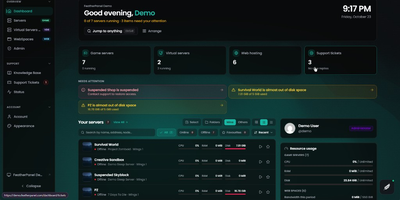
FeatherPanel is one control panel for game servers, Proxmox virtual machines, and web hosting, so a small host stops juggling three different admin tools to run its infrastructure. Game servers deploy from spells (the egg system Pterodactyl users will recognize, with egg imports supported) and open into a live websocket console with power actions, install logs, and CPU, memory, and disk graphs. The built-in file manager browses, edits, uploads, archives, and shares server files, while per-server databases, scheduled backups with retention limits, cron-style schedules, and lifecycle hooks automate the routine work around each server. Virtual machines and containers come from Proxmox nodes with browser VNC consoles, snapshots, ISO mounting, and reinstalls, and web hosting accounts get domains, SSL, databases, mailboxes, one-click WordPress and other apps, and Git deployment in the same UI. Customers help themselves through support tickets, a knowledgebase, and a public status page, while subusers receive fine-grained permissions instead of shared passwords. Plugins and themes from the marketplace extend the panel, a REST API and MCP server connect external tools and AI assistants, and any of the three hosting modules can be switched off when you only need part of the stack. Running on a dedicated VPS on RepoCloud with guaranteed CPU, RAM, and SSD, full root SSH access, and a browser serial console. AGPL-3.0 licensed.
Paymenter
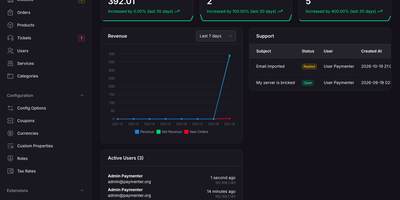
Hosting companies that sell VPS plans, game servers, or dedicated machines get a branded storefront, recurring billing, and a ticket desk from Paymenter, running on their own server. A customer browses a category, picks a free, one-time, or recurring plan billed every few days, weeks, months, or years, and shapes the order with select, radio, checkbox, text, number, or textarea options, some of which carry their own price. Prices can differ per currency, and a setup fee is optional. Payment runs through Stripe, PayPal, or Mollie, with tax rates and coupons set from the admin panel. Once it clears, a server extension for Pterodactyl, Virtualizor, VirtFusion, Convoy, cPanel, Plesk, DirectAdmin, or Enhance creates the service. A daily job issues renewal invoices, suspends overdue accounts, and terminates long-overdue ones. The customer portal covers services, invoices, and tickets in 24 languages, and tickets accept replies by IMAP email piping. Staff work with roles, audit logs, email logs, and notification templates, while API keys and OAuth clients connect outside tools. Optional extensions add an affiliate program, announcements, and Discord alerts. Moving over from WHMCS takes one built-in command that imports clients, products, services, tickets, and invoices from a copy of your database. Running on a dedicated VPS on RepoCloud with guaranteed CPU, RAM, and SSD, full root SSH access, and a browser serial console. MIT licensed.