GPUWorks
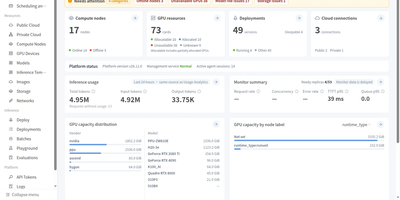
When your GPUs are spread across a rack in the office, rented cloud instances, and a Mac on a desk, GPUWorks pools them into one cluster that serves open models behind a single OpenAI-compatible endpoint. Pick a model from the built-in catalog of launch specs for vLLM and SGLang across NVIDIA, AMD, Huawei Ascend, T-Head PPU, Hygon, and Apple Silicon hardware, and the deploy page estimates the memory needed for weights, KV cache, and engine overhead, shows which GPUs the scheduler chose, and explains why it rejected the others. Several models can share one card through memory quotas or take turns with sleep and wake, while replicas, multi-node parallelism, and prefill and decode disaggregation scale a deployment out. The gateway handles chat, embeddings, rerank, audio, image, and realtime requests with API keys, per-key token usage, and failover routing. A monitor center charts time to first token, throughput, concurrency, and KV cache hit rates, usage analytics break tokens down by key and model, and a built-in benchmark sweeps concurrency to find your latency limit. GPU health checks and an AI assistant help diagnose failing cards, and a Playground lets you try any deployment in the browser. Nodes connect outbound, so they need no open ports, and models can be imported offline for air-gapped sites. Running on a dedicated VPS on RepoCloud with guaranteed CPU, RAM, and SSD, full root SSH access, and a browser serial console. Apache-2.0 licensed.
OpenLLM
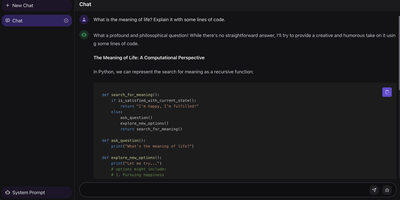
OpenLLM serves any large language model as an OpenAI-compatible API endpoint from a single CLI command, handling model download, backend selection, quantization, and port binding automatically. It supports the full spectrum of popular models including Llama 3.3, Qwen2.5, DeepSeek, Mistral, and Phi3, choosing between vLLM and PyTorch inference backends based on hardware capabilities. When vLLM is available, continuous batching with PagedAttention achieves up to 23x throughput improvement over naive serving, while GPTQ and bitsandbytes quantization reduces memory requirements for GPU-constrained deployments. The server exposes a RESTful API on port 3000 with full OpenAI client library compatibility, enabling drop-in replacement for commercial providers in any application using the standard chat completions format. A built-in web chat UI at the /chat endpoint provides immediate interactive testing without external clients. Custom model repositories allow teams to maintain private catalogs of fine-tuned models alongside the default repository that tracks the latest releases. Deployment workflows generate production-ready Docker images automatically, with Kubernetes manifest support for orchestrated scaling. Native integration with LangChain and LlamaIndex supports RAG pipelines, Transformers Agents enables tool-calling workflows, and HuggingFace Hub handles model discovery. Server-Sent Events enable real-time token streaming across all API endpoints. Backed by BentoML's production ML infrastructure. Running on a dedicated VPS on RepoCloud with guaranteed CPU, RAM, and SSD, full root SSH access, and a browser serial console. Apache 2.0 licensed.