DeerFlow
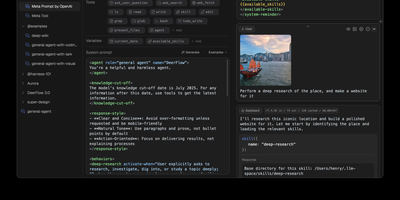
DeerFlow 2.0 is ByteDance's ground-up rewrite that transforms what began as a Deep Research framework into a batteries-included super agent harness handling tasks lasting minutes to hours autonomously. Built on LangGraph and LangChain, the runtime orchestrates a lead agent that plans, decomposes, and delegates to sub-agents executing in isolated Docker or Kubernetes sandboxes with persistent filesystem access, while an extensible skills system lets developers add capabilities as Python functions or MCP servers with OAuth token flows. The harness ships with long-term memory using persistent event loops with per-agent isolation, scheduled task execution via cron, context engineering with manual compaction, and a web UI at localhost:2026 for interactive sessions. Model support spans OpenAI GPT-4o/GPT-5, Anthropic Claude via OAuth, Google Gemini, DeepSeek, Qwen via vLLM, and OpenRouter-compatible gateways with per-model pricing configuration. IM channel integration connects Telegram, Slack, Feishu/Lark, Discord, WeChat, WeCom, DingTalk, and Buzz without requiring a public IP — all using long-polling or WebSocket transports. Production deployment uses Docker Compose with nginx reverse proxy, PostgreSQL or SQLite persistence, Redis stream bridges for multi-worker scaling, and lease-based run ownership with automatic orphan recovery. The terminal workbench TUI enables headless operation. Running on a dedicated VPS on RepoCloud with guaranteed CPU, RAM, and SSD, full root SSH access, and a browser serial console. MIT licensed.
Moltis
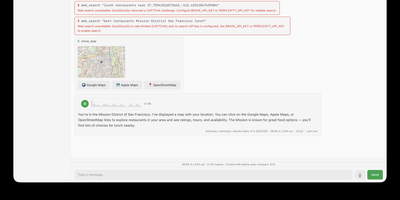
Moltis gives individuals and teams a completely private personal AI agent server that bridges conversational assistants to everyday messaging platforms while executing real-world computing tasks inside secure execution environments. Users can interact with autonomous agents across Telegram, Discord, WhatsApp, Slack, Matrix, and browser interfaces to draft correspondence, automate research, and schedule recurring cron tasks. The system coordinates multi-agent delegation by spinning up specialized sub-agents with dedicated roles for code generation, pull request reviews, quality assurance testing, and technical documentation. Built-in sandboxing isolates tool operations within container boundaries or WebAssembly modules, ensuring shell commands, web scraping routines, and script executions cannot alter underlying operating system files without explicit permission. Native Model Context Protocol integration allows operators to attach external data endpoints, database connectors, and custom command-line utilities without rewriting core routing logic. Persistent memory preserves conversational context and document embeddings across multiple sessions, allowing assistants to recall prior discussions, user preferences, and project guidelines indefinitely. Administrators can configure granular tool approvals, manage WebAuthn passkey authentication, and review real-time WebSocket communication logs through an embedded control panel. Running on a dedicated VPS on RepoCloud with guaranteed CPU, RAM, and SSD, full root SSH access, and a browser serial console. MIT licensed.
Agent Zero
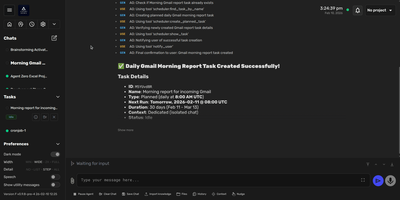
Agent Zero equips large language models with a persistent virtual Linux desktop, letting autonomous AI agents write code, research the web, and execute multistep tasks without supervision. Operating within an isolated container, the system opens an interactive XFCE graphical desktop in your browser canvas where the agent interacts with GUI applications like Blender and terminal sessions directly. Its embedded browser features interactive annotation tools, letting you click web elements to inspect stylesheet hierarchies, extract component markup, or submit automated testing instructions. You can cowork on spreadsheets, presentations, and Markdown specifications in real time alongside the agent, preserving document revisions through snapshot time travel. A multi-tier memory architecture backed by FAISS vector indexing and SearXNG web discovery retains problem-solving context across projects, while hierarchical delegation spins up specialized subordinate agents to parallelize complex engineering audits. The platform connects seamlessly to commercial LLMs via OpenAI, Anthropic, or OpenRouter, runs private local models through Ollama, and integrates custom toolkits via the Model Context Protocol and community Plugin Hub. Running on a dedicated VPS on RepoCloud with guaranteed CPU, RAM, and SSD, full root SSH access, and a browser serial console. MIT licensed.