PostgreSQL
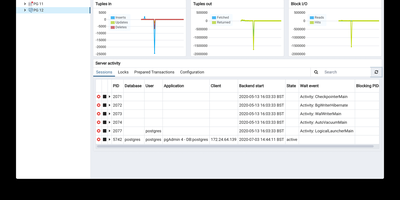
Consistently ranked the most loved and most wanted database in developer surveys, PostgreSQL powers mission-critical workloads at Apple, Instagram, Spotify, and the U.S. Federal Aviation Administration with an architecture refined over nearly four decades since its origins at UC Berkeley. Its native JSONB type stores JSON in an indexed binary format with GIN and GiST index support, enabling document-store capabilities that eliminate the need for a separate NoSQL database in many architectures. The extension ecosystem exceeds 1,000 add-ons: PostGIS provides ISO-compliant geospatial queries, pgvector enables AI embedding similarity search, TimescaleDB adds time-series hypertable compression, and Citus distributes tables across nodes for horizontal scaling. PostgreSQL supports declarative partitioning by range, list, or hash, parallel query execution across multiple CPU cores, and four transaction isolation levels including full Serializable. Streaming replication provides physical standby servers with synchronous or asynchronous modes, while logical replication enables selective table-level change data capture through the Write-Ahead Log. Stored procedures run in PL/pgSQL, PL/Python, PL/Perl, and PL/V8 JavaScript, and advanced indexing includes B-tree, GIN, GiST, SP-GiST, BRIN, and hash types. Full-text search is built in with tsvector and tsquery, and row-level security policies enforce fine-grained access control. Running on a dedicated VPS on RepoCloud with guaranteed CPU, RAM, and SSD, full root SSH access, and a browser serial console. PostgreSQL License (MIT-like permissive) licensed.
Autobase
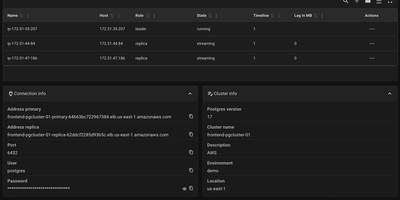
Provisioning, scaling, and maintaining production-grade PostgreSQL clusters becomes completely automated with Autobase, an internal database-as-a-service control plane. Through a unified web console, database administrators provision multi-node replication topologies, execute non-disruptive minor version updates, and orchestrate automated failovers without manual intervention. Operators can configure continuous physical backups and point-in-time recovery to S3-compatible object storage, ensuring resilient disaster recovery for mission-critical workloads. The integrated dashboard provides granular visibility into cluster topology, replication lag, connection pool saturation, and query throughput across primary and replica instances. Teams can scale read capacity on demand by provisioning dedicated read replicas and load-balanced query endpoints managed by intelligent routing layers. Comprehensive backup verification routines run scheduled restore rehearsals to confirm data integrity before emergencies occur. Automated maintenance playbooks handle index reindexing, vacuum scheduling, and parameter tuning without requiring custom shell scripts. Running on a dedicated VPS on RepoCloud with guaranteed CPU, RAM, and SSD, full root SSH access, and a browser serial console. MIT licensed.