GoCD
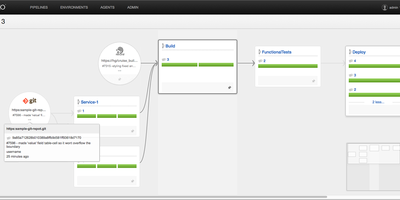
GoCD treats delivery as a pipeline you can see: every commit enters a sequence of stages, passes or fails in the open, and travels from first build to production deployment along one visible, traceable path. Stages split work into jobs that run in parallel on a fleet of agents, so unit tests, integration suites, packaging, and security scans finish together instead of queueing behind each other. Pipelines connect with fan-in and fan-out dependencies, meaning a release pipeline waits for every upstream component to pass before it assembles them, and one library build can feed a dozen services. The value stream map draws that whole web on one screen, from the triggering commit through every stage to deployment, and any run can be compared with another to spot exactly what changed. Materials watch Git, Subversion, or Mercurial repositories and start pipelines on new commits, while artifacts produced by one stage are fetched, versioned, and promoted by the stages after it. Environments group pipelines and agents so test and production stay isolated, resources tag agents by capability, and elastic agents appear on Docker, Kubernetes, or cloud hosts only while work exists. Pipeline definitions can live in YAML or JSON inside a repository, changing through code review like the software they deliver, and templates keep repeated release patterns consistent across teams. Running on a dedicated VPS on RepoCloud with guaranteed CPU, RAM, and SSD, full root SSH access, and a browser serial console. Apache-2.0 licensed.
GitLab
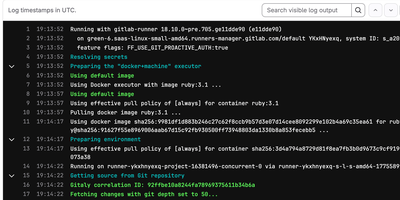
Used by over 100,000 organizations and ranked first in the Gartner Magic Quadrant for DevOps Platforms, GitLab is the open-core DevSecOps platform that delivers the complete software development lifecycle — from planning and source code management through CI/CD, security scanning, and monitoring — in a single self-managed application. The built-in CI/CD engine executes pipelines defined in YAML with parallel jobs, directed acyclic graph scheduling, multi-project pipelines, and auto-scaling runners on Docker, Kubernetes, or bare metal. Merge requests provide inline code review with approval rules, code owners, merge trains for serialized merging, and five merge strategies including fast-forward and semi-linear history. The integrated container registry stores Docker images alongside code, while the package registry supports npm, Maven, NuGet, PyPI, Conan, Go, and generic packages. Issue boards with epics, milestones, and labels enable agile planning, while the built-in wiki and GitLab Pages provide documentation hosting and static site publishing. Security scanning in the Community Edition includes basic SAST, secret detection, and container scanning running as pipeline jobs. The Omnibus installer bundles Rails, Puma, Gitaly, Workhorse, Nginx, PostgreSQL, Redis, Sidekiq, and Prometheus into a single package installable in minutes, while Docker and Helm chart options support containerized and Kubernetes deployments. GitLab Duo AI assists with code suggestions, merge request summaries, and vulnerability resolution. Running on a dedicated VPS on RepoCloud with guaranteed CPU, RAM, and SSD, full root SSH access, and a browser serial console. MIT licensed.
Gerrit Code Review
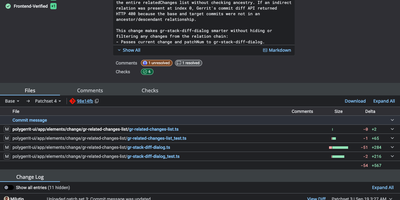
Unlike pull-request forges, Gerrit reviews every Git change as a series of patchsets, and nothing merges until the required approvals are in. Developers upload with a plain git push to a refs/for ref, adding push options for topics, hashtags, work-in-progress, or private changes. Each change gets a page listing reviewers, CCs, an attention set that flags who must act next, and submit requirements driven by labels such as Code-Review and Verified, with a quick approve button for the last missing vote. Side-by-side diffs with syntax highlighting take inline comments written in Markdown, saved as drafts and published together. A Checks tab shows CI runs reported by plugins, and integrations reach Jenkins, GitHub Actions, Zuul, and webhooks. Access rights attach to groups and branch patterns, including regular expressions, and inherit from parent projects and All-Projects. Sign-in works with LDAP, OAuth, OpenID, or HTTP single sign-on, and SAML through a plugin. A query language filters changes by status, owner, reviewer, label, file path, and reviewer count. Projects pick a submit strategy: merge if necessary, fast forward only, rebase if necessary, rebase always, merge always, or cherry pick. A REST API, SSH commands, and a plugin system extend the server, and an optional Review Agent chat panel can summarize a change once an AI provider plugin is installed. Running on a dedicated VPS on RepoCloud with guaranteed CPU, RAM, and SSD, full root SSH access, and a browser serial console. Apache-2.0 licensed.