ArchivesSpace
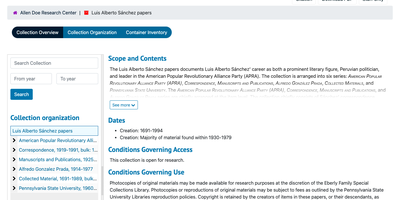
ArchivesSpace manages an archive from the moment a donation arrives to the day a researcher finds it online. Accession records capture what was received, whether a single item or a large aggregation, and can be spawned into other record types so details are never retyped. Resource records describe a collection as a tree of series, files, and items with dates, extents, notes, and rights statements, while digital object records point to born-digital files and digitized surrogates held elsewhere. Shared subject and agent records give persons, families, organizations, and software one set of authority terms linked across accessions, resources, and digital objects. Assessment records rank condition and research value, and location records track the shelves, drawers, and bins where boxes sit. Staff move data with spreadsheet importers and with EAD, EAC-CPF, MARCXML, METS, MODS, and Dublin Core, and an OAI-PMH responder lets aggregators harvest published records. The optional public interface offers keyword search, year ranges, and filters, plus browsing by collection, subject, and name, with a switcher for six languages, and shows only records a staff member has deliberately published. Several repositories can share one installation, each user receives granular permissions, and the REST API, plugins, and LDAP sign-in connect it to the rest of an institution. Running on a dedicated VPS on RepoCloud with guaranteed CPU, RAM, and SSD, full root SSH access, and a browser serial console. ECL-2.0 licensed.
CollectiveAccess Providence
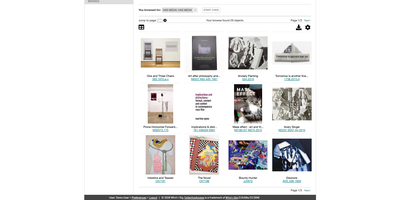
For a museum, archive, or research collection that must describe everything it holds in its own metadata terms, CollectiveAccess Providence offers a web-based catalogue that needs no custom programming. Objects, entities, places, collections, storage locations, and loans link through bi-directional relationships with configurable types such as creator, donor, or subject, and DACS, Dublin Core, and VRA Core come pre-loaded. Fields, entry screens, search displays, and reports are defined in the web interface or an XML installation profile with validation for dates, measurements, and URLs; images, video, audio, PDFs, and 3D scans open in browser viewers with pan and zoom. Mapping files import Excel, CSV, XML, and MARC data in bulk, exports cover OAI-PMH formats such as EAD and Dublin Core plus finding aids and reports, and Getty vocabularies and Library of Congress services supply controlled terms. Staff check items in and out like a library, follow location and provenance history over time, and share sets of records with collaborators. Access can be limited by user or group down to specific fields or record types, logins can use LDAP, and every edit is logged with a user and timestamp. MD5 fixity checks arrive by email, BagIt packages support preservation, an optional GraphQL API handles search, browse, and editing, and a separate companion, Pawtucket2, can publish the catalogue as a public website. Running on a dedicated VPS on RepoCloud with guaranteed CPU, RAM, and SSD, full root SSH access, and a browser serial console. GPL-3.0 licensed.