RAGOps Observatory
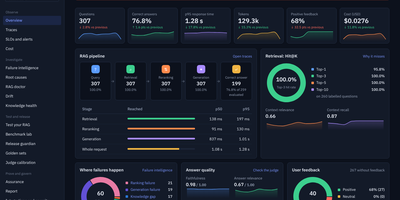
Between a RAG demo that looks fine and an assistant that fails quietly in production sits RAGOps Observatory, a platform that names the broken pipeline stage and blocks worse releases. Failed answers are assigned to one of seven stages, from knowledge gap and chunking to ranking and generation. An evidence graph links documents, retrieved passages, and answer claims, marking claims supported, contradicted, or sourceless. Failure intelligence groups recurring problems as new, growing, steady, or shrinking, so one fix can retire a whole pattern. The release guardian compares a candidate with the current version on the same questions and answers Pass, Review, or Block against your gates, logging every decision. A metric regression blocks only when statistically significant. The benchmark lab sets two to five runs side by side across models, retrievers, rerankers, or chunk sizes. The assurance report writes tests from your documents, including prompt-injection probes, then issues a sealed Ready or Not ready verdict with supporting evidence mapped to the EU AI Act. When answers go wrong, the RAG doctor re-runs your pipeline with candidate fixes and recommends only the one that verifiably helps. SLOs with error budgets, drift checks, cost tracking, and Slack, Teams, PagerDuty, or e-mail alerts cover monitoring. Use it to explain a quality drop, prove a new chunk size is safe, or give a reviewer evidence. Running on a dedicated VPS on RepoCloud with guaranteed CPU, RAM, and SSD, full root SSH access, and a browser serial console. MIT licensed.
Rhesis
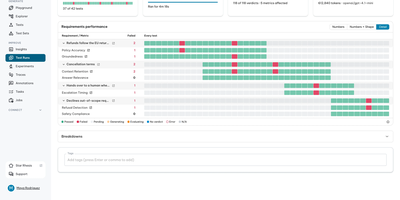
The people who know what an AI agent should answer rarely build it, so Rhesis gives them a browser link to chat with it, mark replies pass or fail and turn the misses into tests. Connect an agent through the SDK connector, an outbound WebSocket that needs no public URL, or register a REST endpoint with bearer or OAuth 2.0 authentication and JSONPath mapping. The Playground chats with the live endpoint, splits into two conversations side by side, opens the trace behind any reply and saves a conversation as a test. Architect reads a PRD you name in chat, proposes requirements, metrics and test sets, waits for approval, runs them and charts the results. Tests can also be generated from requirements, a PRD or an uploaded file, imported from garak, or simulated as multi-turn conversations by Penelope. Each test run shows pass rate, cost and a requirement-by-test grid of verdicts. Reviewers annotate a whole result, one metric or a single turn, and the original score stays on record. Experiments compare prompt, model or retrieval versions on one test set, and OpenTelemetry tracing records latency, tokens and cost for LangChain, LangGraph, Pydantic AI and Google ADK agents. Notion, GitHub, Jira and Confluence feed requirements, and an agent skill lets Cursor or Claude Code drive the workspace. Running on a dedicated VPS on RepoCloud with guaranteed CPU, RAM, and SSD, full root SSH access, and a browser serial console. MIT licensed.