Sulu
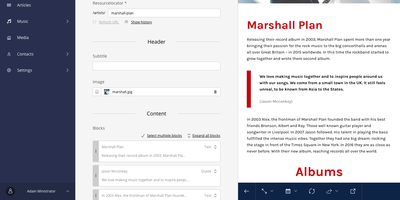
Running several multilingual websites does not mean juggling several admins: Sulu is a content management system that hosts them all in one, with a live preview beside every form. Webspaces are separate websites, each with its own page tree, languages, domains, and permissions. Pages are built from templates of fields and reorderable blocks, grouped under Content, SEO, Excerpt, and Settings tabs. Unsure how a page will look in search? The SEO tab previews it, counts characters in the meta title and description, and offers keywords, a canonical URL, and no-index and no-follow switches. Changing a page address automatically redirects the old one. Files stay organized in nestable media collections with grid and list views, and images are resized automatically to the formats a design asks for. Snippets hold content shared across pages, and smart content assembles dynamic lists of pages, contacts, or organizations. Landing pages get their own custom URLs, and target groups can show different content at the same address to different visitors. Editors who should not see everything get roles with view, add, edit, and delete rights per webspace. An activity log lists changes, and the trash restores deleted items. Contacts and organizations live in the same interface, and developers can add their own admin sections with lists, forms, and preview. Running on a dedicated VPS on RepoCloud with guaranteed CPU, RAM, and SSD, full root SSH access, and a browser serial console. MIT licensed.
Strapi
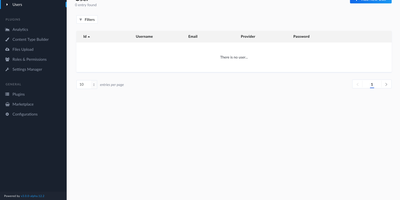
The leading open-source headless CMS with over 72,800 GitHub stars and more than 20 million npm downloads, Strapi has powered content APIs for thousands of organizations since its creation in 2015, providing a complete backend for websites, mobile applications, IoT devices, and any frontend framework through auto-generated REST and GraphQL endpoints. The visual Content-Type Builder lets editors define collections, single types, components, dynamic zones, and relations without code, while Strapi AI introduced in 2026 generates complete content schemas from natural language descriptions, Figma file uploads, or existing JavaScript application code analysis. Version 5 rewrote the platform with a TypeScript-first architecture, replacing the Entity Service with the Document Service API, switching admin panel builds from Webpack to Vite, and integrating internationalization directly into core with unlimited locale support. Database flexibility spans PostgreSQL, MySQL, MariaDB, and SQLite with automatic migration handling. The media library manages uploads to local storage, Amazon S3, or Cloudinary with image optimization and responsive formats. Granular role-based access control defines permissions per content type, field, and locale. The plugin marketplace extends functionality with GraphQL, SEO, email, custom fields, and community contributions, while lifecycle hooks, custom controllers, and middleware enable arbitrary backend logic. Draft and publish workflows, webhooks for external system integration, API token authentication, data import and export, and CRON job scheduling round out a platform that handles content operations from prototype to production. Running on a dedicated VPS on RepoCloud with guaranteed CPU, RAM, and SSD, full root SSH access, and a browser serial console. MIT licensed.
Umbraco CMS
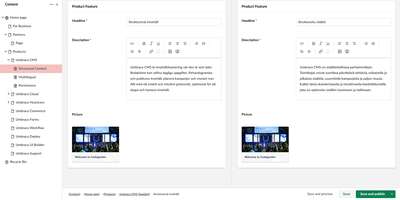
If editors should publish without waiting on developers, and developers should keep full control of the design, Umbraco is the free content management system built around that split. A page begins in the Block Grid editor, where reusable blocks nest inside Areas and each block is sized on a column and row grid. Live preview shows the result before anything goes out. Publish and unpublish times can be scheduled in the editor's own time zone, and any page can roll back to an earlier version from its Info tab. One content node can exist in several languages, and split view puts two of them side by side. The Media section holds images, video, and other files. Visitors can register and log in as members, new members can be placed in member groups, and pages can be hidden from anyone not logged in. On the code side, templates and partial views shape the front end, while the opt-in Content Delivery API returns content items as JSON for mobile apps and any other front end. Webhooks notify outside services when content is published, unpublished, or deleted. Custom dashboards and property editors extend the backoffice, and the Marketplace lists open-source and commercial packages for the rest. Running on a dedicated VPS on RepoCloud with guaranteed CPU, RAM, and SSD, full root SSH access, and a browser serial console. MIT licensed.