CertMate
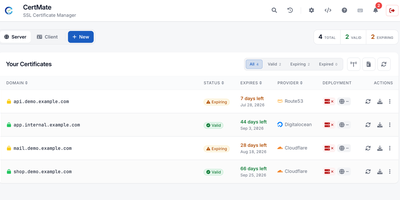
Certificate lifetimes are collapsing toward 47 days, which turns TLS from a yearly chore into a weekly one, and CertMate is the control plane that makes that schedule boring. It issues and renews certificates from Let's Encrypt, ZeroSSL, Google Trust Services, Actalis, DigiCert, SSL.com, Sectigo, or your own private CA, validating by DNS-01 through 29 DNS providers, HTTP-01, or a CSR whose private key never leaves the device. Renewals run automatically, earlier when a certificate's life is short or the CA moves the date through ARI, and deploy hooks push each renewed certificate where it is actually served, then probe the live endpoint to prove the new certificate answers. Discovery watches hosts and certificate transparency logs for certificates you did not issue, folding them into one inventory of what is served where and when it expires. Certificates rest on local disk or in Azure Key Vault, AWS Secrets Manager, HashiCorp Vault, Infisical, or S3 storage, with encrypted backups copied off-site. Its built-in CA issues client certificates for mTLS with OCSP and CRL, and can serve ACME itself, so certbot, lego, acme.sh, and cert-manager get internal certificates under EAB rules you define. Every action lands in a tamper-evident, hash-chained audit trail you can export and verify independently. Running on a dedicated VPS on RepoCloud with guaranteed CPU, RAM, and SSD, full root SSH access, and a browser serial console. MIT licensed.
Certimate
Automate your entire SSL and TLS lifecycle with Certimate, an infrastructure-grade certificate management platform that handles domain verification, ACME issuance, scheduled renewals, and multi-cloud deployment from one unified control plane. A drag-and-drop workflow designer lets administrators construct visual pipelines linking domain validation, certificate issuance from Let's Encrypt or ZeroSSL, and automated distribution to edge destinations. Built-in automation interfaces connect with over seventy DNS providers to handle automated DNS-01 challenge record creation and cleanup without manual API scripting. Engineers can deploy renewed certificates directly to Nginx, Apache, Traefik, and Caddy instances via automated SSH commands or native webhooks. Cloud delivery workflows push updated certificates to AWS CloudFront, Cloudflare, Alibaba Cloud, Tencent Cloud, and Kubernetes Ingress secrets without service interruption. The web management console tracks expiration dates across multiple domains, highlights failing renewal attempts, and dispatches instant alerts through email, Telegram, DingTalk, and enterprise webhooks before outages occur. Running on a dedicated VPS on RepoCloud with guaranteed CPU, RAM, and SSD, full root SSH access, and a browser serial console. MIT licensed.
Ultimate Certificate Manager
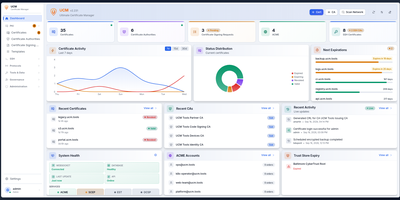
Ultimate Certificate Manager, or UCM, runs your own certificate authority from a web interface, so issuing, renewing, and revoking certificates stops being a pile of OpenSSL commands. Create root and intermediate CAs, arrange them in a hierarchy, and manage every certificate through its life: issue, sign, renew in place, revoke with a reason, and export as PEM, DER, PKCS#12, or JKS. Devices and servers enroll themselves through ACME, SCEP, and EST endpoints, while OCSP answers status checks in real time and CRL distribution points publish revocations on schedule. Network discovery scans your address space and reports the certificates it finds, so expiring or unknown certificates surface before they cause an outage. Templates define server, client, code-signing, email, and smartcard profiles, with key types from RSA and elliptic curves to post-quantum ML-DSA, and issuance policies can route sensitive requests through an approval queue. Signing keys can live in an HSM so private material never leaves the hardware, and every key at rest can be encrypted under a master key. Operators sign in with passwords, TOTP, WebAuthn, mTLS, LDAP, OAuth2, or SAML, and role-based permissions decide who may issue, approve, or merely audit. Running on a dedicated VPS on RepoCloud with guaranteed CPU, RAM, and SSD, full root SSH access, and a browser serial console. AGPL-3.0 licensed.
LocalCA
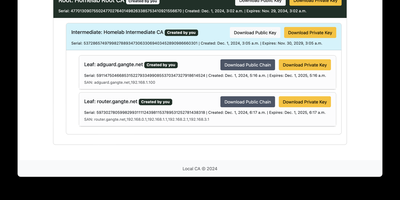
Your internal services deserve padlocks that browsers actually trust, and LocalCA is a small certificate authority you run yourself to issue them. From the web interface you create a self-signed root, install it once on your browsers and client devices, and then mint intermediate and leaf certificates underneath it for each service you host. Proxmox, Pi-hole, Jellyfin, Grafana, and the rest of a homelab stop showing insecure warnings and start presenting certificates your devices accept. The root can carry your own name, so the trust store shows your branding rather than a generic authority. Issued certificates also serve mutual TLS setups, where clients present certificates of their own before a service lets them in. Deployment stays deliberately small: a Docker Compose file brings the application up, ARM images cover Raspberry Pi class hardware, and a configurable time zone keeps expiry timestamps readable for your region. A reverse proxy path prefix is supported for placing the interface behind Traefik or Nginx at an address like /localca. Treat the instance as internal infrastructure, because issued private keys live in its database: keep it on a private network, change the default administrator password immediately, and restrict access to the host. Running on a dedicated VPS on RepoCloud with guaranteed CPU, RAM, and SSD, full root SSH access, and a browser serial console. AGPL-3.0 licensed.