Timon
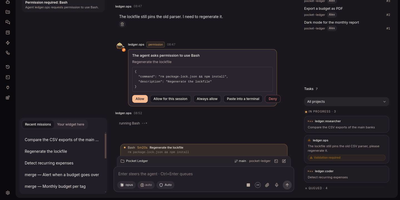
Describe a software job in plain words, and Timon's orchestrator splits it into tasks for a coder, a reviewer, and a merger working in parallel. Each coding task gets its own git worktree, a second model reviews the diff and sends it back when it falls short, and the merger runs the full test suite before landing the branch. A Kanban board tracks briefs, priorities, dependencies, and scheduled start times through pending, in progress, done, and blocked statuses. Agents ask before they push, publish, or delete anything, through clickable questions and permission cards, and secrets stay out of their sight. Work runs on the Claude Code, Codex, Copilot, Grok, opencode, Pi, and Hermes command line tools you already sign in to, and a mission moves to the next backend when one subscription runs dry. Memory carries a rule learned once into the next mission, and a crashed mission resumes from its recorded turns and tool calls. Routines, cron schedules, and webhook triggers run overnight series paced to your quotas. Each mission gets an isolated browser with annotations and recordings, voice dictation turns speech into requests, and the agents answer from a browser, a phone, Telegram, or the command line. Widgets, pages, themes, and layouts install as signed plugins without a restart, and agent roles are plain fields you can rename or extend. Running on a dedicated VPS on RepoCloud with guaranteed CPU, RAM, and SSD, full root SSH access, and a browser serial console. AGPL-3.0 licensed.
Agent Fleet
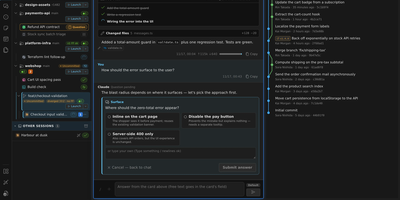
Closing the laptop no longer stops your coding agents: Agent Fleet runs Claude Code, Codex, GitHub Copilot, Cursor, and five more agent kinds on your own server, each member in a persistent, isolated workspace. One session list shows which agents are working and which are waiting on a question, a plan, or a permission prompt. Answer from a card in the browser, on a phone, or in the session's Slack or Discord thread. Each session can start in its own git worktree, and the console adds a commit graph, diffs, staging, split panes, and a live terminal. A session can hand a review to another agent kind, and a fleet graph draws who started whom. Scheduled runs wake a stopped workspace, and a turn cut short by a usage limit resumes when the limit lifts. Token use is broken down by feature, agent, and model, with calls that report no tokens counted as unmeasured. Sign-in works through Google, Microsoft Entra ID, GitHub, or any OIDC provider such as Okta or Keycloak, with tenants, roles, an audit log, and encrypted secrets. The interface switches between English and Japanese, and HTTPS certificates come from Let's Encrypt. Running on a dedicated VPS on RepoCloud with guaranteed CPU, RAM, and SSD, full root SSH access, and a browser serial console. Apache-2.0 licensed.