DockPanel
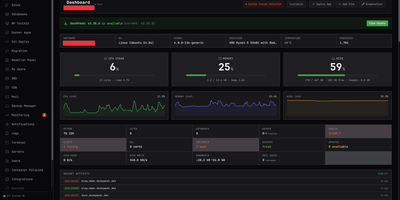
Created in March 2026 and rapidly gaining traction in self-hosting communities, DockPanel delivers the most feature-dense free server panel available — 811 API endpoints, 153 one-click Docker app templates across 14 categories, and full multi-server management, all running on three Rust binaries consuming under 50MB of combined RAM. The panel handles the complete server lifecycle: sites with automatic SSL via Let's Encrypt, MySQL and PostgreSQL databases in Docker containers, Git push-to-deploy using Nixpacks for automatic language detection without Dockerfiles, blue-green zero-downtime deployments with automatic rollback on failed health checks, DNS management, mail servers, monitoring dashboards, and encrypted backups to S3, SFTP, Backblaze B2, or Google Cloud Storage. Security receives production-grade attention with per-image CVE scanning that gates deployments, a built-in WAF, passkey authentication alongside Argon2 password hashing, HttpOnly JWT sessions with blacklist-on-logout, rate limiting on auth endpoints, and fail2ban integration — all verified through an 18-vulnerability pentest with zero remaining issues. Infrastructure as Code support exports your entire server configuration to YAML, and the developer CLI provides status, diagnose, and export commands for automation. GPU passthrough enables AI workload hosting, reseller accounts support white-label branding for agencies, and ARM64 compatibility covers Raspberry Pi and Oracle Cloud free-tier deployments. Running on a dedicated VPS on RepoCloud with guaranteed CPU, RAM, and SSD, full root SSH access, and a browser serial console. AGPL-3.0 licensed.
ServerOS
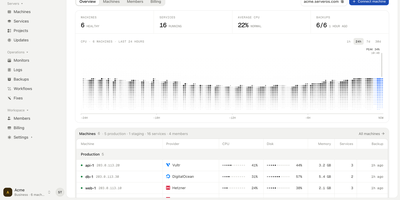
Connect a rented Linux server with one command, then run deploys, uptime checks, backups, and AI-proposed fixes for every machine from the ServerOS web panel. A small daemon on each machine dials out to the panel, leaving no inbound management port to open. The overview charts CPU, memory, and disk across the fleet, and waiting OS updates roll out a few machines at a time. Deploy from a GitHub repository or a .zip, redeploy on every push, and add domains with automatic HTTPS. Pull request previews give each change a running copy, and a staging copy of any project can be tested and then promoted. Install one-click databases and self-hosted apps, and group an app with its database and cache into a private-network project. Monitors check sites, APIs, and ports from outside, status pages carry incident updates, and every service's logs are searchable in one place. Backups go to an S3 bucket or another machine on a schedule, and workflows chain deploys, restarts, and alerts. Add your own Anthropic or OpenAI key and a Fixes agent reads logs, explains what broke, and proposes a repair that waits for a teammate's approval. Claude, ChatGPT, Codex, Cursor, or your own scripts and CI can work in your workspace over MCP and a REST API. Running on a dedicated VPS on RepoCloud with guaranteed CPU, RAM, and SSD, full root SSH access, and a browser serial console. AGPL-3.0 licensed.
VitoDeploy
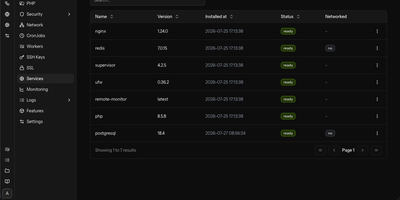
VitoDeploy replaces a pile of SSH sessions and shell scripts with one browser tab for provisioning servers and deploying websites, on a control panel you host yourself. Spin up a server on AWS, Akamai (Linode), DigitalOcean, Vultr, Hetzner, or Proxmox in a few clicks. Attach any Ubuntu machine you already own as a custom server. Add sites built with PHP, Laravel, or WordPress, or run Node.js and Bun apps behind a reverse proxy. Pull code from GitHub, GitLab, Gitea, or Bitbucket. Set environment variables and HTTP basic authentication. Issue Let's Encrypt, wildcard, or custom SSL certificates. Create MySQL, MariaDB, or PostgreSQL databases, manage their users, and send backups to Amazon S3, Wasabi, FTP, SFTP, Dropbox, or local disk. Manage firewall rules, cron jobs, Supervisor workers, Redis, and multiple PHP versions from the same screens. Watch CPU, memory, and disk use for each server, then open a live SSH shell without leaving the page. Agencies split clients into projects, invite teammates as Admins or Users, and send alerts to Slack, Discord, Telegram, or email. Workflows automate deployments, backups, and maintenance. Plugins, DNS record management, export and import of your setup, and a REST API round out the toolkit. The panel itself needs only 1 GB of RAM and 1 CPU core, then manages your other machines over SSH. Running on a dedicated VPS on RepoCloud with guaranteed CPU, RAM, and SSD, full root SSH access, and a browser serial console. AGPL-3.0 licensed.