Cryptgeon
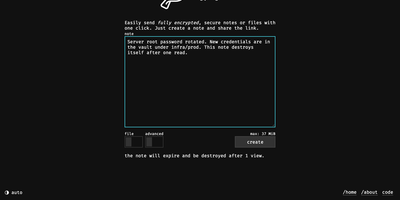
Passwords pasted into chat live forever, but a Cryptgeon note vanishes the moment it has been read. You type a note or pick a file, press create, and get a share link with a QR code to hand over. Encryption happens in the browser with XChaCha20-Poly1305, so the server holds only ciphertext and never sees the key that sits after the hash in the link. Advanced options set the number of views or a lifetime in minutes, and a custom password can be required on top of the generated key. Everything is kept in memory in a Valkey or Redis cache, so nothing is written to disk. Operators tune limits with environment variables for note size, maximum views, maximum expiration, file uploads, and ID length. The interface is a calm monospace page with dark and light themes. A command-line client sends notes from a terminal, and a Raycast extension covers the macOS launcher. Theme text, logo, favicon, and an imprint page can be customized to match a team or company. A health endpoint reports status to proxies and orchestrators. Running on a dedicated VPS on RepoCloud with guaranteed CPU, RAM, and SSD, full root SSH access, and a browser serial console. MIT licensed.
Yopass
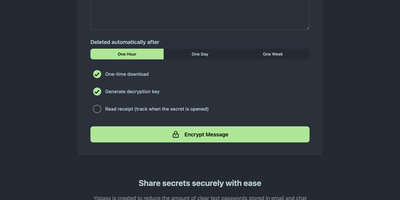
With nearly 3,000 GitHub stars and active development since 2014 through version 14.2.0, Yopass eliminates the universal bad habit of sharing passwords and API keys through Slack messages, email threads, and ticket systems by encrypting secrets entirely in the browser using OpenPGP before anything reaches the server. The Go backend stores only ciphertext — it never sees plaintext — while the React frontend handles all encryption and decryption client-side, generating one-time URLs that self-destruct after a single viewing or when the configured expiration of one hour, one day, or one week passes. File upload support streams encrypted files with configurable size limits, and optional custom password protection adds a second encryption layer beyond the URL-embedded key. The server supports Redis or Memcached as storage backends with automatic key expiration, deploying via Docker Compose in under five minutes or as Kubernetes manifests for production environments. Built-in TLS support works alongside reverse proxy configurations for Nginx, Caddy, and Traefik with automatic Let's Encrypt certificate provisioning. Prometheus metrics expose HTTP request counts, latency histograms, and secret lifecycle counters for Grafana dashboard integration and alerting. Read-only mode enables split-instance deployments separating secret creation from retrieval across different network zones. Multi-language support localizes the interface for international teams. The open-source core under Apache 2.0 provides full self-hosted functionality with no account management required. Running on a dedicated VPS on RepoCloud with guaranteed CPU, RAM, and SSD, full root SSH access, and a browser serial console. Apache-2.0 licensed.