
Serviette
Your documents change every day, and your RAG answers should change with them: Serviette keeps a chat and REST API continuously in sync with the files you point it at, no re-indexing jobs to remember. Point it at a local folder, Google Drive, S3 or MinIO bucket, SharePoint library, or even an FTP or WebDAV share, and edits, additions, and deletions flow into the index in real time. One YAML file, or the interactive wizard, chooses among eight vector databases, from embedded DuckDB with zero setup to pgvector, Qdrant, Milvus, Chroma, Weaviate, Pinecone, or MongoDB Atlas. Text, Office files, PDFs with tables, and scanned images are parsed and answerable by default, with audio and video joining when you add the keys. Embeddings can run fully locally with no credentials, and keyless answers simply quote the retrieved passages with their sources. The indexer and the stateless server scale independently, the server shards across workers with one config line, and both a ChatGPT-style web chat and a versioned /api/v1 retrieval API answer on the same port. A free license key from Pathway activates the engine, and benchmarks cover corpora up to 50 GB of text. Running on a dedicated VPS on RepoCloud with guaranteed CPU, RAM, and SSD, full root SSH access, and a browser serial console. MIT licensed.
TrueForge
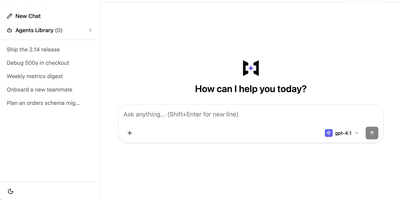
With over 2,100 GitHub stars in its first month and benchmarked at 30-75% lower cost than Claude Managed Agents on enterprise task suites, TrueForge is the open-source agent harness that provides the complete runtime layer for turning any LLM into a working production agent on your own infrastructure. The TypeScript server runs the full execution loop — streaming every step, routing tool calls through MCP servers with centralized header-auth and in-chat OAuth, delegating parallelizable work to isolated subagents, and pausing for human approval on sensitive actions. Context engineering keeps token costs low: deferred tool-schema loading delays MCP schemas until invoked, large-result offloading moves oversized outputs to files, Code Mode processes structured data through sandboxed execution, and automatic compaction summarizes older history at a configurable 50,000-token threshold while preserving the full transcript. The sandbox-as-a-tool architecture provisions isolated Daytona environments only when code execution is required, allowing one server to run many concurrent agents without idle overhead. Agents are configured from shipped YAML catalogs of models, MCP servers, git-backed SKILL.md instruction packs, and sandbox providers, then saved to an Agents Library accessible via the chat UI, TypeScript SDK, or embeddable React UI SDK. Run locally with SQLite via a single npx command, or deploy for teams with Docker Compose or Helm using Postgres and Redis with OIDC authentication. Running on a dedicated VPS on RepoCloud with guaranteed CPU, RAM, and SSD, full root SSH access, and a browser serial console. MIT licensed.
Letta
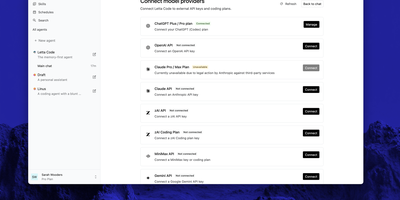
With over 24,000 GitHub stars and origins in the MemGPT research paper on virtual context management, Letta has evolved into the leading open-source platform for building AI agents that maintain persistent memory, identity, and continuity across sessions rather than operating as stateless prompt-response loops. The core architecture uses memory blocks — structured, labeled text chunks that reside permanently in the agent's context window — allowing agents to programmatically rewrite their own memory, learn new skills, and improve through a sleeptime dreaming process that runs reflection and memory organization during idle periods. The self-hosted App Server deploys via Docker and exposes a WebSocket API on port 4500, letting the TypeScript Agent SDK connect from any application using local, remote, or cloud backends. Agents support git-versioned memory through MemFS where every memory change is tracked and auditable, multi-agent communication via subagents, scheduled tasks, and integration with messaging platforms including Slack, Discord, Telegram, WhatsApp, and Signal. The platform is fully model-agnostic, routing to OpenAI, Anthropic, xAI, or self-hosted open-weight models through Ollama depending on cost, performance, and data residency requirements. The Agent File format serializes complete agent state — memory, skills, prompts, and conversation history — into portable snapshots. Desktop applications for macOS, Windows, and Linux provide native interfaces alongside the terminal CLI and web chat at chat.letta.com. Running on a dedicated VPS on RepoCloud with guaranteed CPU, RAM, and SSD, full root SSH access, and a browser serial console. Apache-2.0 licensed.
SandBase Harness
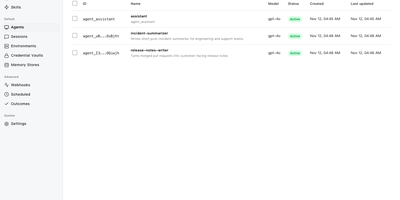
SandBase Harness gives your AI agents a proper home with sessions, tools, sandboxes, and an audit trail instead of a pile of scripts. The console lists agents with their model, status, and version, and an agent page shows its system prompt, attached tools, and skills. Every session keeps a resumable event log, and a transcript view opens any user or agent message as a rendered or raw event. Built-in tools run in a local process, per-session Docker containers, Kubernetes, or a self-hosted worker queue, and permission policies can always allow a tool or always ask a human first. MCP toolsets, credential vaults, and skill packages extend what an agent can reach, with Anthropic's xlsx, pptx, pdf, and docx skills listed next to your own. Memory stores, webhooks, scheduled deployments, and outcome definitions cover longer-running work. Settings include a model provider form, API keys for bearer authentication, and an interactive API reference for sessions, agents, environments, and vaults. A TypeScript SDK and a bundled MCP bridge connect other tools to the same runtime. Running on a dedicated VPS on RepoCloud with guaranteed CPU, RAM, and SSD, full root SSH access, and a browser serial console. Apache 2.0 licensed.
a13n Agent Foundation
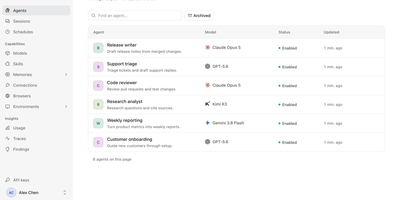
Agents that keep working after you close the tab: a13n gives a team one shared place to define them, run them, and watch what they did. In the Console, an administrator adds models from OpenAI, Anthropic, Gemini, Bedrock, Azure, OpenRouter, DeepSeek, Ollama, and others, then creates agents with instructions, skills, memories, connections, browsers, and sandbox environments. A Try agent button opens a conversation, and the Debug view lays out every run step by step, with model calls, tool calls, token counts, cache rates, and durations. Sessions and schedules keep a history of conversations and recurring jobs. The Usage page charts spend, runs, requests, and tokens by agent, model, or member across a time range. Findings analyzes traces, flags answer quality and tool failures, and lets reviewers confirm or dismiss each one with a suggested improvement. Each agent has a Connect to app screen with its ID, service URL, and API key, so applications can call it over an HTTP API or SDK. Workers lease runs from PostgreSQL and save checkpoints to object storage, so interrupted work resumes. Customer support teams, internal platform groups, and product builders use it to ship agent features without writing their own orchestration layer. Running on a dedicated VPS on RepoCloud with guaranteed CPU, RAM, and SSD, full root SSH access, and a browser serial console. Apache-2.0 licensed.