Unsloth
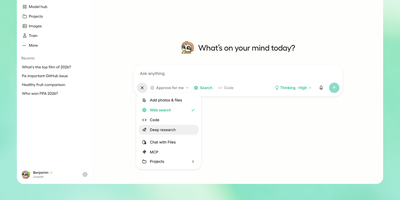
Unsloth puts the whole open-model workflow in one browser tab: pick a model, chat with it, train it, and ship it. Search a model hub, load a GGUF, and talk to it with web search, deep research, file uploads, and sandboxed Python or shell execution that asks before anything risky runs. Line up two models side by side to compare answers, or generate images and video with diffusion models. When a base model is not quite right, a five step wizard sets up fine-tuning with LoRA, QLoRA, FP8, or full training, and a live dashboard charts loss, gradient norm, step progress, and GPU memory. Data Recipes turn PDFs, CSVs, and Word files into question and answer pairs or instruction datasets without hand labeling. Finished models export to GGUF or safetensors for llama.cpp, vLLM, Ollama, and LM Studio. An access token screen exposes an OpenAI-compatible endpoint so Claude Code, Codex, and OpenCode can drive local models. Secure HTTPS links reach the interface from any device. Running on a dedicated VPS on RepoCloud with guaranteed CPU, RAM, and SSD, full root SSH access, and a browser serial console. Apache-2.0 and AGPL-3.0 licensed.
ChainForge
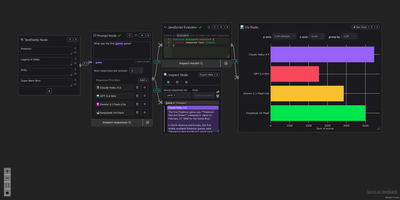
Comparing prompts and models by eye stops working fast, so ChainForge lays every experiment out on one visual canvas. Drop a table of inputs into a Prompt Node, add a handful of models, and the app sends every combination of template variable and model, then collects the answers in an Inspect Node that groups responses by any variable. Evaluator nodes score outputs with a few lines of code, and visualization nodes plot pass rates and numeric scores as histograms or box plots. Chat Turn nodes test follow-up questions, to see if a model caves when a user pushes back. Sparkle buttons draft synthetic table rows, test questions, and starter evaluator code with a model of your choice, and an LLM scorer can judge answers against a rubric you write. Example Flows open ready-made experiments, from a no-key starter with tiny in-browser models to prompt template comparisons, sycophancy checks, gender bias audits, red-teaming runs, and 188 flows converted from OpenAI Evals. Documents, Chunking, Retrieval, and Rerank nodes cover retrieval experiments. Finished flows export as cforge files, and results export to spreadsheets or JSON for the rest of the team. Running on a dedicated VPS on RepoCloud with guaranteed CPU, RAM, and SSD, full root SSH access, and a browser serial console. MIT licensed.