UseAgent
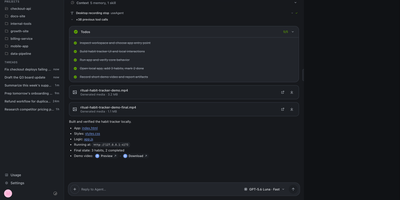
Hand a task to an AI teammate the way you would hand it to a person: describe the work, then follow along and step in when it matters. UseAgent runs Claude Code, Codex, OpenCode, and Pi inside isolated Linux workspaces, each with your repositories, a terminal, a real browser, and a desktop you can open and take over. Start work from the web app, by mentioning an agent in Slack, or through the API, and get pull requests, documents, spreadsheets, presentations, and research back as usable files. Four engines share one thread and one event format, so you can compare how Claude Code and Codex each handled the same bug, then switch engines on the next reply without losing history, files, or memory. Risky operations pause at approval gates, and a decision resumes the run with a one-shot, argument-bound capability instead of blanket trust. Every step, tool call, and approval is stored as an append-only event log in your Postgres, replayable after the fact and durable across restarts mid-task. Teach the workspace your procedures by importing versioned skills from GitHub and pinning playbooks to tasks, while knowledge pages and optional team memory stay beside the work, inspectable and correctable. Recurring tasks run on schedules with full history. Provider keys stay on your server and never enter an agent sandbox. Running on a dedicated VPS on RepoCloud with guaranteed CPU, RAM, and SSD, full root SSH access, and a browser serial console. AGPL-3.0 licensed.
TgWitness
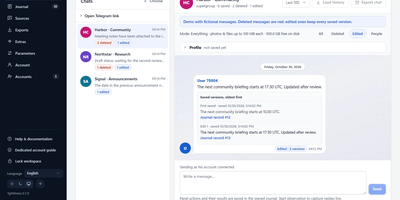
TgWitness preserves what your Telegram account actually saw, even when a message is edited three times and deleted before breakfast. A collector watches the chats, folders, or whole account you choose and records every captured message, edit version, and deletion notice in a local journal. The workspace reads like a familiar conversation view, with captured edits and deletion markers alongside the messages, and a searchable journal timeline ties observations together across chats. Open the edit history to compare versions side by side without overwriting the earlier observation. Connect people, replies, and shared links across recorded chats to trace how a claim travelled. Each account gets an isolated workspace with its own session and signing key, so separate investigations never contaminate each other. When a case moves, export the record as readable HTML, structured JSON or CSV, or a signed ZIP bundle whose hash-linked, Ed25519-signed records expose any tampering, verifiable offline with an independent fingerprint. Optional local OCR and transcription make media searchable, signed webhooks announce new observations, and encrypted backups copy the journal and timestamped checkpoints to S3-compatible storage. Read-only MCP access lets approved tools query the archive without touching the collector. Coverage reports show honestly where downtime left gaps. Running on a dedicated VPS on RepoCloud with guaranteed CPU, RAM, and SSD, full root SSH access, and a browser serial console. MIT licensed.
Pagesift
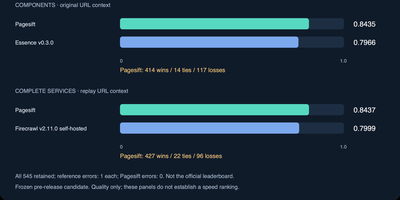
Pagesift converts messy web pages, PDFs, and Office documents into clean Markdown and structured JSON that language models can actually use, from one self-hosted binary you run yourself. Call it the way you already call Firecrawl: the HTTP API speaks the Firecrawl v1 and v2 formats, so existing scrape, crawl, and batch jobs point at your server instead, and a Jina Reader style endpoint answers simple /r/ URL requests. Scrape a single page, submit batches, or crawl whole sites with sitemap support, focused crawling by query, robots.txt respect, and per-host rate limits by default. Headless rendering kicks in only when a page needs JavaScript, keeping plain pages fast. Documents work offline too: Word, Excel, PowerPoint, EPUB, and CSV files become Markdown with titles, links, images, and publication metadata attached. Jobs persist so long crawls survive restarts, webhooks report completions, and per-API-key limits and quotas keep multi-tenant use civilized, with Prometheus metrics and a health endpoint for operators. AI agents can drive the same engine directly through the bundled MCP server over stdio or HTTP, while developers get Python, Node, and Rust libraries. Memory stays bounded under load by design, sized from container limits rather than hope. Running on a dedicated VPS on RepoCloud with guaranteed CPU, RAM, and SSD, full root SSH access, and a browser serial console. AGPL-3.0 licensed.
Statlite
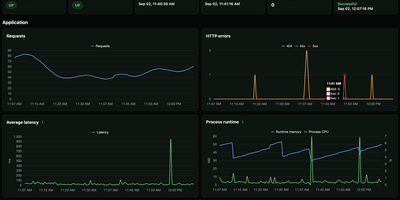
Small server, small monitoring. Statlite watches your applications and their host with a single binary that idles at about 15 MiB, so the observer never becomes the heaviest thing on the box. Point it at a Spring Boot Actuator endpoint and it polls health plus a fixed, curated set of Micrometer metrics: request traffic, latency, CPU, and runtime memory, all drawn as clean charts. Quarkus, Micronaut, and anything else that can answer a fixed JSON metrics profile can join the same dashboard. History lives in one local SQLite file, raw samples only, kept for 90 days by default, so yesterday's latency spike is still there when you go looking. The dashboard also watches the host itself: processor load, memory pressure, and filesystem capacity, including a warning before the metrics database fills its own disk. Restart detection tells you when an application bounced, and per-target Basic Auth support lets you poll protected Actuator endpoints safely. Configuration is one YAML file listing your targets and polling interval, friendly to systemd and Docker alike. Everything is deliberately scoped: no alert manager, no external service, no observability platform to operate. Just open the page and see whether your apps are healthy. Running on a dedicated VPS on RepoCloud with guaranteed CPU, RAM, and SSD, full root SSH access, and a browser serial console. MIT licensed.
Pictaria Server
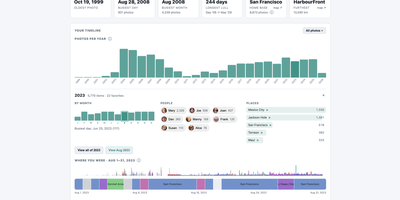
Pictaria Server sits beside your Immich instance and makes a photo library of thirty thousand images legible again, surfacing the trips, people, and best shots buried under duplicate bursts and forgotten folders. It starts with Insights: a clickable timeline of your years, detected trips, a people constellation linked by who appears together, place and camera rankings, and records like your busiest day. Click any number and you land on the actual photos, ready to open in Immich, turn into an album, or send onward. Enrich puts an AI to work describing what it sees, writing captions, menu-driven tags, and quality scores for every photo using a local model through Ollama or LM Studio, or a cloud provider with your own key, on a scheduled daily budget. Those tags can sync back into Immich, so searching improves everywhere, not just here. Curate then collapses bursts and near-duplicates into stacks with a suggested keeper, and one keystroke keeps the best and skips the rest. Smart Albums compose rules from people, places, dates, cameras, and tags, preview the result count, and maintain real Immich albums on a schedule. Frame owners get remote control, display metrics, and voice photo questions, while the Activity feed and runtime-editable Settings keep the whole box manageable from the browser. It connects with a limited-permissions API key and cannot delete a single photo. Running on a dedicated VPS on RepoCloud with guaranteed CPU, RAM, and SSD, full root SSH access, and a browser serial console. AGPL-3.0 licensed.
AgentFlux
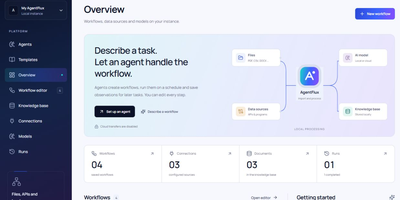
Describe the task in plain words, pick the sources and model it may use, and an agent plans the workflow before running it. That is the core loop: agents build editable visual workflows from a task description, execute them on demand or on a schedule, and keep everything traceable. Prefer building by hand and the canvas offers 17 preconfigured steps, branching, undo and redo, JSON import and export, plus eight starter templates. Feed it real work by importing PDF, DOCX, XLSX, CSV, JSON, and text files, or by connecting folders, HTTP endpoints, and approved local programs. Upload a screen recording and it identifies the actions with timestamps, turning a demonstrated process into an editable workflow you can refine. Model calls go to the endpoint you choose: Ollama, LM Studio, vLLM, or any OpenAI-compatible service, local or cloud with your own credentials. Every run can be inspected step by step, cancelled mid-flight, and exported as JSON, CSV, or Markdown reports. Observations from completed runs land in a knowledge and learnings store, where you review them and promote the useful ones into reusable skills for the next task. The Docker release bundles the application with FFmpeg and local Whisper support, and your documents stay on your own machine. Running on a dedicated VPS on RepoCloud with guaranteed CPU, RAM, and SSD, full root SSH access, and a browser serial console. Apache License 2.0 licensed.

Dewarr
Your want-to-read shelf and your audiobook library finally talk to each other, so the next book you finish can trigger the hunt for the one after it. Dewarr syncs Goodreads shelves, CSV exports, custom public lists, and Hardcover lists, then watches them for new additions worth listening to. Connect Audiobookshelf or Grimmory and it knows what you already own, importing finished downloads into verified library folders instead of leaving files stranded in a downloads directory. Follow authors and series to catch future releases, with back-catalog review, filters, and exclusions before anything is grabbed, including release-day acquisition for titles you are waiting on. When you approve auto-download, it searches MyAnonamouse, Prowlarr, and AudiobookBay, ranks sources by your format, size, and seed preferences, and hands transfers to qBittorrent. Multi-file MP3 releases come back as one chapterized M4B, a chapter per file, ready for your player. The discovery page personalizes shelves with followed lists, award collections, trending books, and new releases. Household members get individual accounts, reading lists, and permissions, with sign-in through OpenID Connect providers or Plex. Notifications for grabs, imports, and digests go out over Discord, ntfy, Apprise, or plain webhooks. Running on a dedicated VPS on RepoCloud with guaranteed CPU, RAM, and SSD, full root SSH access, and a browser serial console. MIT licensed.

Yarrtube
Follow the channels you actually chose, and let their newest uploads land on your own disk instead of in an algorithmic feed. Yarrtube tracks public YouTube playlists and whole channels, checks them on a schedule, and downloads fresh videos automatically the moment they appear. The built-in web player lets you watch the collected library from a desktop or a phone browser without ads interrupting. Downloads are organized into media-server friendly folders, so the same collection shows up inside Plex, Jellyfin, or Kodi next to your films and shows. For Plex homes, an optional scan trigger refreshes the library right after a download finishes, so new episodes surface without manual rescans. You control download quality per source and can cap how many videos each channel keeps, which protects limited disk space from runaway back catalogs. Grouping sources into categories and smart playlists keeps a growing archive browsable instead of turning into one long dump. Everything runs from one Docker container with two persistent mounts, one for its small database and one for the video files. A free YouTube Data API v3 key powers the new-upload checks, so setup takes minutes. Running on a dedicated VPS on RepoCloud with guaranteed CPU, RAM, and SSD, full root SSH access, and a browser serial console. MIT licensed.
MeetDo
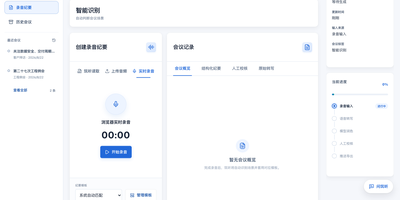
The meeting ends and, instead of a raw transcript, you get minutes you can file: MeetDo is an open-source meeting-to-action system that hosts the meeting, captions it locally, and finishes the record for you. Start a browser meeting with video, screen sharing, and chat, and watch captions stream from a speech model running on the same infrastructure, so no audio is sent to a cloud note-taker. When the call ends, the transcript becomes structured minutes: summary, agenda flow, conclusions, and action items with owners, instead of a wall of raw text. Five meeting types, from management reviews and project weeklies to interviews and customer calls, shape the record, and custom templates export to DOCX or PDF with your original layout preserved. Domain vocabulary is corrected after recognition, so names, units, and industry terms survive transcription instead of turning into near-miss words. Past meetings stay searchable in a local history, and questions can be asked across them without anything leaving the machine. Editable transcripts let a human fix the record before it is filed, and the whole pipeline works offline after the first model download. Running on a dedicated VPS on RepoCloud with guaranteed CPU, RAM, and SSD, full root SSH access, and a browser serial console. MIT licensed.

TubeHaus
Watch YouTube without the ads, accounts, or tracking, from a server you own: TubeHaus is a private YouTube client that keeps the familiar layout, URLs, and keyboard shortcuts. Your subscriptions, watch history, resume positions, Watch Later, and playlists live as files on the server, so every device in the house shares one library and picks up a video where another screen left it. Live streams play with segments fetched ahead of the player, and captions are transcribed on the fly when a stream has none. Chapters, storyboard previews, a mini player, and theater mode make long videos easy to navigate, while sponsors are skipped automatically and dislike counts come back to the page. Save videos offline in 1080p or 4K for trips, send playback to a TV from your phone without a separate casting dongle, and drive the television interface entirely from a remote. Imports arrive from a Google Takeout export, Invidious, NewPipe, or FreeTube, so years of subscriptions move over in minutes instead of being rebuilt by hand. A calm mode hides recommendations and Shorts when you only want to search and watch deliberately. Running on a dedicated VPS on RepoCloud with guaranteed CPU, RAM, and SSD, full root SSH access, and a browser serial console. AGPL-3.0 licensed.
AgentBox
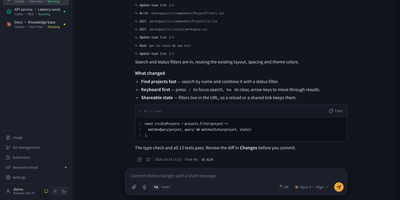
AgentBox is a self-hosted browser workspace that runs Claude Code and Codex CLI on a server you control, so a task goes from chat to reviewed code without leaving one place. Open a workspace from an empty project, an uploaded archive, or a Git clone, then talk to the agent in streaming web chat or drop into its original interactive terminal when you want the CLI itself. Files persist between sessions along with your home configuration and chat history, so a project picked up on a laptop continues on a phone exactly where it stopped. Review per-file diffs line by line before committing, pushing, or opening a pull request, and download the result when no Git connection is configured. Shared files, layered home templates, Claude skills, and MCP configuration carry your setup into every new workspace, with per-workspace overrides when a project differs. A trusted team shares central account pools with per-user scopes, while every model request is recorded with tokens, cache hit rate, cost, and latency, exportable to CSV and optionally capped by credits. An optional tunnel reaches allowlisted repositories and databases on private networks, and six interface styles with light and dark modes keep long sessions comfortable. Running on a dedicated VPS on RepoCloud with guaranteed CPU, RAM, and SSD, full root SSH access, and a browser serial console. Apache-2.0 licensed.
Open Compute
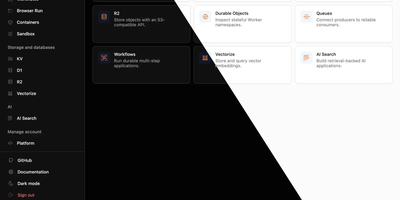
Open Compute is a self-hosted Cloudflare Workers-compatible platform that runs your Workers, storage, and AI services on hardware you own, from one binary and one daemon. Deploy the Worker code you already wrote with its config file and framework adapters, then roll back to an earlier immutable deployment when a release misbehaves. Serve traffic locally or over HTTPS through the shared Gateway, with routes you control instead of a vendor account. Each instance stays isolated with its own data directory and credentials, while you switch between registered instances from the same operator view. Bindings cover the platform pieces applications actually need: key-value data, SQL databases, object storage, stateful objects, queues, durable multi-step workflows, scheduled cron, cache, vector search, and AI search. Logs and a live tail show what running Workers are doing right now, and health, backup, and recovery workflows keep a single machine manageable without a cluster. Verified upgrades roll back automatically when something fails, and object bytes can move to S3-compatible storage when local disk is no longer enough. Running on a dedicated VPS on RepoCloud with guaranteed CPU, RAM, and SSD, full root SSH access, and a browser serial console. Apache-2.0 licensed.
Kanzo
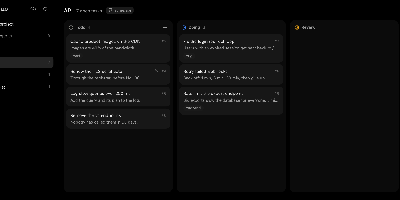
Give your coding agents a board they can work, not just read: Kanzo is a self-hosted kanban board where you and your agents move the same tasks through the same columns at the same time. Tell an agent to take the next task and it moves the card to doing, comments as it works, and leaves the result where you can read it in the browser. Projects follow the code automatically: the agent finds the right board from the Git remote of the repository it is working in, and you can link more repositories to a project from its menu. Press n to add a task, search every project with a slash or Command-K, paste an image straight into a card or comment, and park half-formed ideas in an optional Backlog column that agents leave alone until you promote them. The whole board is one folder, and a private Git repository you own keeps it in step across a laptop, a desktop, and a Raspberry Pi, with conflicts resolved by choosing which side to keep. Statuses are yours to rename in the config file, the board exports cleanly to Markdown or JSON, and one click in the sidebar installs updates and restarts the service. Running on a dedicated VPS on RepoCloud with guaranteed CPU, RAM, and SSD, full root SSH access, and a browser serial console. AGPL-3.0 licensed.
Mediarium
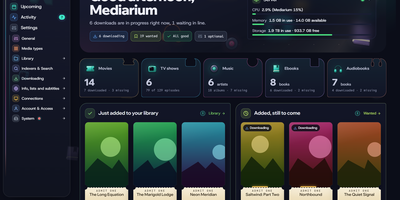
Find a title tonight and wake up to it named, filed, and ready to play: Mediarium is a self-hosted media manager that finds, downloads, repairs, and organizes movies, TV, music, ebooks, and audiobooks from one web page on your own server. Search once and it queries your Usenet and torrent indexers together, grabs the best release, unpacks it, applies your naming rules, and places it where Plex, Jellyfin, or Emby expects it. Quality profiles with upgrades and fallbacks keep hunting better copies automatically, while delay profiles, a blocklist with retries, and tags such as Kids or 4K keep the wrong releases out and collections tidy. Subtitles are matched to your exact file, with a timing fix when one runs out of sync. Family accounts carry permissions of their own: relatives who cannot add titles send requests you approve, and watch history read from your media server drives statistics and optional cleanup rules. The built-in Books app reads ebooks, plays audiobooks chapter by chapter, remembers your place everywhere, and even opens Kindle books. Torrents can run behind a built-in WireGuard VPN with a kill switch, downloads repair and unpack themselves, and notifications, backups, and a post-import script keep the routine invisible. Moving over reads your Radarr, Sonarr, Prowlarr, SABnzbd, and other existing setups without changing them. Running on a dedicated VPS on RepoCloud with guaranteed CPU, RAM, and SSD, full root SSH access, and a browser serial console. AGPL-3.0 licensed.
Respan Gateway
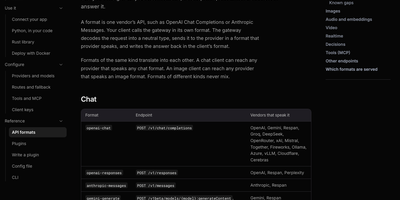
Respan Gateway is a single-binary LLM gateway that lets the SDK you already use call any AI model from any provider, translating between OpenAI, Anthropic, and Gemini API formats on the way through. Point an OpenAI, Anthropic, or Gemini client at it and you reach chat models on sixteen providers, plus any OpenAI-compatible endpoint of your own, with streaming, tools, images, and reasoning translated. Traffic control works the way operators think: name a route, send it to the cheapest or fastest provider, retry on failure, fall back to a second vendor, or hedge a slow call by racing another provider. Models that never had tools get them anyway, because MCP servers and built-in search, browsing, code, document, and memory tools run inside ordinary chat requests behind the gateway. Realtime voice crosses vendors too, with an OpenAI Realtime client able to talk to Gemini Live, alongside images, speech, transcription, embeddings, and video through one endpoint. A live request log in the web UI shows the client key, model, provider, status, tokens, cost, and latency of every call, so runaway agents and surprise bills are visible immediately. Everything is a plugin on one public Rust API, from routing and pricing to tracing, with examples for guardrails, PII masking, and billing. One TOML file configures keys, providers, routes, and tools, validates before it starts, and reloads on signal. Running on a dedicated VPS on RepoCloud with guaranteed CPU, RAM, and SSD, full root SSH access, and a browser serial console. Apache-2.0 licensed.

MailCheap
MailCheap is a newsletter app you host yourself that writes, sends, and publishes your issues while charging you only for the emails you actually send, not for subscribers who never open anything. Write in an editor with slash commands, images, and content boxes, or send Markdown and HTML emails through the API, then work through a pre-send review that flags subject, preview text, unsubscribe link, and sender problems first. Bring your audience with you: CSV exports from beehiiv, Substack, Mailchimp, Kit, MailerLite, Buttondown, Ghost, and EmailOctopus import with each reader's status and signup date intact. Imports clean themselves, dropping invalid, misspelled, duplicate, throwaway, and spam-trap addresses, and a server-wide never-email list keeps known bad addresses out of every future import, signup, and send. Sending protects your domain: new contacts receive issues in paced steps, sends pause when bounce or complaint rates climb, and Gmail spam rates are watched daily. Every issue becomes a page on your newsletter's website, with a signup form, author page, share images, and a sitemap. Run up to three newsletters per account, each with separate contacts and campaigns, and follow subscribers over time with open and click reports by inbox provider. AI agents can do anything the dashboard can through the MCP server, and scripts get the same reach through the REST API, with sending marked irreversible so agents ask first. Running on a dedicated VPS on RepoCloud with guaranteed CPU, RAM, and SSD, full root SSH access, and a browser serial console. AGPL-3.0 licensed.
T3 Code
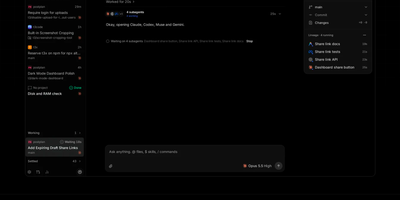
T3 Code puts every coding agent you already pay for behind one control surface, so Claude Code, Codex, Cursor, Grok Build, OpenCode, and Antigravity all run on your server while you direct them from your phone, browser, or desktop. Start a thread, choose the provider and model that fit the job, and watch the agent work in a shared conversation instead of a terminal you have to babysit. Permission modes decide when an agent must stop and ask, and its approvals, questions, and plan reviews arrive in the same thread wherever you happen to be connected from. When the work lands, review it file by file in the built-in diff view, then commit, push, and open pull requests through the Git and GitHub integrations without leaving the app. A real terminal sits beside the chat, and projects, settings, and scheduled tasks stay attached to the machine where the code actually runs. Install it as a background service and reach it from anywhere through T3 Connect, a Tailscale or LAN pairing, or the hosted web client, with a pairing code guarding local access. Outside agents can also drive threads over MCP, launching, messaging, and waiting on work across machines you have linked together. Running on a dedicated VPS on RepoCloud with guaranteed CPU, RAM, and SSD, full root SSH access, and a browser serial console. MIT licensed.
Lightpanda
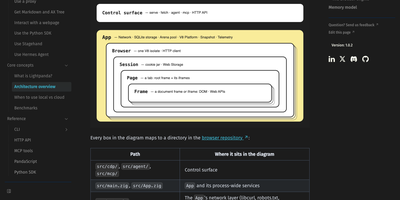
Lightpanda is a headless browser built for AI agents and automation that loads and runs web pages without ever drawing them, so crawling, scraping, and agent browsing finish far faster and lighter than in Chrome. You drive it with the tooling you already have: Puppeteer, Playwright, and Chromedp connect over the Chrome DevTools Protocol, Selenium works over WebDriver BiDi, and existing Chrome automation scripts keep running against the new endpoint. Scripts can execute JavaScript on real pages, wait for network activity, read and mutate the DOM, submit forms, and pull structured data out of dynamic sites that plain HTTP clients cannot see. An MCP server mode hands the browser to AI applications as a callable tool, so a model can open pages, follow links, and read content in the middle of an agent workflow. The built-in agent accepts plain-language browsing tasks and can export what it did as PandaScript, a replayable JavaScript file that runs later with no model call at runtime. A fetch command loads one or more URLs and prints the result as HTML or Markdown, which turns page extraction into a single shell step inside data pipelines. In the project's published crawl benchmark it processed pages roughly nine times faster than headless Chrome at a fraction of the memory, so one server can hold many more concurrent browsing sessions. Running on a dedicated VPS on RepoCloud with guaranteed CPU, RAM, and SSD, full root SSH access, and a browser serial console. AGPL-3.0 licensed.