Unla
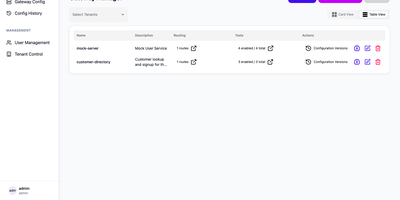
Unla puts a friendly front door on every API you already run, so AI clients can call it as an MCP server without anyone writing a line of glue code. Describe an endpoint in YAML or the form editor, name its arguments, choose where each one goes in the request, and the gateway exposes it as a tool over SSE or streamable HTTP. Import an OpenAPI file to generate a whole server at once, or proxy a third-party MCP server and route it under a prefix of your choice. The Gateway Manager shows every server as a card or table row with its routes, enabled tools, and tool counts. Every save creates a numbered config version with its author and timestamp, so changes are easy to audit and roll back. Tenants keep teams separate, user accounts carry roles, and CORS settings sit next to each route. Configuration hot reloads, syncs across replicas, and persists to disk, SQLite, PostgreSQL, or MySQL. Running on a dedicated VPS on RepoCloud with guaranteed CPU, RAM, and SSD, full root SSH access, and a browser serial console. MIT licensed.
AgentField
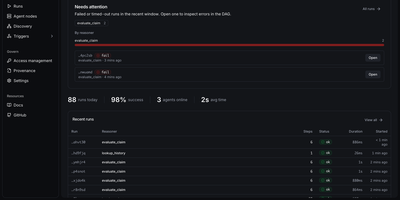
AgentField is the production backend that makes an AI agent as callable as any other microservice. A Python, Go, or TypeScript function decorated as a reasoner or skill registers with the control plane and instantly becomes a REST endpoint, and agents call each other through the same plane, so every hop is routed and traced. The dashboard summarizes runs, success rate, online agents, and a run timeline, and a Needs attention list surfaces failed runs with a one-click jump into the DAG. The Runs page filters and searches every execution, and a run opens into a step-by-step trace with timings, inputs, and outputs, or a graph of the call tree across agents. Agent Nodes lists each registered service with version, endpoints, and process logs. The Playground executes any reasoner from a form and shows the result and recent runs. Fan-outs run async with webhooks, server-sent events, bounded queues, and backpressure, and a single run may continue for hours. Human approval pauses, canary traffic weights, Prometheus metrics, access policies, and signed provenance records cover governance. Running on a dedicated VPS on RepoCloud with guaranteed CPU, RAM, and SSD, full root SSH access, and a browser serial console. Apache-2.0 licensed.
Astron RPA
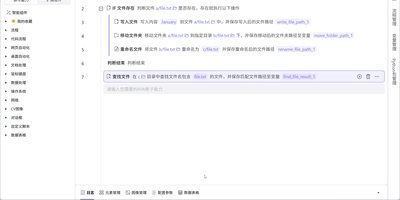
The invoices, reconciliations, and report downloads your team repeats every week are exactly the work a robot should be doing at 2 a.m. Astron RPA is an open-source robotic process automation platform: business users assemble workflows in a visual designer from more than three hundred pre-built components for clicking through desktop applications, driving browsers, reading and writing Excel and PDF files, querying databases, and calling APIs, then robots execute those workflows on schedule, on demand, through API calls, or through MCP services. The platform covers Windows desktop software and web pages alike, reaching office suites, browsers, and the finance and ERP systems that never grew an API, and Python scripting extends any step the components do not cover. A built-in excellence center and team marketplace let organizations publish shared automations, manage permissions, monitor executions, and reuse each other's robots across departments instead of rebuilding the same process ten times. AI components and a native agent platform connect language models to the workflows, so an agent can reason about a task and hand the clicking to a robot, and a workflow can call the agent back when judgment is needed. Self-hosters run the control plane themselves with Docker: database, identity service, and web console behind their own domain and certificates. Running on a dedicated VPS on RepoCloud with guaranteed CPU, RAM, and SSD, full root SSH access, and a browser serial console. Apache-2.0 licensed.
FounderOS
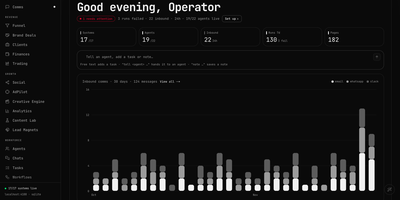
For a solo founder, FounderOS is one live dashboard where AI-assisted departments take care of the busywork of running a company. Home shows system health, agent counts, and inbound message volume, plus a free-text bar that turns a sentence into a task, a note, or an instruction for a named agent. Comms merges email, Slack, WhatsApp, and meeting threads into one inbox with unread counts, needs-reply flags, snooze, mark done, and reply starters that include a drafted answer. Funnel tracks touches, new leads, conversions, and revenue by source, with a pipeline from first touch to converted client. Agents shows a roster of AI seats and a conductor that delegates work, with runs by seat, open task lanes, and the items waiting on you. Tasks adds in-progress, overdue, and runtime stats beside a schedule. The Knowledge Visualizer maps notes, skills, agents, and accounts into a network with matrix, timeline, ranking, and findings views. Clients, Brand Deals, Finances, Social, and Content Lab sit in the same sidebar, and every integration stays optional until you connect it. A bundled demo company makes exploring easy. Creators, small agencies, and one-person businesses get a daily operating view in a single tab. Running on a dedicated VPS on RepoCloud with guaranteed CPU, RAM, and SSD, full root SSH access, and a browser serial console. MIT licensed.
SkillHub
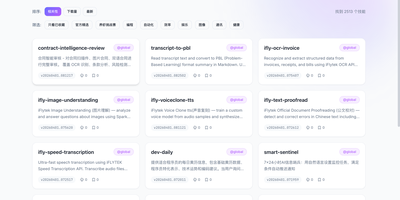
SkillHub gives teams a private, npm-style registry for AI agent skills, so a useful skill package is published once, reviewed, versioned, and installed into a compatible agent from the command line. Upload a package from the web console, the CLI, or the REST API, pick PUBLIC, NAMESPACE_ONLY, or PRIVATE visibility, and track releases with semantic versions plus tags such as beta and stable. Team namespaces keep their own members with Owner, Admin, and Member roles and publishing policies, while full-text search filters by namespace, downloads, ratings, and recency and hides whatever a user may not see. Every submission enters a review queue: namespace admins approve or reject team skills, platform admins decide promotions to the global scope, and each governance action lands in the audit log. A built-in Skill Scanner inspects published packages and shows its report on the skill page, with optional behavioral, LLM, VirusTotal, and Cisco AI Defense engines. Members can star and rate skills, follow download counts, receive notifications, and report problem packages. Skill suites bundle several skills into one versioned collection with an entry skill, scoped API tokens serve the CLI and scripts, and the interface speaks English, Simplified Chinese, Russian, and Korean. Packages live on local disk or S3-compatible storage such as MinIO. Running on a dedicated VPS on RepoCloud with guaranteed CPU, RAM, and SSD, full root SSH access, and a browser serial console. Apache-2.0 licensed.
Coder
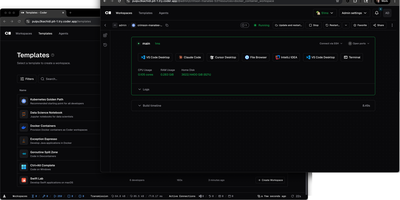
With over 14,000 GitHub stars and enterprise adoption by security-conscious organizations, Coder transforms how development teams provision, manage, and secure their coding environments. Every workspace is defined as a Terraform template, meaning infrastructure engineers can standardize development environments across EC2 instances, Kubernetes pods, Docker containers, or any combination, while developers get self-service provisioning that launches in seconds rather than days of manual setup. The WireGuard-based networking layer establishes encrypted tunnels between developer machines and remote workspaces, providing low-latency access without exposing ports or configuring VPN concentrators. Automatic idle detection shuts down unused workspaces after configurable periods, directly reducing cloud compute costs for organizations running hundreds of developer environments. The Coder Agents feature introduces native AI coding capabilities where the agent loop executes entirely within the control plane on self-hosted infrastructure, keeping LLM API credentials out of individual workspaces and eliminating credential exfiltration risks. Centralized model governance allows platform teams to approve specific AI providers and models, set per-user spend limits, and maintain complete audit logs of all prompts, tool calls, and agent activity. IDE integration supports VS Code through a dedicated extension, JetBrains IDEs via Gateway and Toolbox plugins, and browser-based code-server for web access. The template registry provides pre-built configurations for common development stacks. DevContainer support builds environments from standard devcontainer.json specifications. Deploy on a dedicated VPS on RepoCloud with guaranteed CPU, RAM, and SSD, full root SSH access, and a browser serial console. AGPL-3.0 licensed.
PullMD
PullMD turns any URL or file you point it at into clean Markdown your AI agent can actually afford to read. Paste a web page and get back tidy body text with metadata tucked into frontmatter instead of navigation soup and cookie banners. Send it a Reddit or Hacker News thread and it returns the full comment tree with depth and count under your control. Hand it a PDF, Word file, PowerPoint, spreadsheet, or EPUB and it hands back Markdown, with an optional OCR tier for stubborn table-heavy documents. YouTube links come back as title, description, and a transcript with clickable timecodes, no API key required. The query-scoped mode answers a question about a long page by returning only the relevant sections, typically cutting 70 to 95 percent of the tokens. Every conversion gets a short share link that re-fetches the source when it goes stale and serves the last good snapshot if the original dies. Agents connect through the built-in MCP server with OAuth 2.1, a plain REST API, or a downloadable Claude Code skill, while you keep history, an archive, and cache statistics in the web app. Running on a dedicated VPS on RepoCloud with guaranteed CPU, RAM, and SSD, full root SSH access, and a browser serial console. AGPL-3.0 licensed.
Omnara
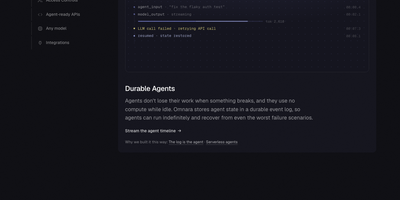
Running AI agents in production takes more than a model call: Omnara supplies the durable runtime, tools, approvals, and complete event history around any model, on your own machines. You define an agent once in a small YAML file: instructions, a model from OpenAI, Anthropic, OpenRouter, Bedrock, LiteLLM, Ollama, or your own endpoint, and the machines it may use. Launch agents from the REST API, the TypeScript SDK, the command line, or the dashboard, then stream every event live or receive it as a webhook while the agent works. Agents run shell commands and edit files on sandboxes from twelve providers, or on your own laptops, VMs, and containers through a daemon that connects outward, so no inbound ports or SSH keys are exposed. Every step is written to Postgres as an event log, which means an agent survives crashes, restarts, and disconnected machines and resumes exactly where it stopped. Tool permissions can run immediately, ask a person first, or block outright, and agents can start subagents, follow cron schedules, and keep shared memory files between conversations. Teams meet the agents where they already talk: mention the bot in Slack or Discord, or let a GitHub pull request trigger a review, with questions and approvals handled in the thread. Running on a dedicated VPS on RepoCloud with guaranteed CPU, RAM, and SSD, full root SSH access, and a browser serial console. Apache-2.0 licensed.
OpenMA
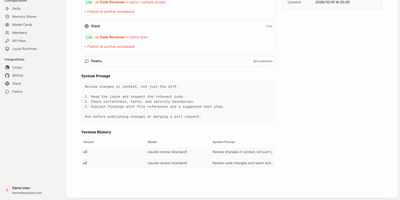
OpenMA lets you build and run AI agents with the model, harness, and sandbox you choose, on infrastructure you control, while it handles the sessions, execution, and recovery around them. Create an agent in the console, give it work, and come back later to the same session, because conversation history, streamed progress, and execution attempts are preserved rather than tied to one process that might die. Agents start with shell, file, web, and browser tools, then grow through MCP services and reusable Skills, while resources such as GitHub repositories, uploaded files, and shared memory attach to the work that needs them. Deployments run agents manually or on schedules you define, environments carry their own networking and package configuration, and model cards keep provider settings in one place instead of scattered environment files. If a sandbox fails, the session survives it; a replacement harness can rebuild context from durable events and workspace checkpoints. Operate everything through the console, the API, or the CLI, and plug in the database, queue, and object storage your deployment already trusts. Running on a dedicated VPS on RepoCloud with guaranteed CPU, RAM, and SSD, full root SSH access, and a browser serial console. Apache 2.0 licensed.
AgentFlux
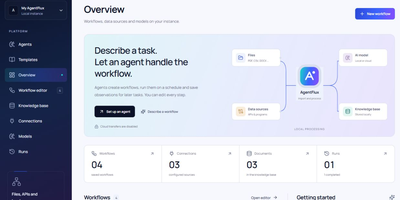
Describe the task in plain words, pick the sources and model it may use, and an agent plans the workflow before running it. That is the core loop: agents build editable visual workflows from a task description, execute them on demand or on a schedule, and keep everything traceable. Prefer building by hand and the canvas offers 17 preconfigured steps, branching, undo and redo, JSON import and export, plus eight starter templates. Feed it real work by importing PDF, DOCX, XLSX, CSV, JSON, and text files, or by connecting folders, HTTP endpoints, and approved local programs. Upload a screen recording and it identifies the actions with timestamps, turning a demonstrated process into an editable workflow you can refine. Model calls go to the endpoint you choose: Ollama, LM Studio, vLLM, or any OpenAI-compatible service, local or cloud with your own credentials. Every run can be inspected step by step, cancelled mid-flight, and exported as JSON, CSV, or Markdown reports. Observations from completed runs land in a knowledge and learnings store, where you review them and promote the useful ones into reusable skills for the next task. The Docker release bundles the application with FFmpeg and local Whisper support, and your documents stay on your own machine. Running on a dedicated VPS on RepoCloud with guaranteed CPU, RAM, and SSD, full root SSH access, and a browser serial console. Apache License 2.0 licensed.
ShowAI
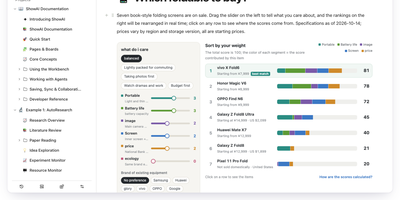
Your coding agent answers a question, and instead of a wall of Markdown you get a page you can actually use. ShowAI turns replies into interactive pages built from text, tables, charts, flow diagrams, sliders, and boards, so you can drag a weight, compare options, or step through an idea and watch the result change. Every page is saved as versioned files in a local project, with undo, retained drafts, and conflict protection, and the agent reads your edits before it continues. Select any text, cell, or board object to ask the agent to expand, reorganize, or visualize it, and run several conversations on one project in parallel. When a needed component is missing, the agent builds it, and pages that work can be distilled into templates. Export a page as standalone HTML, an inline fragment, or a static site. Connect a self-hosted ShowAI Server for projects shared by administrators, editors, and viewers, with account login and device management. Running on a dedicated VPS on RepoCloud with guaranteed CPU, RAM, and SSD, full root SSH access, and a browser serial console. MIT licensed.
CUGA
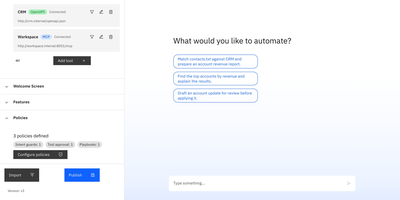
Turn a plain business request into a finished workflow, with a human sign-off on anything risky. CUGA is an agent harness you run on your own infrastructure, with a browser workspace where you build agents, test them beside a draft chat, and publish a versioned configuration when it behaves. Connect tools through MCP servers or OpenAPI specs, then write five kinds of policy: intent guards, playbooks, tool guides, tool approvals, and output formatters. A supervisor agent can route work to specialists that each carry their own tools and instructions. The chat workspace keeps conversation threads, uploaded files, and a knowledge panel for cited answers from company documents. Event Studio runs watchers on cron schedules, polling, or push triggers, with run history showing tools used and results. Memory records task guidance and user preferences, shows where each came from, and lets users switch it off or forget items, and administrators set retention rules. OIDC sign-in separates chat users from managers. Point it at any OpenAI-compatible endpoint, including a private inference server. Operations teams, internal tooling groups, and platform engineers can automate CRM reports, document review, and recurring briefs without sending data outside their boundary. Running on a dedicated VPS on RepoCloud with guaranteed CPU, RAM, and SSD, full root SSH access, and a browser serial console. Apache-2.0 licensed.
Agent Zero
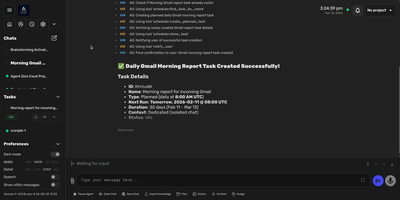
Agent Zero equips large language models with a persistent virtual Linux desktop, letting autonomous AI agents write code, research the web, and execute multistep tasks without supervision. Operating within an isolated container, the system opens an interactive XFCE graphical desktop in your browser canvas where the agent interacts with GUI applications like Blender and terminal sessions directly. Its embedded browser features interactive annotation tools, letting you click web elements to inspect stylesheet hierarchies, extract component markup, or submit automated testing instructions. You can cowork on spreadsheets, presentations, and Markdown specifications in real time alongside the agent, preserving document revisions through snapshot time travel. A multi-tier memory architecture backed by FAISS vector indexing and SearXNG web discovery retains problem-solving context across projects, while hierarchical delegation spins up specialized subordinate agents to parallelize complex engineering audits. The platform connects seamlessly to commercial LLMs via OpenAI, Anthropic, or OpenRouter, runs private local models through Ollama, and integrates custom toolkits via the Model Context Protocol and community Plugin Hub. Running on a dedicated VPS on RepoCloud with guaranteed CPU, RAM, and SSD, full root SSH access, and a browser serial console. MIT licensed.
DB-GPT
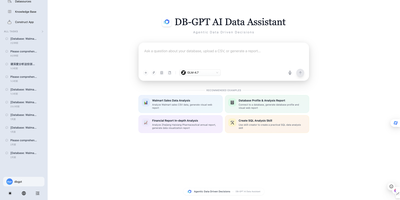
DB-GPT lets a team talk to its data: ask a business question in plain English, and an AI agent plans the work, writes the SQL, runs it, and hands back charts and a written report. Connect MySQL, PostgreSQL, SQL Server, ClickHouse, DuckDB, Doris, StarRocks, or MaxCompute, or drop in CSV and Excel files, including several at once. Every step appears in a live task view with its query, result table, code, and console output, and the agent pauses to ask clarifying questions, with answer options, when the data cannot settle the matter. Reusable skills package proven procedures, including CSV analysis, SQL analysis, and financial report analysis, and a skill creator helps write new ones. Code executes in a sandbox, parallel sub-agents split larger jobs, and an agentic knowledge-base search answers questions over uploaded documents. Scheduled tasks run saved conversations on a cron timetable with on/off switches and execution history, while MCP connectors link tools like Notion, Linear, Tavily, and GitHub. Pick OpenAI, DeepSeek, Qwen, SiliconFlow, Ollama, or vLLM for the model, then use the application and AWEL workflow tools to build data apps of your own. Running on a dedicated VPS on RepoCloud with guaranteed CPU, RAM, and SSD, full root SSH access, and a browser serial console. MIT licensed.
Garcon
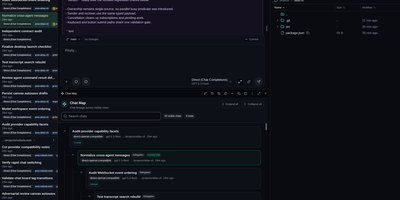
Garcon gives developers one browser workspace for running several coding agents at once, steering their work live, and turning reviewed changes into commits. Tile up to four resizable windows, move chats between them, and place live sessions on durable canvases that show delegated children, handoffs and parentage. Turn that activity into a tag-driven delivery board, or create tickets first and open chats from them with the project, priority, assignee and discussion already attached. Queue instructions, reorder them, answer agent questions, approve tool calls, pause work, interrupt a run or stop it without losing the transcript. Exchange labelled messages between chats, delegate bounded tasks to child agents, and bring final results back into the parent conversation. Browse and edit files, open terminals, inspect reasoning and tool calls, then stage individual lines, hunks, files or folders before committing and pushing. Search transcripts, save filters, pin or archive chats, export Markdown or XML, schedule prompts for later, and review token use and estimated API cost by day, agent and model. Connect trusted remote executors when work belongs on another machine, and open the same workspace from a phone when an agent needs a decision away from your desk. Running on a dedicated VPS on RepoCloud with guaranteed CPU, RAM, and SSD, full root SSH access, and a browser serial console. GPL-3.0 licensed.
Pizza Bot
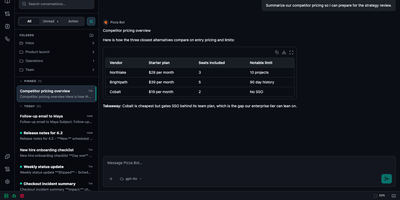
Start an AI task, close the tab, and come back to finished work waiting in an inbox. Pizza Bot keeps agents running when you navigate away or disconnect, sorting results into Unread for completed work and Action for approvals that need your decision. Conversations can be grouped into folders, pinned, searched, and forwarded from any message, without hiding matching items from the global queues. Schedules run a prompt on a cron expression with a time zone, and webhooks start a run from an external alert. A shared pool of Markdown memories carries your preferences into every conversation. Skills package step-by-step playbooks with scoped tools, and plugins bundle skills with MCP servers, so a request can be handed to a specialist subagent whose progress shows in an Activity panel. Connect Amazon Bedrock, Anthropic, Google Gemini, OpenAI, OpenRouter, Requesty, Opper, or Ollama, or point OpenAI at any compatible endpoint. Local folders are visible to the agent only after you grant them, read-only by default. Open it in the browser from one container behind a bearer token, or use the desktop app or terminal client against the same server. Running on a dedicated VPS on RepoCloud with guaranteed CPU, RAM, and SSD, full root SSH access, and a browser serial console. Apache-2.0 licensed.
AstrBot
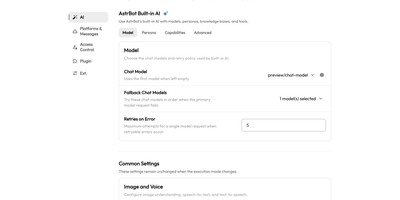
Getting a language model into the chat apps people already use takes a single self-hosted server running AstrBot, which answers in QQ, Telegram, Discord, Slack, Lark, DingTalk, LINE, and WeCom. The model itself is a setting. OpenAI-compatible endpoints, Anthropic, Google Gemini, DeepSeek, Ollama, and LM Studio all work, with fallback models and retry limits for failed requests, and Dify, Coze, or Alibaba Cloud Bailian can take over a conversation too. A bare model cannot act, so the built-in agent calls MCP servers and Skills, delegates to SubAgents, runs scheduled tasks, and executes code in an isolated sandbox. It cannot read your files either, so a knowledge base takes PDF, Word, Markdown, and EPUB uploads and searches them with hybrid dense and BM25 retrieval. Personas shape each bot's personality, and Whisper or Edge TTS adds speech. When an answer looks wrong, the ChatUI shows thinking, tool calls, token counts, and latency, and a per-message trace timeline shows how the bot got there. Because the panel steers the bot, administrator IDs, session whitelists, optional TOTP login, and HTTPS protect it. Backups live under System Settings, and the plugin market installs any of more than 1,000 extensions in one click. Running on a dedicated VPS on RepoCloud with guaranteed CPU, RAM, and SSD, full root SSH access, and a browser serial console. AGPL-3.0 licensed.
Xiryn
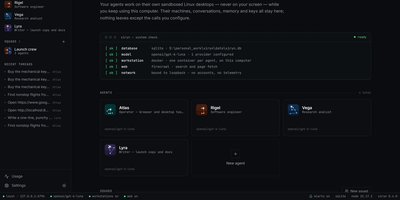
Picture a small staff of AI agents clocking in on your own server, each with a name, a specialty, its own model, and a private Linux desktop it can click around in. Every agent works inside a disposable Docker workstation with a shell, persistent files, and a Chromium browser, so it can research the web, write and run code, and finish multi-step tasks without touching your own files. You watch an agent click and type in real time, and when a login, payment, or one-time code needs a human, you take over the desktop, then hand it back with a note and let it continue. Pair a Telegram bot by scanning a QR code and you can assign work, answer questions, and receive results from your phone, with no public URL or port forwarding. Routines turn recurring requests into schedules, so a morning briefing, a price watch, or a weekly report runs by itself and reports back when it is done. Each agent can use a different model, from OpenAI, Anthropic, Google, xAI, Groq, Mistral, or DeepSeek to a local Ollama endpoint, and every reply shows its cost while a monthly budget pauses paid models automatically. Agents remember what matters about you across every thread, and logins or cards you save sit in an encrypted vault the agents themselves never see. Running on a dedicated VPS on RepoCloud with guaranteed CPU, RAM, and SSD, full root SSH access, and a browser serial console. MIT licensed.