Malloy Publisher
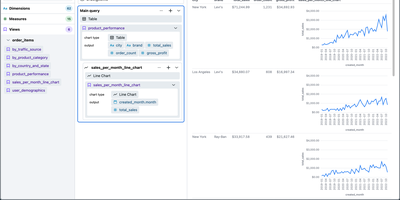
Analytics teams, and increasingly the AI agents working beside them, get one shared definition of the business from Malloy Publisher instead of a pile of SQL queries that each compute revenue slightly differently. You model what your data means once: the sources, the joins, the measures, and who may see what. Agents then compose queries against that model over MCP, so there is no wrong join, no invented column, and no fan-out that double-counts while looking plausible, and the same question returns the same numbers tomorrow. Applications and BI tools reach the same model over REST, and unattended agents use the same governed path instead of scraping raw tables. Reports declared in Malloy read top to bottom or lay out as tile grids you can build by dragging, no-build HTML data apps ship inside the package, and the built-in Console lets anyone browse environments, packages, models, and results without writing code. Access rules decide who may query and which rows they see, discovery curation decides what is even visible, and a single annotation materializes an expensive source or pre-aggregates it on a schedule. Local files work through built-in DuckDB, while BigQuery, Snowflake, Postgres, Databricks, and others connect when the data already lives there. Running on a dedicated VPS on RepoCloud with guaranteed CPU, RAM, and SSD, full root SSH access, and a browser serial console. MIT licensed.
Atom
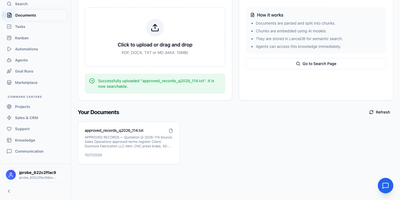
Give an AI agent a price list and it drafts the quote; hand it an invoice and it checks the numbers against purchase and receiving records before anyone pays. Atom is a self-hosted AI agent platform for business automation that wraps every agent action in governance: permissions, ordered policies authored in a canvas editor, human approval checkpoints, and durable audit records. Work starts from your files and instructions, with demonstrated workflows that map unfamiliar spreadsheet columns, calculate against source records, and produce cited Word or PowerPoint documents you can inspect line by line. Corrections become reusable teaching: saved field mappings, commercial terms, and contextual lessons carry into new work, and each job keeps the accepted snapshot it started with. Questions, approvals, and waits survive restarts, completed operations are retained, and uncertain effects must be reconciled before anything retries, so long-running business processes do not silently double-act. Results keep provenance back to the source records and operations that produced them, and unresolved requirements block completion instead of being invented away. You bring the model: configure a hosted provider or a local OpenAI-compatible endpoint, route by capability and cost, and run everything in a single-tenant workspace with user, role, and workspace boundaries. A starter sample runs with no model or cloud key at all. Running on a dedicated VPS on RepoCloud with guaranteed CPU, RAM, and SSD, full root SSH access, and a browser serial console. AGPL-3.0 licensed.
Nerve
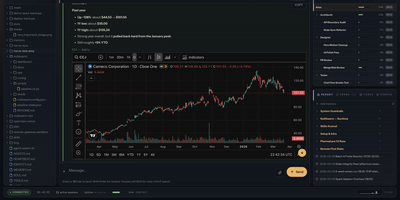
Nerve is the web cockpit for OpenClaw, giving you one real-time screen to run an entire fleet of AI agents instead of chasing them through chat threads. Every agent keeps its own workspace, memory, identity, and skills, and you can switch between agents, browse their files, and edit memory or configuration in a tabbed editor during a live conversation. Work moves onto a kanban board where subagents pick up delegated tasks, and returned work waits in a proposal inbox for your review before it is accepted. Cron jobs run as their own sessions in a navigable session tree, so scheduled automation has logs and output you can actually inspect. Voice is a first-class input: push to talk or use a wake word, watch live transcription, and hear replies spoken back in your chosen language. Ask for a chart and the answer arrives as a real rendered chart, with diffs, file previews, and highlighted code inline in the stream. Token usage, running costs, and context pressure stay visible on every session, so long tasks never quietly drain your budget. Run it privately on localhost, reach it over your LAN behind password authentication and signed-cookie sessions, or keep access inside a Tailscale tailnet. Running on a dedicated VPS on RepoCloud with guaranteed CPU, RAM, and SSD, full root SSH access, and a browser serial console. MIT licensed.
Murmur
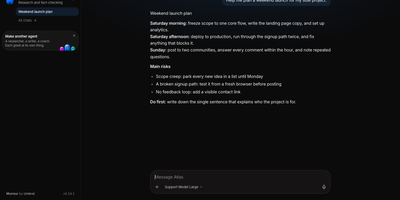
Every AI agent gets a face, a colour, and a job in Murmur, a chat app that makes running Hermes Agent as friendly as texting a colleague. Start from a template (Researcher, Writer, Planner, Coder, Coach, or Chef) or describe a new agent from scratch, then talk to one at a time or drop several into a group room and call on a single one with an at-mention. Replies stream in live, long jobs show a plan that ticks itself off, and every step appears in plain words. Connect a model with a ChatGPT plan, a local model server, or an API key from OpenRouter, OpenAI, Anthropic, and others, with the model and thinking effort chosen per agent or chat. Agents can reach Notion, Linear, Todoist, Figma, and dozens of other apps, and they ask for an Allow or Don't allow before changing anything important. Morning briefings run as routines, a memory view shows what each agent knows with controls to edit or forget it, and WhatsApp or Telegram can be linked by scanning a code. A voice call mode lets an agent answer out loud, and slash commands set long-running goals or ask quick side questions. Chats sync across browser, desktop, and phone. Solo builders, homelab fans, and small teams get a calm front door to their own agents. Running on a dedicated VPS on RepoCloud with guaranteed CPU, RAM, and SSD, full root SSH access, and a browser serial console. MIT licensed.
ShadowBroker
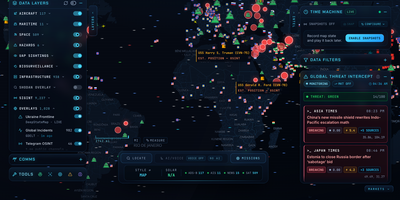
ShadowBroker puts aircraft, ships, satellites, hazards, news, and radio signals from over 60 public feeds on a single dark-themed world map that runs on your own server. More than 40 layers switch on and off independently, with a left sidebar of groups for aircraft, maritime, space, hazards, infrastructure, and overlays, each showing live counts. Click an aircraft to open a detail card with operator, photo, type, and registration, or search a callsign and let the map fly there. A threat panel scores the day from headlines and lists breaking stories with source counts. Flip between dark, satellite, and street map styles, record snapshots with the Time Machine, and drop pins or layers of your own. The AI Intel tool walks you through connecting an agent as a co-analyst: pick a local or remote agent, choose read-only or full access, and copy ready-made environment variables for HMAC signing. Agents can search telemetry and news, run recon lookups, and move the map for you. The first-run briefing also lists free sources that need no keys. Running on a dedicated VPS on RepoCloud with guaranteed CPU, RAM, and SSD, full root SSH access, and a browser serial console. AGPL-3.0 licensed.
OpenVoiceUI
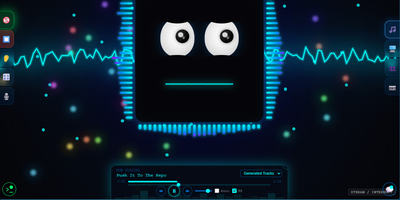
OpenVoiceUI is the voice-first front end for a self-hosted AI agent that lives entirely on your own hardware; you talk, it answers out loud, and it builds live pages on screen while the conversation runs. Hold a hands-free conversation with wake word, push-to-talk, and the ability to interrupt, or switch to text when the room is quiet. Speech recognition runs in the browser for free or through Deepgram, Groq Whisper, or your own Whisper server, while nine speech providers from local Supertonic to ElevenLabs give the agent its voice, cloned voices included. As it talks, the agent opens live canvas pages, dashboards, galleries, reports, and tools, and files them on an OS-style desktop you can reopen from the start menu. Ask for music and it generates songs with a built-in player and playlists; ask for images and it creates those too, alongside an audio clip maker and a soundboard. Profiles swap the agent's persona, voice, and model provider, animated faces react while it speaks, and sub-agents and workspace files stay visible in the admin dashboard. The agent itself runs in the OpenClaw gateway with your choice of model provider, so your keys, conversations, and files never leave your server. Running on a dedicated VPS on RepoCloud with guaranteed CPU, RAM, and SSD, full root SSH access, and a browser serial console. MIT licensed.
Agenvoy
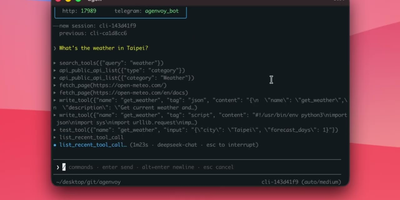
While ordinary chatbots sit idle between prompts, Agenvoy runs around the clock on your own machine, turning one-sentence requests into finished research, files, and reports. Say what you need once and it builds the missing tool itself, tests that tool inside a sandbox, saves it, and reaches for it again the next time a similar job appears. Recurring work becomes a schedule in plain words; a morning briefing, a watched folder, or a weekly report then runs unattended, and a long task interrupted mid-run resumes from its checkpoint instead of starting over. Ask questions about your own files and it searches them like a private archive, transcribing audio and video into text it can quote back to you. Each task is routed to the model tier that fits it, a light model for lookups and a heavy one for hard reasoning, across subscription logins, API keys from eleven providers, or a local Ollama that never phones home. Commands run in a sandbox with the network off until you approve a call, sensitive paths ask before they open, and credentials wait in the system keychain instead of the chat history. You drive it from the terminal, the browser dashboard, or Telegram and Discord when you are away from the desk, and it lends its sandboxed tools to Claude Code and Codex over MCP. Running on a dedicated VPS on RepoCloud with guaranteed CPU, RAM, and SSD, full root SSH access, and a browser serial console. AGPL-3.0 licensed.
Varin
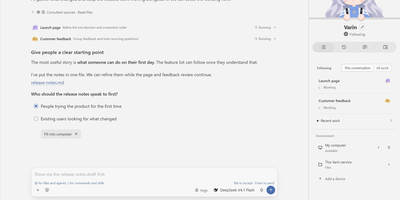
Talk to one assistant and a small team of agents quietly does the heavy lifting in the background. Ask for something in plain conversation and it answers, delegates tasks to other agents, and shows their progress in a side panel next to the thread. Answers are not just paragraphs: choices, checkboxes, tabbed drafts, tables, and live charts with adjustable sliders appear right inside the conversation. Open the Workbench to follow a task and message the agent doing it, or switch to the IDE for a Monaco editor, diffs, terminals, and Git beside the chat. Agents can read and edit files, run shell commands, search the web, work with PDF and Office documents, browse pages, and call MCP servers, skills, and extensions. Memory is inspectable and editable, work can be scheduled, and Codex or Claude Code can join as external agents. Connect any model provider or local service and watch usage and estimated cost per model. Running on a dedicated VPS on RepoCloud with guaranteed CPU, RAM, and SSD, full root SSH access, and a browser serial console. AGPL-3.0 licensed.
Kanzo
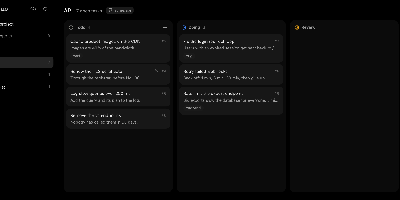
Give your coding agents a board they can work, not just read: Kanzo is a self-hosted kanban board where you and your agents move the same tasks through the same columns at the same time. Tell an agent to take the next task and it moves the card to doing, comments as it works, and leaves the result where you can read it in the browser. Projects follow the code automatically: the agent finds the right board from the Git remote of the repository it is working in, and you can link more repositories to a project from its menu. Press n to add a task, search every project with a slash or Command-K, paste an image straight into a card or comment, and park half-formed ideas in an optional Backlog column that agents leave alone until you promote them. The whole board is one folder, and a private Git repository you own keeps it in step across a laptop, a desktop, and a Raspberry Pi, with conflicts resolved by choosing which side to keep. Statuses are yours to rename in the config file, the board exports cleanly to Markdown or JSON, and one click in the sidebar installs updates and restarts the service. Running on a dedicated VPS on RepoCloud with guaranteed CPU, RAM, and SSD, full root SSH access, and a browser serial console. AGPL-3.0 licensed.
RustXNG
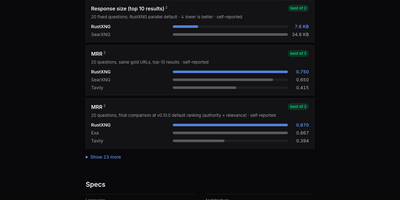
RustXNG gives your AI agents a private web search API that needs no keys, no accounts, and no per-search fees: ask once and get ranked results plus the text of the top pages, ready to ground an answer in real sources. A single request fans out to 180 search engines in parallel, drawn from 226 engine types covering general web, images, video, academic literature, package registries, and news, then merges what comes back with its own ranking that rewards term coverage and canonical-site authority instead of trusting any one engine's order. Engines that time out or keep answering nothing are suspended with backoff and rested automatically, so one dead source never stalls a task, and a repeated query returns from cache in about a hundredth of a second. Call it over HTTP with the familiar SearXNG-shaped JSON, CSV, RSS, or HTML formats, narrow results by domain, engine, or time range, or run the built-in MCP server and hand your agent native search and read_page tools with bounded, truncation-aware responses. Page fetches are hardened against untrusted URLs, an experimental local index can crawl your own corpus and merge it into results, and health, metrics, and per-engine status stay visible through the ops endpoints and the browser UI. Running on a dedicated VPS on RepoCloud with guaranteed CPU, RAM, and SSD, full root SSH access, and a browser serial console. AGPL-3.0 licensed.
ADHDev
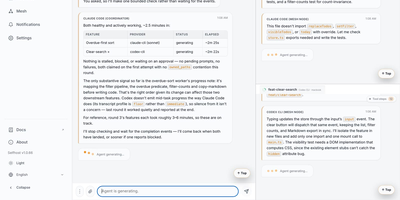
Your laptop, a desktop, and a build box each have a coding agent installed, and until now nothing has coordinated them. ADHDev is a self-hosted control plane that puts Claude Code, Codex, Kimi, Cursor CLI, Antigravity CLI, Grok CLI, and OpenCode behind one shared task queue and one web and mobile dashboard. Machines pair directly with an address and a one-time code on your own network, and a mesh binds to a single repository. Idle nodes claim tasks themselves. Dependencies order the queue, retries absorb failures, and missions group the work that belongs together. Every task gets an isolated git worktree the moment it starts. Agents build in parallel without touching each other's files, and the coordinator's prompt is rendered from live mesh state at launch, with events pushed in as they happen. Difficulty tags route easy work to cheap models and hard work to strong ones. The dashboard also reads how much of each subscription window remains, skips plans that are nearly empty, and shows the routing forecast before anything runs. Finished work enters the Refinery. Your repository's gates decide, the branch is rebased onto main, and the merge happens only when main has not moved, followed by automatic worktree cleanup. Running on a dedicated VPS on RepoCloud with guaranteed CPU, RAM, and SSD, full root SSH access, and a browser serial console. AGPL-3.0 licensed.
Agentic Resource Registry
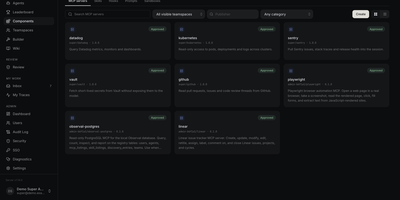
Every team building with coding agents has the same drawer problem: the best Skill, MCP server, or agent file lives in one person's repo, undocumented, while three colleagues rebuild it from scratch. Agentic Resource Registry is the internal catalog that ends the duplication, a self-hosted registry where your organization publishes Skills, MCP servers, hooks, prompts, agent files, and sandboxes in one searchable place. Browse by teamspace, publisher, category, or harness and see at a glance what each resource supports and how often it has been pulled. Authors build agent files in a four-step builder with a live summary and draft readiness checks, then submit them into a review queue where admins inspect the full prompt and version diffs before approving. Forking an approved release creates your own draft with pinned components, and reviewers can compare it against upstream line by line. The companion CLI installs any approved resource into Claude Code, Cursor, Codex, Kiro, Copilot, OpenCode, Pi, and more, generating the correct config for each harness automatically. Approved resources are also discoverable over the open ARD standard, so a running agent can hand part of its task to another approved agent or a remote A2A service. Running on a dedicated VPS on RepoCloud with guaranteed CPU, RAM, and SSD, full root SSH access, and a browser serial console. Apache-2.0 licensed.
Overclick
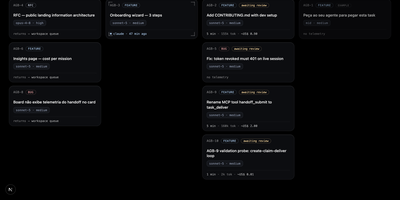
OverClick is the task board where your AI agents clock in: you write the assignments, they claim the work, and you stamp what actually got done. A card here is a contract, not a ticket: what should happen, why it matters, and a plain-language test script that says how to confirm it, all written before anyone starts. You tell your agent to grab the next task, and it claims the card over MCP, declares the CLI and model it really runs on, receives a self-contained briefing with the mission context and branch convention, and the card slides into progress. When it finishes, the handoff lands with a summary, evidence, branch and pull request links, and measured telemetry, the tokens per model and minutes the run actually took, read from the session transcript rather than guessed. Every card keeps three roles straight, who asked, who executed, and who reviews, and only a human can mark it validated; reopening with a comment puts your note in front of the agent's next claim. Big decisions can start as RFC cards whose approval spawns the execution cards, and insights roll up what each project, mission, and model consumed. Running on a dedicated VPS on RepoCloud with guaranteed CPU, RAM, and SSD, full root SSH access, and a browser serial console. MIT licensed.
SITREP
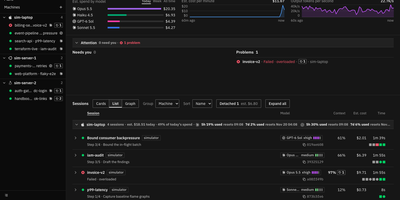
Watch every coding agent you run, on every machine, from one live browser dashboard. Sessions appear as cards, a sortable list, or a graph, grouped by machine or project, each showing its plan and current step, subagents, model and effort, context fill, git branch, and cost. Anything waiting on you, like a permission, a question, or a plan to approve, rises to a Needs you panel with the longest wait first, and you can answer it from the page or in the terminal. A Problems panel flags sessions that are stuck, failed, or colliding on the same file. The Plans board sorts every plan step into pending, in progress, review, blocked, and done. A session page adds a timeline of loops and subagents, changed files, and token and context charts. Spend is broken down by model and machine, and plan windows show how close each provider is to its limit. History keeps ended sessions by day, a wall view suits a spare screen, and browser alerts fire when a session needs you. Running on a dedicated VPS on RepoCloud with guaranteed CPU, RAM, and SSD, full root SSH access, and a browser serial console. MIT licensed.
Clawboo
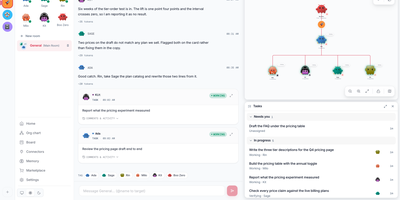
Describe the outcome once, in plain language, and a small crew of AI agents divides the work between them and reports back in the same chat. You type the request in the team chat; Boo Zero, the team lead, splits it into jobs on a shared board and hands each card to the teammate best placed to do it. Teammates run on Claude Code, Codex, Hermes, OpenClaw, or Clawboo's built-in runtime, and one team can mix them freely, so the researcher, the writer, and the coder can each work on their strongest tool. You follow every card live on the board and in the chat, watch the team graph to see who is doing what, and add a reviewer agent when a second pair of eyes matters. Finished work returns to Boo Zero, which pulls the pieces together and answers you in the chat. Ready-made teams from the marketplace cover marketing squads, dev teams, and research crews, and you can bring an API key from Anthropic, OpenAI, OpenRouter and more, a free local model through Ollama, or your ChatGPT subscription through the Codex CLI. Spend is tracked per team with budget warnings before costs surprise you. Running on a dedicated VPS on RepoCloud with guaranteed CPU, RAM, and SSD, full root SSH access, and a browser serial console. MIT licensed.
Deep Research Web UI
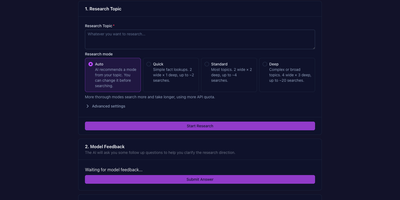
Ask a hard question and get back a cited report instead of a chat answer: Deep Research Web UI plans its own searches, reads the pages it finds, checks claims against the sources, and shows its work as it goes. The research unfolds as a live tree in your browser, each branch a search direction with streaming responses, so you watch a broad question narrow into answerable parts. When snippets are not enough, it fetches full source pages and extracts verbatim evidence, sharing one token and request budget across the run. Every claim cites its source inline, and clicking a citation opens an evidence panel with the source, retrieval time, and the excerpt behind the finding. Findings can be followed up: name what to verify and the agent searches again, updating only the passages that cite that finding while the original report stays untouched in your history. You bring the models, from OpenAI-compatible endpoints, DeepSeek, and OpenRouter to a local Ollama or LiteLLM proxy, paired with Tavily, Firecrawl, Google PSE, You.com, or Serply for the searching. Finished reports export as Markdown or PDF, search separates your question from time and source filters and retries once with a revised query when evidence is thin, and Server Mode keeps the team's API keys in environment variables behind an optional access password instead of in every visitor's browser. Running on a dedicated VPS on RepoCloud with guaranteed CPU, RAM, and SSD, full root SSH access, and a browser serial console. MIT licensed.
Aegra
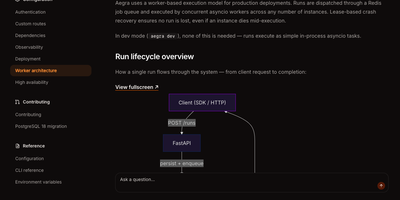
Aegra runs your LangGraph agents on your own infrastructure with the same SDK and APIs you would use on the managed platform, so moving in does not mean rewriting your agents. You deploy an agent once and clients connect through Agent Chat UI, LangGraph Studio, or CopilotKit, while threads, runs, and checkpoints persist between sessions instead of vanishing when a process restarts. Streaming answers arrive token by token over server-sent events, and if a connection drops, the stream reconnects and replays missed events rather than losing the run. Human-in-the-loop gates pause an agent at the step you choose, wait for a person to approve or edit, and then resume from exactly that state. Scheduled cron jobs trigger runs on standard or seconds-level expressions with timezone support, which turns agents into recurring workers for reports, checks, and follow-ups. When traffic grows, Redis-backed workers process runs with lease-based crash recovery, so a dead worker's job is picked up instead of disappearing. Authentication handlers plug in JWT, OAuth, or Firebase, custom endpoints sit beside the agent API, and traces fan out to the observability backend you already run. Running on a dedicated VPS on RepoCloud with guaranteed CPU, RAM, and SSD, full root SSH access, and a browser serial console. Apache-2.0 licensed.
OnGrid
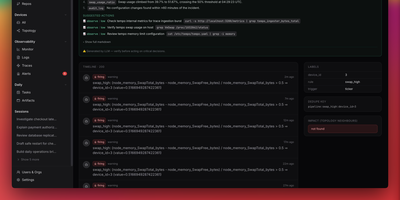
When an alert fires, OnGrid investigates it for you: an AI operations agent that correlates metrics, logs, traces, and topology, then names the root cause in plain language. A coordinator agent hands each question to specialist SRE, network, or database sub-agents, and the incident investigator walks the service graph for blast radius, queries Prometheus, Loki, and Tempo, and pins the cause to a line of source code before posting its report back to chat. Lightweight edge agents on every host dial out over a single tunnel, so no inbound ports are opened, and operators can reach any machine through an audited browser shell. The agent works through more than 26 read-only inspection tools in a sandbox, while anything that changes production waits behind an approval gate. Ask questions or receive reports in Slack, Telegram, Larksuite, DingTalk, or WeCom, and run it on Anthropic, OpenAI, GLM, DeepSeek, Gemini, Kimi, or any OpenAI-compatible endpoint. A workflow builder turns triggers, agents, tools, and notifications into repeatable automations, and a knowledge vault indexes runbooks, incident history, and repositories for search. Enroll Kubernetes clusters to inspect workloads and manage upgrades, or discover network neighbors, verify them over SNMP, and map them into the topology. Role-based access separates admins, users, and viewers. Running on a dedicated VPS on RepoCloud with guaranteed CPU, RAM, and SSD, full root SSH access, and a browser serial console. AGPL-3.0 licensed.