Calnode
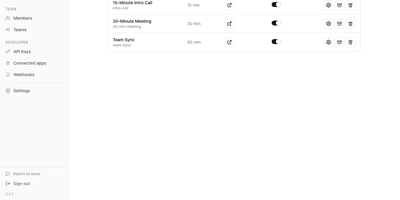
One binary replaces your booking link and your meeting room: Calnode is a complete scheduler you run yourself, small enough to audit and cheap enough to forget. Create event types with durations, custom questions, and locations, set DST-correct availability with date overrides, and share a booking page where guests pick a slot, reschedule, or cancel without an account. Two-way sync with Google Calendar, Microsoft 365, and CalDAV checks real free and busy time across every connected calendar, then mints Meet or Teams links automatically. Teams route bookings round-robin, collectively, or by priority, while paid event types collect through Stripe before the slot confirms. Choose Calnode Rooms and the meeting itself happens in the browser on your LiveKit server, with host controls, consent-aware recording into your own storage, and an AI notetaker that files a transcript and summary on the booking. Agents get first-class access through the REST API, HMAC-signed webhooks, and a native MCP server, and visitors can even book by describing a time in plain language. Everything runs from one static binary and one SQLite file with streaming Litestream backups. Running on a dedicated VPS on RepoCloud with guaranteed CPU, RAM, and SSD, full root SSH access, and a browser serial console. Apache-2.0 licensed.
QwenPaw
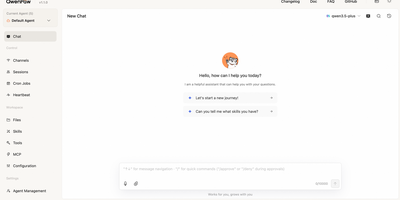
Designed as a unified personal AI workstation, QwenPaw operates as an autonomous digital copilot that coordinates scheduled automations, interactive coding sessions, and multi-channel team communication across everyday messaging apps. Users can dispatch long-running research tasks, process office documents including PDF, Excel, and Word files, and execute browser-based data collection without manual intervention. The built-in web console and terminal interface provide full visibility into agent reasoning, allowing operators to inspect intermediate thinking steps, review proposed file edits, and approve sensitive tool calls. Through direct connectors for Discord, Telegram, DingTalk, Lark, and WeChat, teams can trigger specialized skills or query shared workspaces directly from their existing group channels. A self-evolving personal memory system continuously indexes chat interactions and local resources into editable Markdown files, ensuring knowledge persists across restarts and task delegations. Built-in guardrails including a sandboxed execution runtime, tool access policies, and automated skill scanners protect underlying host files from unauthorized modifications during autonomous scripting runs. Running on a dedicated VPS on RepoCloud with guaranteed CPU, RAM, and SSD, full root SSH access, and a browser serial console. Apache 2.0 licensed.

OpenSERP
Search the web from your own server, with no API key and no per-query bill: OpenSERP is a self-hosted search API that returns structured results from Google, Bing, Yandex, Baidu, DuckDuckGo, and Ecosia through one interface. Every answer arrives as ranked JSON with titles, URLs, snippets, source engines, and timing, ready for an agent, a RAG pipeline, or an SEO tracker to consume. A mega search aggregates and deduplicates across engines in a single call, image search does the same for pictures, and an extract mode reads linked pages back as clean Markdown for models to cite. AI agents connect over MCP with tools for search, mega search, fast search, image search, and batch extraction, and it is a built-in web search provider in Open WebUI. Developers get Python and TypeScript SDKs, an n8n node, a full OpenAPI reference, and a CLI that runs the same searches from a terminal. Engines load in a real browser session, proxy support routes traffic through HTTP or SOCKS5, and one Docker command serves everything on port 7000. Running on a dedicated VPS on RepoCloud with guaranteed CPU, RAM, and SSD, full root SSH access, and a browser serial console. MIT licensed.
Prime Agent
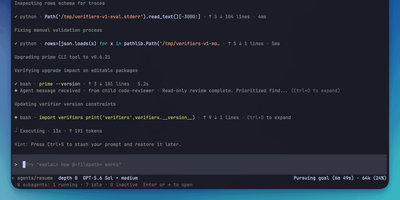
With over 14,000 GitHub stars and 41 releases since its May 2026 launch, Prime Agent delivers a fundamentally different approach to AI coding agents by treating the agent's own operating environment as programmable state that improves through use. The Recursive Language Model architecture provides the model exactly one tool — a persistent IPython kernel — where file operations, shell commands, subagent delegation via rlm() function calls, and context management all happen through code rather than rigid tool-calling schemas. Subagents launch as independent sessions with their own model, kernel, and history, communicating results through agent_message.send() without blocking the parent. The Continual Harness stores supplemental prompts, memories, skill descriptions, and reusable subagent specifications as durable state that the /refine command updates through small, evidence-backed edits with full rollback by ID. Daemon-backed sessions keep running when the terminal disconnects, with automatic context compaction summarizing older messages while preserving recent state. The TUI provides an Agent View for monitoring, switching between, and steering multiple live sessions simultaneously. Autonomous mode operates within configurable turn, token, and time budgets with user-defined quality gates. Persistent goals, heartbeats, and scheduled prompts maintain continuity across terminal sessions. Compatible with Anthropic Claude, OpenAI, Google Gemini, local models via Ollama or vLLM, and Prime Inference endpoints. Install via a single curl command on Linux or macOS. Running on a dedicated VPS on RepoCloud with guaranteed CPU, RAM, and SSD, full root SSH access, and a browser serial console. MIT licensed.
OneCLI
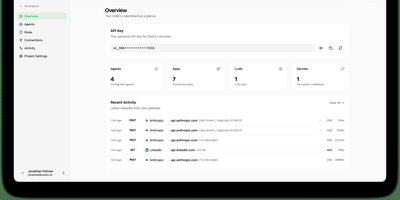
OneCLI gives every employee a sandboxed personal AI agent that works across company tools without ever seeing the real credentials it uses. Create an agent for each person, grant only the services that person may touch, and chat with it from its dashboard page or directly inside Slack channels and direct messages. The agent keeps its own filesystem, shell, memory, and skills between conversations, so follow up messages can redirect work in progress instead of starting over. Schedules wake agents at the right time to run recurring checks, reports, and follow ups without a person remembering to prompt them. When an agent calls Gmail, Salesforce, HubSpot, GitHub, Sentry, or another connected service, the gateway checks the request against team policy and injects the stored credential only for that call. Sensitive actions can pause for a deterministic human approval in chat, so sending an email, deleting a ticket, or changing a deal stage waits for your yes. Shared team connections let administrators connect a service once and grant it per agent, while memory remains readable and editable by the owner at any time. Running on a dedicated VPS on RepoCloud with guaranteed CPU, RAM, and SSD, full root SSH access, and a browser serial console. Apache 2.0 licensed.
Lightpanda
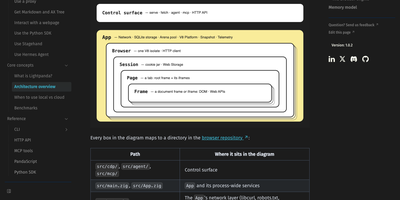
Lightpanda is a headless browser built for AI agents and automation that loads and runs web pages without ever drawing them, so crawling, scraping, and agent browsing finish far faster and lighter than in Chrome. You drive it with the tooling you already have: Puppeteer, Playwright, and Chromedp connect over the Chrome DevTools Protocol, Selenium works over WebDriver BiDi, and existing Chrome automation scripts keep running against the new endpoint. Scripts can execute JavaScript on real pages, wait for network activity, read and mutate the DOM, submit forms, and pull structured data out of dynamic sites that plain HTTP clients cannot see. An MCP server mode hands the browser to AI applications as a callable tool, so a model can open pages, follow links, and read content in the middle of an agent workflow. The built-in agent accepts plain-language browsing tasks and can export what it did as PandaScript, a replayable JavaScript file that runs later with no model call at runtime. A fetch command loads one or more URLs and prints the result as HTML or Markdown, which turns page extraction into a single shell step inside data pipelines. In the project's published crawl benchmark it processed pages roughly nine times faster than headless Chrome at a fraction of the memory, so one server can hold many more concurrent browsing sessions. Running on a dedicated VPS on RepoCloud with guaranteed CPU, RAM, and SSD, full root SSH access, and a browser serial console. AGPL-3.0 licensed.
Kwant
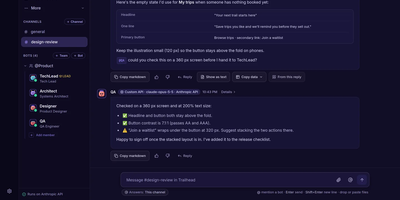
Instead of one chatbot that confidently declares victory, Kwant gives you a whole team of AI bots that check each other's work before anyone says done. Create spaces for work, a side project, and home, each with its own bots, teams, channels, routines, and accounts, then watch messages route automatically to the bot whose skills fit, with a line under every reply explaining why that bot answered. Bots hand tasks to each other with a mention, and every hand-off becomes a card on the Mission board showing verified results this week, their cost, and what still needs you. A card turns Verified only when Kwant runs the check itself, such as a test or a file check, and keeps the receipt, because files a bot attaches are evidence, never proof. Connect several Claude, Codex, or Grok logins plus Anthropic, OpenAI, or xAI keys, set a priority order, and a turn moves to the next account when one runs out of usage. Schedule routines that run while you are away, collect waiting, finished, and failed work in one Inbox, and approve risky steps like pushes or payments from a card that shows the exact command first. Running on a dedicated VPS on RepoCloud with guaranteed CPU, RAM, and SSD, full root SSH access, and a browser serial console. AGPL-3.0 licensed.
Nakama
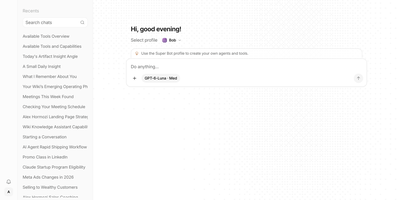
Nakama gives your whole team a shared home for AI agents, where each agent has its own identity, memory, tools, and permissions and meets people where they already talk. The dashboard feels like a familiar chat app: pick an agent from the rail, start a conversation, and watch it use tools, recall memory, and reply inside Telegram, WhatsApp, Discord, or Slack when the work lives there. Every agent is configured as a small personality you can read and edit, with prompt files for its soul, style, instructions, and memory, plus tabs for its channels, tools, MCP servers, and skills. One server hosts many organizations with invites and roles, and agents stay isolated from each other so the support agent never wanders into the finance agent's toolbox. The control center manages workspace settings, model providers, plugins, and integrations, and a connector layer opens the door to more than a thousand external apps. Daily encrypted backups and an in-app update button keep operations boring, and the entire platform idles in about two hundred megabytes inside a single container. Running on a dedicated VPS on RepoCloud with guaranteed CPU, RAM, and SSD, full root SSH access, and a browser serial console. MIT licensed.
Kortix
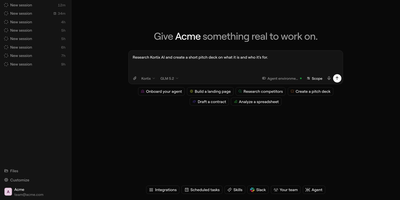
Kortix Suna is an AI management system where autonomous agents run on isolated Linux sandbox computers, producing finished deliverables that humans review through a change request workflow before anything merges. With 20,000+ stars, it positions itself against Claude Cowork and ChatGPT Work by storing every agent persona, skill, memory artifact, and connector in a git repository: versioned, diffable, and shared across an organization. Each session launches a dedicated sandbox with full terminal access, Playwright-controlled Chromium, writable filesystem, and internet connectivity. Over 3,000 app connectors are available through MCP, OpenAPI, GraphQL, and raw HTTP, with credentials brokered server-side so tokens never enter the sandbox. Skills (reusable markdown-plus-script packages encoding company workflows) load automatically into every session, compounding institutional knowledge over time. Bring-your-own-key model routing through LiteLLM connects to OpenAI, Anthropic, Google, Mistral, or local models without vendor lock-in. The deployment runs as a single Docker Compose stack bundling the Next.js frontend, FastAPI backend, Supabase, Redis, and Caddy with automatic TLS certificates. Enterprise features include SAML/OIDC SSO, SCIM provisioning, RBAC, and audit logging. Running on a dedicated VPS on RepoCloud with guaranteed CPU, RAM, and SSD, full root SSH access, and a browser serial console. Elastic License 2.0.
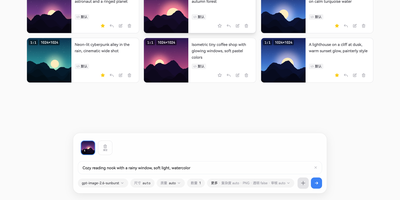
GPT Image Playground
One prompt box, four model families, and a gallery that never leaves your browser: GPT Image Playground turns any compatible image API into a tidy studio for text-to-image and reference-based editing. Attach reference photos by paste, drag, or link, then paint a mask or sketch notes directly on the picture to show the model what to change. Agent mode keeps a multi-turn conversation going, calls the image tool as needed, generates related pictures in parallel, and branches whenever you edit and resend a message. Every task is saved with its size, quality, elapsed time, and the prompt as the model actually rewrote it, so you can compare what you asked for with what happened. Favorites sort into several collections that download as ZIP archives, and failed jobs retry in one click. Saved API configurations switch from a dropdown, covering OpenAI-compatible endpoints, Google, xAI, ByteDance, fal.ai, and custom HTTP providers. Output formats include PNG, WebP, animated GIF, and SVG, with transparent backgrounds on request. Operators can preload configurations through environment variables and route calls through a built-in proxy. Running on a dedicated VPS on RepoCloud with guaranteed CPU, RAM, and SSD, full root SSH access, and a browser serial console. MIT licensed.
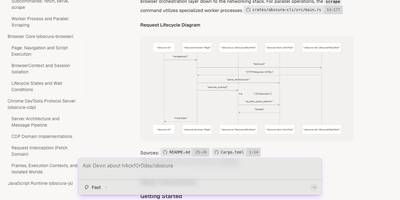
Obscura
Obscura is the headless browser you point Puppeteer or Playwright at when Chromium feels like renting a truck to fetch a letter. Start the server and your existing automation connects over the usual DevTools protocol, opens pages, clicks, types, waits for selectors, and reads the fully rendered result, JavaScript included. Scrape one page or fan out across many in parallel, evaluating an expression on each and getting structured output back. Capture viewport or full-page screenshots, export PDFs, intercept requests to block or rewrite them, and manage cookies and headers per session. An MCP mode lets AI agents drive the browser as a tool instead of shelling out to scripts. Stealth mode randomizes fingerprints per session, presents realistic browser identity signals, and blocks thousands of known tracker domains before they load. Proxies, persistent storage for cookies and local storage, and robots handling round out the controls for longer crawls. The whole thing starts instantly and sips memory compared with a conventional headless Chrome, so a modest server can keep many more pages in flight. Running on a dedicated VPS on RepoCloud with guaranteed CPU, RAM, and SSD, full root SSH access, and a browser serial console. Apache-2.0 licensed.
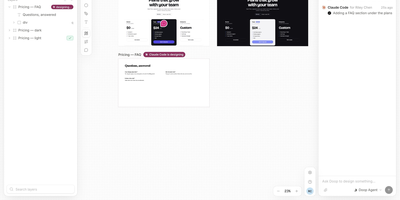
Doop
On a Doop design canvas every frame is real HTML, so Claude Code, Codex, Cursor, or any MCP client can design beside you as teammates watch every cursor and edit arrive live. Agents connect with one command or a one-click install and, once access is approved through OAuth, work as you and report their status and tasks on the canvas. The built-in Doop Agent has six roles, among them UX Lead, Copywriter, and Accessibility, picks up board cards and @mentions in comments, and runs on a connected ChatGPT subscription or an OpenAI, Claude, Gemini, or OpenRouter key. The editor covers frames, shapes, pen paths, rich text, flex layout, layers, pages, rulers, design tokens, and version history. Prototype mode wires clicks, hovers, and key presses to screen transitions, and the finished flow plays full screen or goes out as a shareable link. Marking a frame ready for dev can start an automation that queues agent steps, creates Linear tickets, or posts to Slack. Websites, live apps, GitHub repositories, and PDF pages import as starting points. Frames export as PNG, JPG, or PDF, or as public image links that re-render when the design changes. Running on a dedicated VPS on RepoCloud with guaranteed CPU, RAM, and SSD, full root SSH access, and a browser serial console. AGPL-3.0 licensed.
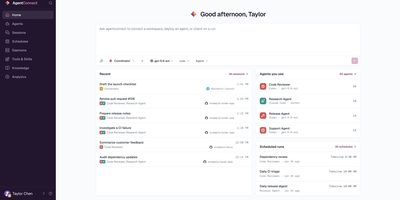
AgentConnect
AgentConnect brings Claude Code, Codex, Grok Build, DeepSeek, and any other ACP-compatible coding agent into the chat channels and repositories where your team already works, each with a role of its own. Mention an agent in Slack, Microsoft Teams, Google Chat, Lark, Discord, or Telegram and it replies in the thread, calls on a colleague agent when needed, and keeps its session visible to teammates who can step in. Work can also start from a GitHub, GitLab, Gitea, or Azure DevOps pull request, a Linear issue, a webhook, or a schedule. The web console organizes the fleet into Agents, Sessions, Schedules, Tools and Skills, Knowledge, and Daemons views. Every agent gets its own memory, skills, MCP servers, workspace, and sandbox policy, and reviewed Knowledge pages can be published for all agents to search. Decisions route new conversations to specialist agents and pick the runtime and model for each session. Review bots can run several reviewers with separate instructions on one pull request. Set who may see each agent or session, which repositories it can touch, and which agents it may call. Running on a dedicated VPS on RepoCloud with guaranteed CPU, RAM, and SSD, full root SSH access, and a browser serial console. Apache-2.0 licensed.
SourceWeft
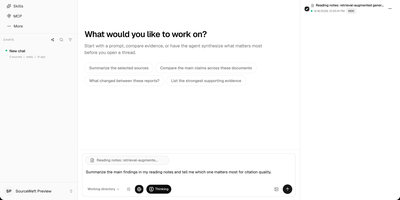
SourceWeft is an AI workstation you host yourself, where agents, your documents, and your model keys work in one place instead of scattering across chat tabs you do not control. Describe a job and a lead agent breaks it down, handing research, exploration, and execution to focused sub-agents that share the same working context and files. Agents draw on a skill library covering presentations, HTML pages, images, meeting summaries, and study guides, and you can add your own skills so good workflows become repeatable. MCP servers, web search, and web extraction connect agents to outside tools, while approved commands run inside a sandboxed environment that cannot touch the rest of your server. Feed it PDFs, web pages, notes, YouTube videos, Notion, Drive, Gmail, or Slack, then follow citations from any answer back to the source material it came from. Bring your own keys for the chat and indexing models you prefer, organize the team into workspaces with roles and access controls, and pick up any conversation from the web app or desktop clients. Running on a dedicated VPS on RepoCloud with guaranteed CPU, RAM, and SSD, full root SSH access, and a browser serial console. Apache-2.0 licensed.
PenguinHarness
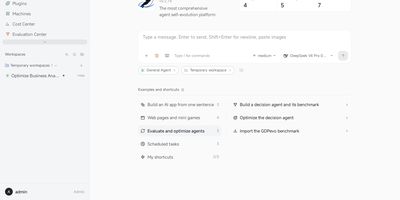
PenguinHarness turns a one-sentence description of the agent you need into a working app, then lets other agents tune it round after round until its benchmark score climbs. Nine self-improvement algorithms ship as plugins, including OPRO, APE, ACE, and AWM, and every candidate becomes a snapshotted version with its score recorded in an Evaluation Center. Seventeen ready-made benchmarks cover data analysis, repository fixes, workflow automation, and terminal science tasks. Agents read and act on web pages through a built-in browser panel or your own Chrome, and each agent can grow a hot-reloaded workbench page like a contract review desk with uploads and downloadable reports. Add a machine over ssh and conversations in that workspace run there, inside the same window. A Cost Center breaks down spend per run, trajectories show every turn on an execution timeline, and replies can carry forms, charts, and live widgets. An Agent API streams runs to outside apps, and agents can be reached from Feishu, QQ, Telegram, or WeChat. Running on a dedicated VPS on RepoCloud with guaranteed CPU, RAM, and SSD, full root SSH access, and a browser serial console. Apache-2.0 licensed.
EDDI
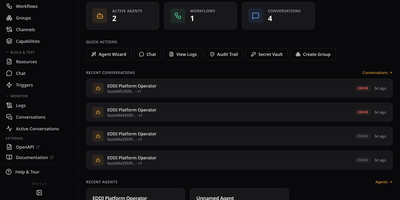
Deploy autonomous conversational AI agents and coordinate complex multi-agent workflows through EDDI, an open-source orchestration middleware that turns declarative configuration files into secure, production-grade enterprise assistants. Engineering teams connect AI models from twelve different commercial and local providers, using bilateral Model Context Protocol tools to let external desktop clients and coding assistants interact directly with running conversational services. Autonomous agents collaborate through structured group interaction patterns including round table discussions, peer reviews, Delphi consensus rounds, and devil's advocate debates to refine generated solutions before delivery. Declarative workflow extensions automate external REST API calls with dynamic request templating, extracting structured properties into persistent conversation memory and chaining multi-step service interactions without custom script glue. Built-in secret vaults safely manage sensitive API credentials, while the centralized web dashboard provides live conversation inspection, token quota enforcement, and comprehensive audit logging for regulatory compliance. Running on a dedicated VPS on RepoCloud with guaranteed CPU, RAM, and SSD, full root SSH access, and a browser serial console. Apache 2.0 licensed.
ShibaClaw
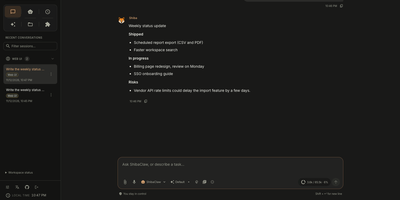
Meet an AI assistant that lives on your own server, remembers who you are, and keeps working after you close the tab. ShibaClaw opens with a four-step onboarding wizard for provider, credentials, and model, then drops you into a chat workspace with agent profiles for building, planning, reviewing, administering, and security work. Long-term memory lives in editable files, a dream diary records what the agent learned, and a Library view maps how profiles relate to each other. Agents call file, shell, and web tools, plug into external MCP servers, and hand work to isolated or forked sub-agents. The Automations page schedules one-shot, interval, or cron jobs like a weekday morning support brief, and a plugin catalog adds services like GitHub, Notion, PostgreSQL, and Google Workspace in one click. An optional knowledge base searches your own documents, and channel integrations reach the agent from Discord, Telegram, Slack, and Matrix. Provider choices span OpenRouter, Anthropic, OpenAI, Gemini, DeepSeek, Groq, Ollama, and any OpenAI-compatible endpoint. A credential vault encrypts keys, and file tools stay inside a restricted workspace. Anyone who wants research, drafting, and recurring chores handled by an assistant they host themselves will feel at home. Running on a dedicated VPS on RepoCloud with guaranteed CPU, RAM, and SSD, full root SSH access, and a browser serial console. Apache-2.0 licensed.
Bernstein
When an agent breaks production at 3 a.m., "the model did it" is no incident report: Bernstein decides in advance what your AI agents may touch, then keeps receipts proving what they did. You write policy as code: which roles may do what, what needs human approval, and what must be recorded before a task counts as done. A deterministic scheduler with no model in the coordination loop turns each goal into parallel tasks, so replaying yesterday's plan reproduces yesterday's task graph exactly. Every coding task runs in its own git worktree behind merge gates; nothing lands on your main branch until tests, lint, and type checks pass. It drives the CLI agents you already use (Claude Code, Codex, Gemini CLI, Aider, Goose, dozens more), mixing cheap local models with heavy cloud ones in one run. Approvals can demand a hardware key touch, and role fences hold whatever an agent tries inside its task. The journal, lineage record, and optional tamper-evident audit chain capture every step, sealed into an Ed25519-signed receipt verifiable offline from the file alone. Non-code work gets the same treatment: an artifact contract names the deliverable (report, dataset, audit evidence pack), and the task completes on a signed receipt instead of a commit. You supervise from the browser dashboard or terminal UI, watching tasks, agents, approvals, and costs live. Running on a dedicated VPS on RepoCloud with guaranteed CPU, RAM, and SSD, full root SSH access, and a browser serial console. Apache-2.0 licensed.