Open Journal Systems
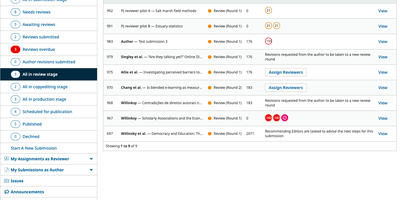
Running a scholarly journal means tracking every manuscript from first submission to published issue, and Open Journal Systems (OJS) keeps that whole journey in one web application. Authors submit through a step-by-step wizard, and editors follow each manuscript on a dashboard with views for submissions that need reviewers, await reviews, are overdue, or sit in copyediting, production, or scheduled stages. Peer review can be double-anonymous, single-anonymous, or open, with due dates, reminders, review forms, and multiple review rounds. Editors assign participants to each submission, request revisions, accept or decline, and manage galleys, the PDF, HTML, or other full-text files readers download, including a JATS XML preview for journals that publish in XML. Articles are grouped into volumes and issues with covers and sections, then published to a mobile-friendly journal website with archives and search. Journal managers pick a theme (Default, Pragma, Manuscript, Classic, Health Sciences, or Immersion) and post announcements. A DOI manager tracks which articles and issues have DOIs and whether they are registered, and indexing support covers Google Scholar, DOAJ, Crossref, DataCite, and PubMed, with OAI-PMH for harvesters. Statistics chart daily or monthly article views by abstract, PDF, and HTML, report editorial trends like days to first decision, and include COUNTER R5 reports. One installation can host several journals, each with its own theme, languages, and roles. Running on a dedicated VPS on RepoCloud with guaranteed CPU, RAM, and SSD, full root SSH access, and a browser serial console. GPL-3.0 licensed.
Deploy