Marketing Dashboard
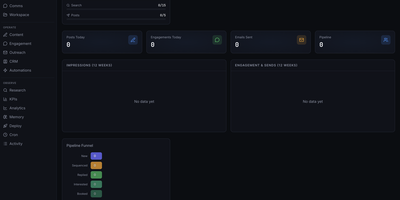
This is a marketing operations control center that replaces fragmented CRM, outreach, content, and analytics tools with a unified self-hosted interface designed for AI agent-assisted go-to-market teams. The CRM module manages leads through a configurable pipeline funnel with stages from New through Sequenced, Replied, Interested, and Booked, tracking source attribution, industry segments, company size, lead quality scores, and LinkedIn URLs per contact. Outreach sequencing supports email campaigns with pause controls, audit endpoints, suppression workflows, and engagement tracking. The content operations surface provides calendar views, content item management, performance metrics, and approval queues for editorial control. Analytics and KPI dashboards show impressions, engagement, and send volumes over configurable time periods, with optional connectors to Plausible, Google Analytics 4, X, and LinkedIn for cross-platform reporting. The OpenClaw-native agent runtime enables dynamic agent and squad discovery, workspace management, session monitoring, and communications surfaces. Automation scheduling uses cron job templates with OpenClaw-compatible schedule variants including cron expressions, every intervals, and at timestamps. The tech stack combines Next.js 16 App Router with React 19, Tailwind CSS 4, Recharts, and Zustand for state management. Authentication supports session cookies, API keys, and optional Google OAuth with role-based access controls. All state persists locally in SQLite via better-sqlite3 with no required external infrastructure. On RepoCloud, deploy Marketing Dashboard on a dedicated VPS with persistent SQLite storage, root SSH access, and complete control over your marketing operations data, all under the MIT license.
CPA Usage Keeper
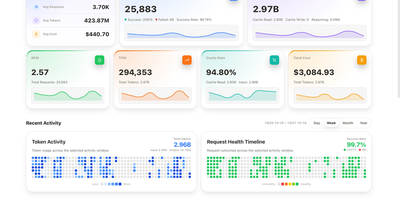
Somewhere between the third coding agent and the fifth model subscription, nobody can say where the tokens went. CPA Usage Keeper keeps the receipts for a CLIProxyAPI gateway, saving every request locally with scheduled backups so history survives restarts. The Overview page shows requests, success rate, tokens, cache hit rate, and estimated cost with sparklines and a calendar heatmap, and Realtime plots time to first token against total latency and shows rolling cache levels and model speed. Analysis breaks usage down by API key, model, credential, or provider with donut charts and ranked lists. The Request Events log filters by model, source, and status, adjusts its columns, and exports records. Credentials cards show success rates, remaining five-hour and weekly quotas, priorities, and enable switches, and quota history charts how many tokens and dollars each percentage point costs over a cycle. Individual API keys can be given a read-only usage view. Deployment uses a Docker Compose file that bundles CPA with Keeper or runs Keeper beside an existing gateway, and the interface switches between English and Chinese and between light and dark themes. Check the dashboard before the invoice arrives and see exactly who spent what. Running on a dedicated VPS on RepoCloud with guaranteed CPU, RAM, and SSD, full root SSH access, and a browser serial console. MIT licensed.
OpenSearch Dashboards
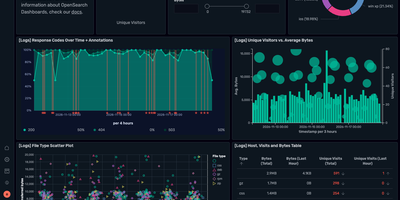
Point OpenSearch Dashboards at an OpenSearch cluster and the documents inside become searchable tables, charts, maps, and dashboards in a browser, with no API requests to write. Discover shows a histogram of documents over time. A field list sits beside expandable results. DQL or Lucene query strings narrow them, and the rows export as CSV. Visualize builds area, bar, line, pie, heat map, gauge, tag cloud, and map charts in a point-and-click editor. TSVB, Timeline, and Vega cover advanced cases. Dashboards combine those panels with input controls, a time picker, and a query bar that filters every panel at once. Sample data brings ready-made logs, flights, and eCommerce dashboards. Query Workbench runs SQL and PPL. Dev Tools sends Query DSL requests. Index Management lists indexes with health, size, and document counts. Reporting exports dashboards and visualizations as PDF, PNG, CSV, or XLSX, once or on a schedule. Observability apps explore logs, traces, and metrics. Alerting monitors and Anomaly Detection flag problems, and Notifications channels reach Slack, email, and webhooks. Data sources connect other OpenSearch clusters, Amazon S3, or Prometheus. Dashboards Management holds index patterns, saved objects, and advanced settings. Security Analytics adds threat alerts, findings, and correlations. Running on a dedicated VPS on RepoCloud with guaranteed CPU, RAM, and SSD, full root SSH access, and a browser serial console. Apache-2.0 licensed.
DHIS2
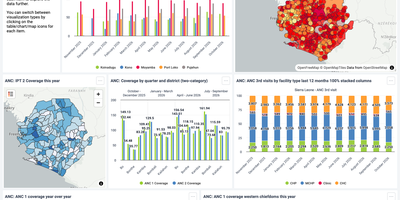
Health programs that tally clinic visits, vaccine doses, and disease cases on paper or in spreadsheets can switch to DHIS2, which turns those routine reports into live dashboards, maps, and charts. Data Entry opens a form for each facility and reporting period, grouped into sections like Immunization and Nutrition, with validation checks and a mark for complete or incomplete reports; Capture follows registered people through program stages like Birth and Baby Postnatal, with scheduled events, notes, and relationships. Dashboards gather charts, maps, tables, and text into one page per topic, with a filter bar, a slideshow mode, sharing, and interpretations, and the Data Visualizer builds column, line, pie, gauge, scatter, and radar charts or pivot tables from indicators, data elements, periods, and organisation units. Maps overlays thematic layers, facility markers, and boundaries on a choice of basemaps, with legends that count the areas in each class, and Metadata Management defines data elements, data sets, indicators, organisation units, programs, option sets, validation rules, and approval workflows from one sidebar. Users, roles, and groups control access; Messaging, Scheduler, Data Quality, and Import/Export apps cover notifications, jobs, checks, and bulk exchange; and Android devices, SMS, and a RESTful API bring in data from remote sites and other systems. Running on a dedicated VPS on RepoCloud with guaranteed CPU, RAM, and SSD, full root SSH access, and a browser serial console. BSD-3-Clause licensed.