Aural
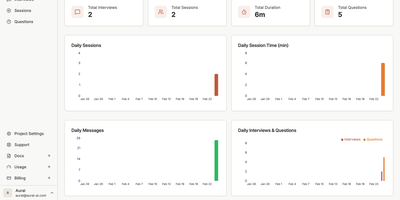
Aural runs the interview for you: describe the role in plain language, share one link, and its AI conducts the whole conversation with each candidate. The generator turns your brief into a complete interview with questions, assessment criteria, and recommended settings, or you build the flow yourself in the editor. Candidates join by chat, voice, or video, and the interviewer adapts in real time, adjusting follow-up depth, tone, and direction as answers develop. Technical rounds run inside the session with a full code editor for live programming questions and a whiteboard for sketching designs. Anti-cheating controls watch for tab switches, blocked external paste, and extra monitors, logging every event into a per-session integrity report. When the session ends, an AI report scores each question, pulls highlights, and names the areas to improve. Teams manage organizations, projects, and role-based access, invite candidates individually, in spreadsheet batches, or by parsing uploaded resumes, and rehearse with a practice mode that gives spoken feedback after every answer. Interviews speak English and Chinese, and the platform connects to the language model provider you already use. Running on a dedicated VPS on RepoCloud with guaranteed CPU, RAM, and SSD, full root SSH access, and a browser serial console. MIT licensed.

Light-Interview
Light-Interview is a practice room for job interviews where you answer out loud and get a scored report afterwards. Fill in a target role, company, job description, and resume, and the app writes a question set to match. A digital interviewer reads each question, listens, and asks a follow-up when an answer is thin, and the browser records every answer on its own. Reports show relevance, completeness, professionalism, STAR structure, logic, speaking pace, pauses, and filler words, with the transcript beside the recording so you can jump to the moment that cost points. Rewrite a weak answer, record it again, and compare the two takes. Answers below the pass line land in a mistake book for retries, and each job goal gets a daily three question plan and a weekly review. Coding assessments run in a web editor with Java, Python, C++, JavaScript, and Go, judged in disposable containers with no network access. A resume library, spoken English and Japanese practice, and study groups with peer review round out the toolkit. Running on a dedicated VPS on RepoCloud with guaranteed CPU, RAM, and SSD, full root SSH access, and a browser serial console. Apache-2.0 licensed.
SurveyKing
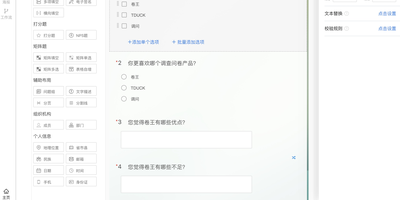
SurveyKing combines survey creation and online examination in a single platform — generate complete questionnaires from plain English via built-in LLM integration, administer timed exams with anti-cheating proctoring, and collect structured data through 20+ question types including matrix questions, cascading selectors, file uploads, and electronic signatures. Built on Spring Boot 3 with a React and TypeScript frontend using the UMI framework and Ant Design components, version 1.12 delivers each question type with independent validation rules, data type controls, and formula calculations. The AI engine connects to mainstream LLMs for survey generation from natural language prompts and provides real-time answer explanations during practice sessions. Exam mode features item banks with Word and Excel bulk import, fixed and randomized question selection, composite paper assembly, live proctoring dashboards with anti-cheating controls, automatic and manual grading with per-question scoring, and PDF score report archiving. The visual logic designer and DSL expression engine handle show/hide conditions, required rules, skip branching, quota controls, randomization, and cross-tabulation analysis with SPSS export. Role-based access controls support multi-user collaboration with department and permission management via Spring Security and JWT authentication. Redis handles caching and queuing while MyBatis Plus manages database operations. Deploy via a single Docker command with embedded H2 for trials or Docker Compose with MySQL for production. Running on a dedicated VPS on RepoCloud with guaranteed CPU, RAM, and SSD, full root SSH access, and a browser serial console. MIT licensed.
OpenOlat
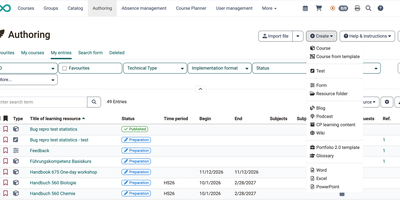
OpenOlat is a learning management system where educators build a course, run the exams, and follow every learner's progress without leaving the browser. Courses are assembled from more than 40 element types: pages, video, podcasts, blogs, wikis, forums, SCORM 1.2 and CP packages, tasks, group tasks, checklists, and surveys. They run as conventional courses or as learning paths whose completion criteria track each person's progress. The test editor offers 16 question types, from single choice and gap text to hotspot, drawing, essay, and file upload; closed questions score themselves, while essays autosave every minute and wait for manual grading. Questions live in a shared question bank, and an optional AI module can draft multiple-choice or essay questions from pasted text. Coaches follow people, courses, and assessment orders in one tool, and the Course Planner schedules products, implementations, events, rooms, and certification programs with recertification. Participants collect badges, certificates, and credit points, or book offers from a catalog. Virtual classrooms connect BigBlueButton, Zoom, or Microsoft Teams, and LTI pages embed outside tools. Hosting it on a dedicated RepoCloud VPS brings guaranteed CPU, RAM, and SSD, full root SSH access, and a browser serial console. Apache-2.0 licensed.
Watchtower
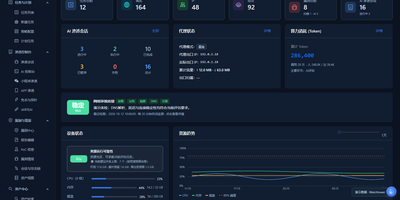
Watchtower puts AI-driven security assessments into one web console, where sessions probe your attack surface while every request, finding, and piece of evidence is captured as it happens. The AI session console follows the attack surface, session progress, tool calls, and findings as an assessment runs, so you can watch an engagement unfold instead of reading a log afterwards. A built-in proxy workflow records HTTP and HTTPS traffic history with highlighted patterns, and any captured request can be sent to the Repeater for editing, replay, and response comparison. Mobile work is covered too: connect phones over USB or wireless, capture app traffic separately from accessibility control, and import WeChat mini-program packages to configure an assessment session. A public vulnerability intelligence library can be searched by component, severity, and source and kept synchronized locally, giving assessments current context without sending your targets anywhere. Findings are managed by source, severity, and status, each linked back to its supporting evidence, and the report editor assembles them with a live preview, impact notes, and remediation guidance. The dashboard tracks assets, tasks, AI sessions, token usage, and runtime resources, and task admission is budgeted against physical memory so heavy scans do not starve the host. Running on a dedicated VPS on RepoCloud with guaranteed CPU, RAM, and SSD, full root SSH access, and a browser serial console. GPL-3.0 licensed.
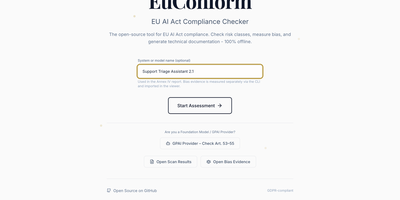
EuConform
Find out where your AI system stands under the EU AI Act with a short guided quiz, without sending a word to anyone's servers. EuConform walks you through its questions covering prohibited practices and the eight high-risk areas of Annex III, from biometrics and education to employment and justice, then returns a risk class with a score and a plain list of recommendations. A compliance gap analysis ranks missing obligations by severity and cites the matching article, from risk management to post-market monitoring. A deadline timeline shows which dates already apply to you. Providers of foundation models get their own track for the general-purpose obligations. Import the JSON artifacts written by the EuConform command line to review compliance signals, open questions, gaps, and an AI bill of materials in the browser, or load bias evidence to compare two model runs. Everything is processed locally, with no tracking and no cookies. The interface comes in English and German, with light and dark themes and keyboard navigation. Running on a dedicated VPS on RepoCloud with guaranteed CPU, RAM, and SSD, full root SSH access, and a browser serial console. MIT licensed.