CRW
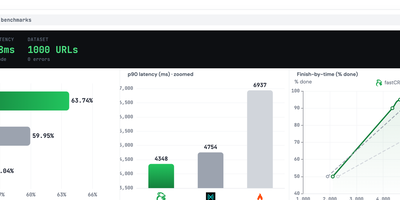
CRW gives your apps and AI agents a private web data API that scrapes pages, crawls sites, maps links, and searches the web without sending every request to a hosted scraping service. Post a URL to the scrape endpoint and receive clean Markdown, HTML, screenshots, links, or structured JSON shaped by a schema you supply. Start a crawl when a whole section matters, then poll for progress while CRW walks pages asynchronously and returns the collected content in one job. Use map first to discover the URLs on a site before spending effort extracting pages you do not need. Connect agent tools through the MCP endpoint so assistants can search, scrape, and crawl from the same self-hosted service your applications call. Add browser rendering when JavaScript-heavy pages hide content from a plain HTTP fetch, and keep simpler pages on the fast lightweight path. Protect a public deployment with Bearer token authentication, your own reverse proxy, logging, and rate limits, or keep the service inside a private network for internal tools. Run one Docker container for the core API, or use the Compose stack when you want bundled search and rendering sidecars beside it. Running on a dedicated VPS on RepoCloud with guaranteed CPU, RAM, and SSD, full root SSH access, and a browser serial console. AGPL-3.0 licensed.
Webclaw
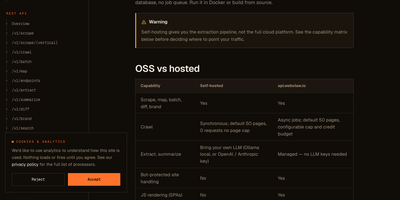
Webclaw turns messy web pages into clean content your AI tools can actually use, extracting the meaningful text and leaving the navigation, ads, and boilerplate behind. You point it at a URL and get back Markdown, plain text, structured JSON, raw HTML, or a format trimmed for language model input, with images stripped, links deduplicated, and whitespace cleaned. Crawl a whole site by following same-origin links page after page, map a domain first to discover every URL from its sitemap before deciding what to fetch, or batch many URLs at once and stream the results as they finish. CSS selectors let you include only the part of a page you care about or exclude the parts you never want, and main-content filtering keeps the article while dropping the chrome around it. Compare today's page against an earlier snapshot to see exactly what changed, or pull a site's colors, fonts, and logo into a brand profile. With your own language model connected, extraction follows a JSON schema or a plain prompt, and summaries come back at the length you ask for. Agents reach the same engine through an MCP server, scripts through the command line, and applications through the REST API. Running on a dedicated VPS on RepoCloud with guaranteed CPU, RAM, and SSD, full root SSH access, and a browser serial console. AGPL-3.0 licensed.
Firecrawl
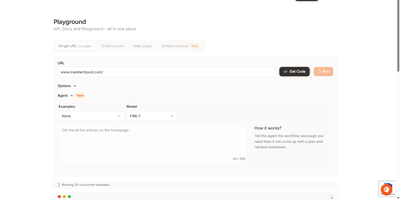
With over 164,000 GitHub stars and one of the fastest-growing open-source projects in the AI tooling ecosystem, Firecrawl is the web context API that turns any website into clean markdown, structured JSON, or screenshots optimized for large language models. The Scrape endpoint converts a single URL into LLM-ready output with approximately 67% fewer tokens than raw HTML, handling JavaScript rendering, rotating proxies, anti-bot bypasses, and dynamic content extraction with zero configuration. The Crawl endpoint recursively scrapes entire websites from a single request with configurable depth, URL filters, and concurrent page limits. The Map endpoint discovers all URLs on a domain instantly for sitemap generation. The Search endpoint performs web searches and returns full page content from results. The Interact endpoint scrapes a page then continues working with it — clicking buttons, filling forms, and extracting dynamic content using AI prompts or code. The Agent endpoint provides autonomous web data gathering where users describe what they need in plain English. SDKs are available for Python, Node.js, Go, Rust, Ruby, PHP, Java, C#/.NET, and Elixir, with an MCP server for connecting to any AI agent or MCP client. Self-hosting deploys via Docker Compose and requires Redis and a Playwright-based browser service for JavaScript rendering. Running on a dedicated VPS on RepoCloud with guaranteed CPU, RAM, and SSD, full root SSH access, and a browser serial console. AGPL-3.0 licensed.
Lightpanda
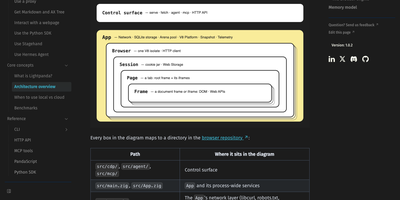
Lightpanda is a headless browser built for AI agents and automation that loads and runs web pages without ever drawing them, so crawling, scraping, and agent browsing finish far faster and lighter than in Chrome. You drive it with the tooling you already have: Puppeteer, Playwright, and Chromedp connect over the Chrome DevTools Protocol, Selenium works over WebDriver BiDi, and existing Chrome automation scripts keep running against the new endpoint. Scripts can execute JavaScript on real pages, wait for network activity, read and mutate the DOM, submit forms, and pull structured data out of dynamic sites that plain HTTP clients cannot see. An MCP server mode hands the browser to AI applications as a callable tool, so a model can open pages, follow links, and read content in the middle of an agent workflow. The built-in agent accepts plain-language browsing tasks and can export what it did as PandaScript, a replayable JavaScript file that runs later with no model call at runtime. A fetch command loads one or more URLs and prints the result as HTML or Markdown, which turns page extraction into a single shell step inside data pipelines. In the project's published crawl benchmark it processed pages roughly nine times faster than headless Chrome at a fraction of the memory, so one server can hold many more concurrent browsing sessions. Running on a dedicated VPS on RepoCloud with guaranteed CPU, RAM, and SSD, full root SSH access, and a browser serial console. AGPL-3.0 licensed.