Flowsint
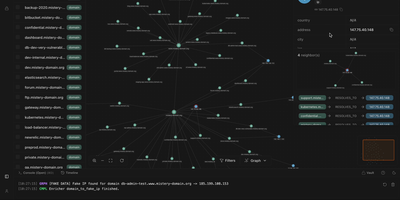
Flowsint turns scattered OSINT leads, like a domain, a username, an email, or a crypto wallet, into one interactive graph that you expand with a right click. Drop an entity on the canvas, run an enricher, and the results appear as new nodes with their relationships already drawn in. Over 30 built-in enrichers cover subdomain discovery, WHOIS and historical records, DNS and ASN lookups, IP geolocation, username searches with Maigret and Sherlock, breach checks for emails and phone numbers, Gravatar profiles, website crawling for contacts and tracking codes, and Ethereum wallet transactions and NFT transfers. Chain enrichers into flows so each output feeds the next step, then replay the same flow on any entity of that type. Missing a source? Write an enricher template in YAML, or describe the API in plain language and let the built-in AI draft it, with API keys kept in an encrypted vault instead of config files. Custom entity types, aliases, tags, JSON import and export, and basic role-based access control make it workable for small teams, and an n8n connector pipes findings into alerts and reports. Double-click the canvas to add items fast, or alt-drag between nodes to link them. Every graph stays on your own server, and no default accounts exist. Running on a dedicated VPS on RepoCloud with guaranteed CPU, RAM, and SSD, full root SSH access, and a browser serial console. Apache-2.0 licensed.

VoidAccess
VoidAccess is a self-hosted dark web OSINT platform that takes a single investigation question and returns a sourced report, a searchable relationship graph, and indicators you can load straight into your defenses. One query fans out in parallel to more than a dozen Tor search engines, code hosts, paste sites, security feeds, and curated onion seeds, then follows newly discovered onion links while mandatory safety gates drop prohibited queries, URLs, and content. A thirteen-step pipeline refines the question, collects across English, Russian, and Chinese sources, filters signal from duplicates and dead ends, enriches what survives, and extracts the entities that matter. It recognizes threat actors, ransomware groups, malware families, IP addresses, domains, onion addresses, file hashes, cryptocurrency wallets across seven chains, exposed credentials with secrets masked, messaging handles, CVEs, and MITRE ATT&CK techniques. Everything lands in an interactive graph with communities and infrastructure clusters, so you can start from one wallet or handle and walk the neighborhood it belongs to, cross-referenced against earlier investigations. Scheduled monitors watch for changes and send Telegram or email alerts when your targets move. Finished work exports as STIX 2.1, MISP events, Sigma and YARA rules, CSV, JSON, and bundled IOC packages, with multi-user access for a team. Running on a dedicated VPS on RepoCloud with guaranteed CPU, RAM, and SSD, full root SSH access, and a browser serial console. MIT licensed.

Social Analyzer
Social Analyzer scans over 1,000 social media platforms in parallel to discover and correlate user profiles from a single username query, making it the most comprehensive OSINT reconnaissance tool of its kind. Three detection modes cover different accuracy and speed tradeoffs: fast HTTP library checks for rapid sweeps, Selenium WebDriver validation for JavaScript-heavy sites, and a special mode for stubborn edge cases. String analysis generates username permutations and combinations to catch related accounts with slight naming variations. Three interfaces serve different workflows: a Node.js web application on port 9005 with a browser-based GUI, a CLI for scripted batch operations, and Python plus Node.js APIs for embedding into automated investigation pipelines. The QeeqBox OSINT library extracts profile metadata, screenshots, titles, descriptions, and activity patterns, all visualized through Ixora-based force-directed graphs that map relationships between discovered accounts. Tesseract OCR analyzes profile images for additional detection vectors. Search results narrow by country codes, website categories, Alexa ranking thresholds, and confidence levels. Optional Google API and DuckDuckGo API integration adds search engine correlation alongside direct platform queries. Docker deployment bundles Node.js, Firefox ESR, Tesseract, and all dependencies into one container. Trusted by law enforcement and security researchers for digital forensics and identity verification. 23,000+ GitHub stars. AGPL-3.0 licensed.