Moodle
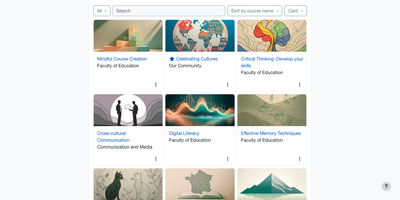
Moodle gives teachers a place to build courses and learners a place to work through them, with quizzes, assignments, grading, and progress tracking on a learning platform you host yourself. Custom or weekly sections sit beside a course index, and Previous and Next buttons walk learners through activities in order. The activity chooser adds forums, wikis, glossaries, lessons, H5P content, and SCORM packages. Question banks can be shared across courses and track every edit, and quizzes combine calculated, ordering, and essay questions with due dates and Safe Exam Browser settings. Assignments offer in-browser PDF annotation, rubrics, and marking guides, and with a marking workflow several markers can leave separate feedback before grades are released. Peer assessment runs through workshops, competency frameworks feed learning plans, and Open Badges recognize achievement. With learning outcomes enabled, a course page lists each outcome beside the activities linked to it. Learners follow deadlines on a dashboard timeline, message classmates, and take course content offline in the official mobile app. Sign-in works through email self-registration, LDAP, Shibboleth, OAuth 2, or LTI, and enrollment through keys, cohorts, flat files, or PayPal. Administrators assign roles, build custom reports, and upload plugin ZIP files. AI actions can run on providers including OpenAI, Azure AI, Gemini, Ollama, and Anthropic Claude, and a course-level report shows how students use them. Running on a dedicated VPS on RepoCloud with guaranteed CPU, RAM, and SSD, full root SSH access, and a browser serial console. GPL-3.0-or-later licensed.
LearnHouse
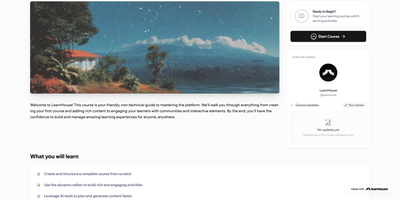
LearnHouse delivers a modern open-source learning platform that replaces proprietary course builders with a self-hosted alternative shipping a rich feature set out of the box. The Tiptap-powered block editor supports videos, documents, embeds, quizzes, and file uploads in a Notion-like interface with real-time co-editing powered by Hocuspocus and Yjs CRDT synchronization over WebSocket. AI tutoring integrates Google Gemini and LlamaIndex for RAG-powered context-aware assistance that adapts to course content, while interactive Playgrounds use AI to generate simulations, diagrams, and learning exercises. The platform handles the full course lifecycle: chapters and activities organize into collections and learning paths, assignments support automated and manual grading, and code blocks execute student submissions in 30+ languages with auto-grading. Analytics dashboards track learner engagement, progress, and completion rates in real time. The backend runs on FastAPI with SQLModel and Alembic migrations against PostgreSQL 16 with pgvector for AI embeddings, while Redis handles caching and session management. The frontend builds on Next.js 16 with React 19 and Tailwind CSS v4. Deployment uses an interactive CLI wizard that configures domain, database, admin account, SSL via Let's Encrypt, and optional features like email via Resend, S3 storage, and Google OAuth, then generates a Docker Compose stack ready to start. On RepoCloud, deploy LearnHouse on a dedicated VPS with root SSH access, persistent PostgreSQL storage for your course data, and complete control over AI provider keys and branding customization, all under the AGPL v3 license.
ClassroomIO
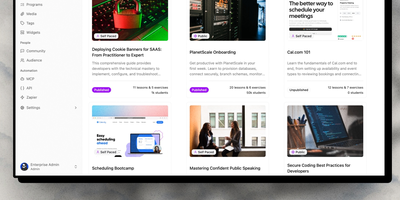
Turn company knowledge into structured courses in minutes: ClassroomIO's AI course builder takes your documents, policies, or topic outlines and generates complete lessons with exercises using Gemini, GPT-4o, or Claude — then an in-lesson AI tutor helps employees study the material at their own pace. The SvelteKit 5 and Hono API architecture backs a platform purpose-built for employee compliance training, customer education, and partner certification programs. Programs group courses into cohorts with team management, progress tracking, and goal setting. Live Kahoot-style quizzes drive real-time engagement during training sessions with automatic scoring and leaderboards. Exercises support multiple question types with automatic grading for multiple choice and AI-assisted evaluation for open-ended responses — teachers review and override all AI decisions. Branded certificates with custom IDs reward course completion. Custom domain mapping through Cloudflare lets organizations serve their learning portal under their own brand. MinIO provides S3-compatible storage for documents and video uploads. The REST API and signed webhooks enable programmatic enrollment and completion tracking, while an MCP server on npm supports AI-native authoring workflows. An embeddable widget drops the course catalog onto any website. Better Auth handles sessions and OAuth with optional SSO. Running on a dedicated VPS on RepoCloud with guaranteed CPU, RAM, and SSD, full root SSH access, and a browser serial console. AGPL-3.0 licensed.
OpenTutor
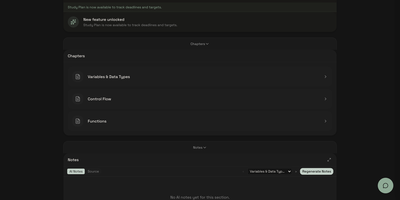
Your lecture slides go in one end, and a personal tutor who has actually read them comes out the other: OpenTutor turns uploaded course material into structured notes, flashcards, quizzes, and a chat tutor that answers from your own documents. Drop in a PDF, DOCX, or PPTX file, or connect Canvas LMS, and within seconds the workspace fills with generated study material organized into twelve composable blocks you can rearrange as your habits change. Ask the tutor questions and every answer cites the source material it came from, with a Socratic mode that prods you toward the answer and depth that adjusts when your replies show fatigue or repeated mistakes. Practice with seven question types, from multiple choice and fill-in-blank to matching, ordering, and coding, and wrong answers are tracked with diagnostic feedback that reshapes later difficulty. Flashcards return on an FSRS 4.5 spaced-repetition schedule tuned to what you are about to forget, and an experimental knowledge graph maps concept mastery, prerequisites, and weak spots into a learning path. Plan study sessions on the calendar, watch progress in analytics, export your work, and connect ten or more LLM providers or a local Ollama model so your documents never have to leave your server. Running on a dedicated VPS on RepoCloud with guaranteed CPU, RAM, and SSD, full root SSH access, and a browser serial console. MIT licensed.
Mentingo
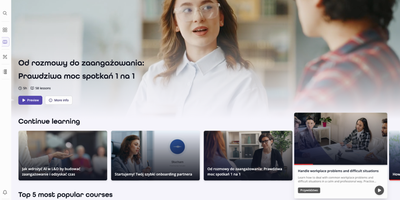
Mentingo is an open-source learning management system where employees practice real workplace conversations with an AI mentor instead of only clicking through slides. The voice and chat mentor plays a customer, candidate, or colleague in role-play scenarios, asks follow-up questions, and returns scored feedback on how the conversation actually went. You can generate a course draft from your own documents, presentations, and procedures, then edit the structure and lessons instead of starting from a blank page. Learners work through a course catalog and distraction-free lessons, while quizzes, scenario questions, and long-form answers check understanding beyond simple recall. Compliance and safety courses can expire on a schedule, with automatic re-enrolment, reminders, and certificate validity tracking keeping renewals from slipping. Administrators organize people by departments, branches, and teams, inherit course access from group membership, and follow engagement and completion analytics per learner, group, and course. A knowledge base, company blog, announcements, and FAQ keep supporting material beside the training itself. Multiple organizations can share one deployment with separate domains and branding, and courses can be exported as SCORM packages for other tools. Integrations include Microsoft 365, Google Workspace, and Slack sign-in, plus an MCP endpoint for AI assistants. Running on a dedicated VPS on RepoCloud with guaranteed CPU, RAM, and SSD, full root SSH access, and a browser serial console. MIT licensed.
Gibbon
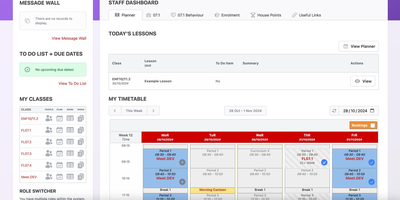
Running a school means juggling lesson plans, timetables, attendance, behaviour notes, and grades all at once; Gibbon gives teachers, students, parents, and administrators one shared web system for that daily work. Teachers build lessons from reusable Smart Blocks, assemble them into units with learning outcomes, set and collect homework online, and grade the results in a colour-coded markbook that stays linked to every class. The timetabling engine builds schedules from reusable day structures, ties them to real calendar dates, handles exceptions, books rooms and facilities, and shows every student and teacher exactly where they should be. Attendance can be taken by form group, class, or individual student, with future absences recorded ahead of time and reports ready for emergencies or truancy follow-up. Behaviour records log the good alongside the bad using your school's own descriptors and severity levels, notify form tutors when something needs attention, and surface patterns across a student's history. Each student's profile pulls timetable, attendance, behaviour, library, and assessment information into one page, while activities sign-ups, a school-wide resource library, and departmental scope-and-sequence views keep the wider community connected. Because every module can be switched on or off per role and extended with community modules, the same platform fits a small primary school and a large secondary school in 26 languages. Running on a dedicated VPS on RepoCloud with guaranteed CPU, RAM, and SSD, full root SSH access, and a browser serial console. GPL-3.0 licensed.
TutorLoom
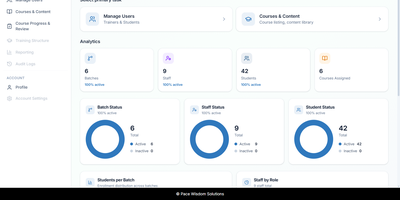
A training institute can run its courses, batches, trainers, and students from a single self-hosted TutorLoom installation it fully controls. One deployment serves many organizations at once, and every query is scoped to the organization, so trainers and learners only ever see their own data. Institute admins manage people and time-boxed batches, inviting trainers and students one by one or in bulk from CSV and Excel files. Courses are built as levels, chapters, and steps mixing videos, documents, tasks, and quizzes, with prerequisites and sequential unlocking so learners follow the path you designed instead of wandering. Students work through a guided step-by-step roadmap on the web or in the mobile app, watching completion fill in as they go and earning points and levels along the way. When learners submit work, trainers review everything in a single grading queue, approving or rejecting with a score and written feedback, then export progress to Excel when management asks for a report. Finishing a course produces a PDF completion certificate automatically. One account can hold several roles at once, so a trainer who also administers an institute switches portals without signing out. Branded email notifications keep learners informed under your own institute's name, and a documented REST API with interactive documentation powers the web app, the mobile app, and your own integrations. Running on a dedicated VPS on RepoCloud with guaranteed CPU, RAM, and SSD, full root SSH access, and a browser serial console. Apache-2.0 licensed.
OpenOlat
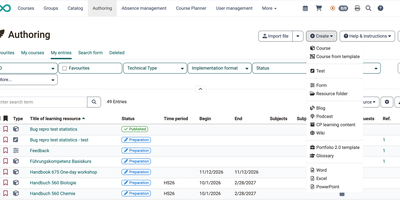
OpenOlat is a learning management system where educators build a course, run the exams, and follow every learner's progress without leaving the browser. Courses are assembled from more than 40 element types: pages, video, podcasts, blogs, wikis, forums, SCORM 1.2 and CP packages, tasks, group tasks, checklists, and surveys. They run as conventional courses or as learning paths whose completion criteria track each person's progress. The test editor offers 16 question types, from single choice and gap text to hotspot, drawing, essay, and file upload; closed questions score themselves, while essays autosave every minute and wait for manual grading. Questions live in a shared question bank, and an optional AI module can draft multiple-choice or essay questions from pasted text. Coaches follow people, courses, and assessment orders in one tool, and the Course Planner schedules products, implementations, events, rooms, and certification programs with recertification. Participants collect badges, certificates, and credit points, or book offers from a catalog. Virtual classrooms connect BigBlueButton, Zoom, or Microsoft Teams, and LTI pages embed outside tools. Hosting it on a dedicated RepoCloud VPS brings guaranteed CPU, RAM, and SSD, full root SSH access, and a browser serial console. Apache-2.0 licensed.
ILIAS
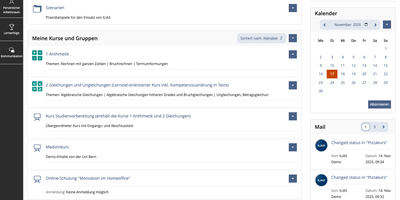
ILIAS is an open-source learning management system that puts courses, SCORM modules, online exams, surveys, wikis, and portfolios on one platform for universities, schools, and companies. Content lives in a repository where categories and courses hold files, learning modules, and tests, and a fine-grained permission system decides who may read, edit, or administer each object. Authors write learning modules, glossaries, and wikis in the browser, import SCORM 1.2 and SCORM 2004 packages, and connect external tools through IMS LTI. The Test and Assessment tool covers everything from self-check quizzes to complete e-exams, and the Scoring tab lets markers work participant by participant or question by question, anonymously if needed, with Markdown feedback. Preconditions unlock the next activity from a test result, so a score of 0 to 30 percent can open one follow-up test while 31 to 50 percent opens another. Study Programmes map whole study and training courses, and an optional progress bar shows learners their completion percentage. Every learner gets a personal workspace for portfolios and blogs, drag-and-drop file upload, profiles, contacts, mail, and chat. Administrators can add guided tours that point at tabs and buttons, assign short links to categories, and export data as XML, CSV, or Excel. The OER Harvester spots Creative Commons material and publishes it in a dedicated category. Running on a dedicated VPS on RepoCloud with guaranteed CPU, RAM, and SSD, full root SSH access, and a browser serial console. GPL-3.0 licensed.