Prefect
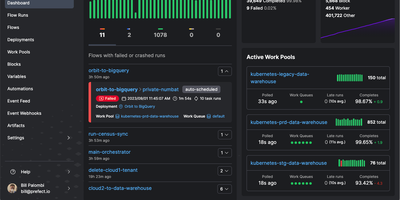
With 23,600 GitHub stars, 13 million monthly PyPI downloads, and 425+ contributors automating over 200 million data tasks monthly for Fortune 50 companies like Progressive Insurance and disruptors like Cash App, Prefect is the most widely deployed open-source workflow orchestration framework for Python — turning any script into a resilient production pipeline with a single @flow decorator while eliminating rigid DAG structures entirely. The durable execution engine persists task results and automatically resumes from failures without replaying expensive upstream work, guaranteeing exactly-once execution for any Python function. Event-driven automation triggers workflows from webhooks, cloud events, or state changes through a real-time event bus that detects what happens or fails to happen across your entire data platform. Work pools decouple workflow code from infrastructure, enabling seamless switching between Docker, Kubernetes, AWS ECS, Azure Container Instances, GCP Cloud Run, and serverless environments without modifying pipeline logic. Native Ray and Dask task runners extend execution across clusters for compute-intensive workloads. The self-hosted server provides a monitoring dashboard with flow run timelines, task state visualization, scheduling, and automation configuration. The third-generation engine reduces overhead by over 90 percent compared to Prefect 2, supporting batch, event-driven, interactive, and background task workflows. Deploy via Docker Compose with PostgreSQL, Redis, server, background services, and worker containers, or use official Helm charts for production Kubernetes. Running on a dedicated VPS on RepoCloud with guaranteed CPU, RAM, and SSD, full root SSH access, and a browser serial console. Apache-2.0 licensed.
Dagster
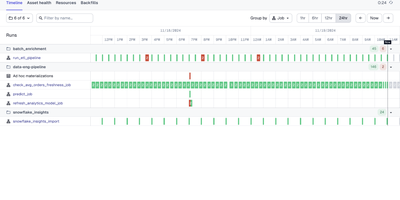
With nearly 16,000 GitHub stars, 5.7 million monthly PyPI downloads, and 400+ contributors, Dagster is the most widely adopted asset-centric data orchestration platform — replacing task-oriented schedulers like Apache Airflow with a declarative model where every pipeline is defined as Python functions producing data assets such as tables, datasets, machine learning models, and reports. The built-in asset graph provides automatic lineage tracking across your entire data platform, showing exactly how data flows from ingestion through transformation to downstream consumption in a single unified view. Declarative Automation goes beyond cron scheduling with event-driven conditions that intelligently trigger materializations based on upstream freshness, data quality signals, and dependency state. The integrated data catalog auto-generates documentation from asset metadata, ensuring it never drifts out of sync with production. Native first-class integrations connect dbt, Snowflake, BigQuery, Databricks, Fivetran, Airbyte, Spark, Great Expectations, Tableau, Power BI, AWS, GCP, and Azure without custom glue code. The web UI visualizes asset graphs, run history, schedules, sensors, and partitioned materializations with built-in alerting via Slack and PagerDuty. Dagster Pipes enables executing arbitrary code in external environments including Spark clusters, Kubernetes Jobs, and cloud functions. Deploy via Docker Compose on a single VM with separate containers for the webserver, daemon, and code locations, or use official Helm charts for production Kubernetes with K8sRunLauncher scaling each run as an independent Job. Running on a dedicated VPS on RepoCloud with guaranteed CPU, RAM, and SSD, full root SSH access, and a browser serial console. Apache-2.0 licensed.

MLflow
Trusted by thousands of organizations with over 30 million monthly downloads and 20,000+ GitHub stars, MLflow is the largest open-source AI engineering platform providing end-to-end lifecycle management for traditional ML models, LLMs, and AI agents. The OpenTelemetry-based tracing system captures complete request flows through any LLM provider or agent framework — including OpenAI, LangChain, DSPy, Vercel AI, PydanticAI, and smolagents — with one-line auto-instrumentation that tracks inputs, outputs, token usage, and costs at every intermediate step. MLflow's evaluation engine offers 50+ built-in metrics and LLM judges for systematic quality assessment, detecting issues across correctness, latency, adherence, relevance, and safety dimensions before code reaches production. The Prompt Registry versions, tests, and deploys prompts with full lineage tracking while automated optimization algorithms improve prompt performance using evaluation feedback. The AI Gateway provides a unified API endpoint for all LLM providers, enforcing rate limits, cost controls, and access policies across the organization. MLflow 3.0 introduces the LoggedModel abstraction linking traces, metrics, and prompts to specific model versions across Python, TypeScript, Java, and R SDKs. The model registry manages deployment workflows with automated quality gates, while experiment tracking records parameters, metrics, and artifacts across training runs. Running on a dedicated VPS on RepoCloud with guaranteed CPU, RAM, and SSD, full root SSH access, and a browser serial console. Apache License 2.0 licensed.
OpenLLM
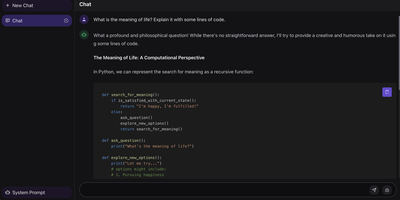
OpenLLM serves any large language model as an OpenAI-compatible API endpoint from a single CLI command, handling model download, backend selection, quantization, and port binding automatically. It supports the full spectrum of popular models including Llama 3.3, Qwen2.5, DeepSeek, Mistral, and Phi3, choosing between vLLM and PyTorch inference backends based on hardware capabilities. When vLLM is available, continuous batching with PagedAttention achieves up to 23x throughput improvement over naive serving, while GPTQ and bitsandbytes quantization reduces memory requirements for GPU-constrained deployments. The server exposes a RESTful API on port 3000 with full OpenAI client library compatibility, enabling drop-in replacement for commercial providers in any application using the standard chat completions format. A built-in web chat UI at the /chat endpoint provides immediate interactive testing without external clients. Custom model repositories allow teams to maintain private catalogs of fine-tuned models alongside the default repository that tracks the latest releases. Deployment workflows generate production-ready Docker images automatically, with Kubernetes manifest support for orchestrated scaling. Native integration with LangChain and LlamaIndex supports RAG pipelines, Transformers Agents enables tool-calling workflows, and HuggingFace Hub handles model discovery. Server-Sent Events enable real-time token streaming across all API endpoints. Backed by BentoML's production ML infrastructure. Running on a dedicated VPS on RepoCloud with guaranteed CPU, RAM, and SSD, full root SSH access, and a browser serial console. Apache 2.0 licensed.