
BeikeShop
BeikeShop gives international merchants a free e-commerce platform with language switching, currency conversion, and drag-and-drop page design built into one admin panel. Shoppers browse nested categories with price and attribute filters, pick size and color variants that carry their own price and stock, save favorites, and check out as guests when that option is enabled. Eleven language packs ship in the box (German, English, Spanish, French, Indonesian, Italian, Japanese, Korean, Russian, and Simplified and Traditional Chinese), and product names and descriptions are written per language. The page builder arranges slideshows, banners, tabbed product lists, brand strips, and article blocks with desktop and mobile previews. Separate builders handle menus and footers. The dashboard charts visitors, traffic sources, conversion, and the order funnel; orders can be filtered, exported, and printed; returns follow a reason-driven workflow; and customer groups, tax classes, regions, and role-based staff accounts keep operations tidy. Email goes out through SMTP, Mailgun, SendGrid, SendCloud, or Sendmail with a delivery log. PayPal, Stripe, and WinToPay payments, flat-rate shipping, and Facebook, X, or Google login are bundled plugins, the marketplace adds more, and an admin REST API covers products, categories, brands, and orders. Cross-border sellers, small brands, and agencies use it to launch multilingual storefronts without custom code. Running on a dedicated VPS on RepoCloud with guaranteed CPU, RAM, and SSD, full root SSH access, and a browser serial console. OSL-3.0 licensed.
S-Cart
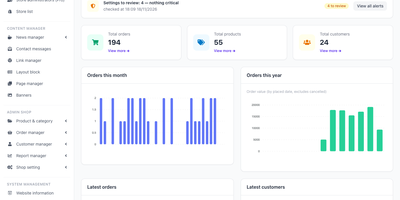
A complete online shop with its own admin panel, order desk, and content manager, S-Cart is free software for merchants who would rather own their store than rent one. The catalog holds single products, bundles, and grouped products, organized by categories, brands, suppliers, tags, and attributes, with stock tracked per item. Shoppers get search, price-range and brand filters, sorting, a wishlist, a cart, customer accounts, and language and currency switchers. Staff move orders through processing, payment, and shipping statuses and review tax, shipping, discount, and fee totals before printing the order or resending its email. News posts, content pages, banners, layout blocks, and a link manager cover the marketing side, and built-in SEO adds meta tags, a sitemap, JSON-LD, hreflang, automatic 301 redirects, and a check screen that flags missing descriptions. An extension library inside the admin installs payment, shipping, coupon, social login, and anti-spam plugins in one click, and optional Multi-Store and Multi-Vendor plugins add store chains and marketplaces. A REST API v2 with an OpenAPI 3.1 spec and signed webhooks keeps ERPs and inventory tools in sync, and an optional MCP server, off until enabled, lets AI agents look up orders and stock. Role-based permissions, an activity log, CAPTCHA, and encrypted backups every 24 hours protect daily operations. Running on a dedicated VPS on RepoCloud with guaranteed CPU, RAM, and SSD, full root SSH access, and a browser serial console. MIT licensed.
Saleor
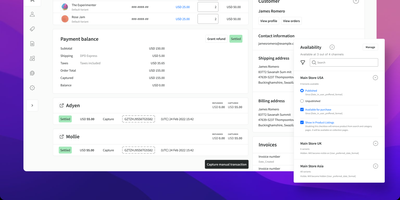
Backed by 23,000+ GitHub stars and trusted by global brands processing millions of orders, Saleor delivers the open-source headless commerce API that replaces monolithic ecommerce platforms with a composable, GraphQL-native architecture where APIs are the only way to interact with the system. The core engine built on Python and Django handles catalog management, order processing, payment orchestration, inventory tracking, and fulfillment workflows while remaining completely decoupled from any frontend technology. Native multichannel support enables per-channel control of pricing, currencies, warehouses, product availability, and payment methods, managing Instagram, Amazon, regional websites, and retail POS from a single backend. The extensibility layer provides 160+ webhooks spanning synchronous payment callbacks, asynchronous event notifications via Google Cloud Pub/Sub and AWS SQS, and subscription queries that shape webhook payloads to deliver only the data your services need. Dashboard UI Extensions offer 45+ mount points for embedding custom interfaces via iframes without forking, while the Apps system allows building payment gateways, PIM integrations, loyalty programs, and discount logic in any language. The React-based administration dashboard provides product management, order processing, customer segmentation, and analytics with multi-language and multi-currency support. OIDC integration connects existing identity providers for single sign-on across the merchant organization. Running on a dedicated VPS on RepoCloud with guaranteed CPU, RAM, and SSD, full root SSH access, and a browser serial console. BSD 3-Clause licensed.
PrestaShop
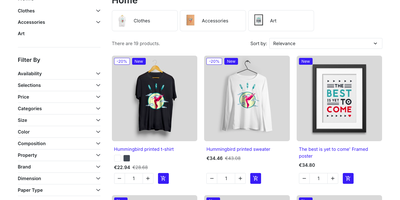
Behind a storefront you own sits PrestaShop, an open-source e-commerce platform that runs the catalog, the checkout, and the order desk. Products carry size and color combinations, features, brands, suppliers, and categories, CSV import loads products and customers in bulk, and Extra Properties adds custom fields with their own types to products, customers, and orders. The bundled One Page Checkout module, switched on from the back office, puts every checkout step on a guest-first page, and the four-page flow stays available. Hummingbird, the default theme, presents a mobile-optimized, accessibility-minded storefront, and native WebP and AVIF image support helps pages load faster. Staff handle orders, invoices, credit slips, abandoned carts, and returns, create orders by hand, and answer shoppers from the customer service page. Carriers, payment methods, taxes, currencies, languages, and shipping zones are configured in the back office, multistore runs several shops with separate settings, and the Update Assistant guides upgrades through backup, update, and restore. In the Classic edition, an Ask AI assistant answers questions from real store data and runs plain-language requests after asking your approval, using the provider and API key you connect. The Admin API connects ERP, order management, PIM, and marketing automation tools through scoped OAuth clients, and Addons marketplace modules extend the shop. Running on a dedicated VPS on RepoCloud with guaranteed CPU, RAM, and SSD, full root SSH access, and a browser serial console. OSL-3.0 licensed.
Open Food Network
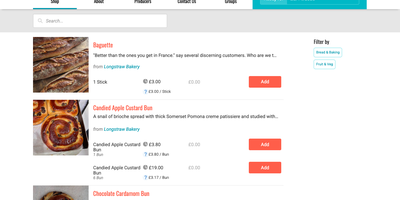
Farmers, bakers, and food hubs that want to sell directly to nearby customers can run their own shopfronts, or one shared marketplace for many producers, on Open Food Network. Each shop opens and closes through order cycles: a coordinator sets the dates, chooses which producers' products go in, and applies fees, so orders are packed and delivered in one batch. Enterprise fees for packing, transport, admin, sales, or fundraising appear to shoppers as a price breakdown. Catalogs support variants, properties such as Certified Organic, unit prices, group-buy bulk ordering, and CSV import. Shipping methods cover delivery or pickup with flat-rate, per-item, or per-kilogram calculators, and payments run through Stripe, PayPal Express, or cash and bank transfer. Customer tags and tag rules decide who sees which products, order cycles, and payment methods, which suits wholesale and member shops, and vouchers and private shopfronts are available. Subscriptions create standing weekly, fortnightly, or monthly orders. The back office handles bulk order management, manual orders, refunds, packing reports, tax and payment reports, and Xero invoice exports. A public map, shop directory, and group pages help shoppers find producers nearby. Running on a dedicated VPS on RepoCloud with guaranteed CPU, RAM, and SSD, full root SSH access, and a browser serial console. AGPL-3.0 licensed.
nopCommerce
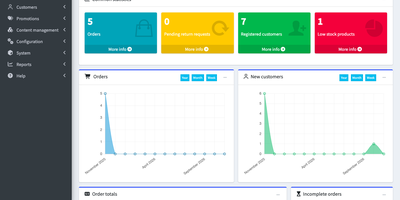
nopCommerce is a self-hosted shopping cart and merchant back office for selling physical goods, downloads, rentals, and gift cards from a storefront you fully control. The catalog covers simple, grouped, downloadable, rental, recurring, and gift card products, with categories, manufacturers, tier prices, product and specification attributes, stock tracking, and Excel import with Excel or XML export. Shoppers get a one-page checkout, wishlists, product comparison, reviews, reward points, gift card redemption, and return requests. Run several stores or outside vendors from a single back office; vendors can apply for accounts and manage their own products, orders, and shipments. Orders move through status changes, offline refunds, shipments, recurring payments, and PDF invoices, while built-in reports surface bestsellers, low stock, country sales, and top-spending customers. Multiple languages and currencies, tax and shipping providers, warehouses, pickup points, and EU Omnibus and GDPR settings support selling abroad. Discounts, affiliates, newsletters, campaigns, SEO-friendly page names, blog, news, forums, and polls cover promotion and content. Customer roles and an access control list set who can manage what, and multi-factor authentication protects sign-ins. Plugins and themes add payment gateways, social sign-in, search, and exchange rates, and the Web API plugin exposes store functions over REST for mobile apps, ERP, CRM, and accounting systems. Running on a dedicated VPS on RepoCloud with guaranteed CPU, RAM, and SSD, full root SSH access, and a browser serial console. nopCommerce Public License 4.0 licensed.
Magento Open Source
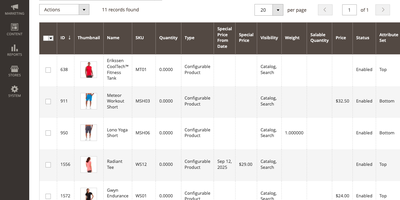
One admin panel, many storefronts: Magento Open Source is a free ecommerce platform for selling online under separate domains, category trees, languages, and currencies from a single install. Catalog managers create simple, configurable, grouped, virtual, bundle, and downloadable products and organize them with categories and attribute sets. Merchandisers assemble CMS pages, blocks, and product and category content in Page Builder by dragging rows, columns, tabs, banners, sliders, videos, and product lists onto a visual stage. Catalog price rules and cart price rules with coupon codes drive promotions, and customer groups such as Wholesale and Retailer can get targeted discounts and their own tax class. Shoppers browse the Luma storefront theme and check out as guests or with accounts. Staff then take each order through invoice, shipment, and credit memo, while Multi-Source Inventory tracks stock across warehouses, stores, and drop shippers. Built-in sales, customer, and product reports show what sells, and Login as Customer lets permitted staff view the storefront as an opted-in shopper sees it. Import and export tools move products and customers in bulk, and the REST and GraphQL APIs let ERPs, shipping tools, and headless front ends read and write store data. Running on a dedicated VPS on RepoCloud with guaranteed CPU, RAM, and SSD, full root SSH access, and a browser serial console. OSL-3.0 licensed.
Inventoros
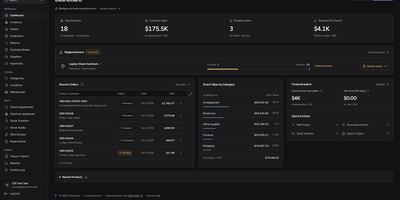
Between the spreadsheet and enterprise software sits Inventoros, a self-hosted system for tracking stock, orders, and suppliers across warehouses. A replenishment panel on the dashboard flags products below their minimum, and purchase orders go to suppliers by email and are received into stock. Products carry SKUs, variants, kits, batches with expiry dates, and serial numbers, with barcodes and QR labels for products and locations. Warehouses nest aisles, shelves, and bins, stock moves between them, and staff can be limited to the sites they work in. Orders handle approvals, payments, refunds, PDF invoices, partial shipments, and returns, and a customer portal shows invited contacts their orders, shipments, and balances. Twelve built-in reports cover valuation, turnover, dead stock, profit margin, and ABC analysis, and a custom report builder exports to CSV, Excel, or PDF on a schedule. Webhooks, a REST API, GraphQL, signed plugins, and an MCP server connect it to the rest of your stack and to AI clients acting with a user's token. Running on a dedicated VPS on RepoCloud with guaranteed CPU, RAM, and SSD, full root SSH access, and a browser serial console. AGPL-3.0 licensed.
Apache OFBiz
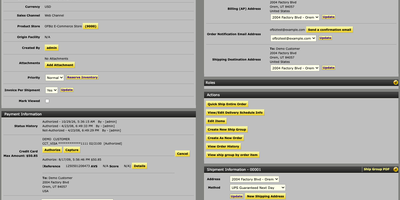
Apache OFBiz is the enterprise resource planning system a company installs when accounting, inventory, orders, and the factory floor must all agree with each other in real time. One shared data model connects the modules, so a sales order entered by the CRM team immediately reserves stock in the warehouse, schedules a pick list, and posts the receivable to the general ledger when it ships. The catalog manager handles unlimited stores, categories, and product variants with price rules and a promotion engine, and the built-in e-commerce storefront and point of sale sell from the same inventory your warehouse counts. Manufacturing plans production with bills of materials, routings, and MRP runs that propose purchase orders for missing raw materials, then costs every job as it moves through the shop. Accounting is proper double-entry: accounts receivable and payable, invoicing, payments, fixed assets with depreciation, budgets, and financial reports across multiple organizations. Facility tools manage several warehouses with lot and serial tracking, receiving, returns, and physical inventory counts, while the HR module keeps positions, contracts, expenses, and performance reviews. Party management unifies customers, suppliers, and employees into one record, REST and service APIs expose every function to integrations, and project and work effort tools track tasks against orders. Running on a dedicated VPS on RepoCloud with guaranteed CPU, RAM, and SSD, full root SSH access, and a browser serial console. Apache-2.0 licensed.
Xianyu SaaS
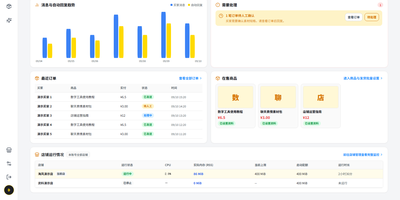
Xianyu SaaS runs all of your Xianyu (Goofish) shops from one self-hosted console, answering buyers with AI, delivering digital goods the moment orders verify, and keeping every store isolated in its own process. Add each shop by scanning a QR code in the Xianyu app, then switch between stores from one header while the overview tracks messages, replies, delivery results, orders, and pending tasks. The AI customer service center lets you pick a service persona, write shop-wide reply requirements in plain language, and maintain a separate knowledge entry for every product, covering audience, specifications, usage, delivery notes, and after-sales wording. Keyword rules answer the repetitive questions first, with product-specific rules outranking store-wide ones, and anything unmatched falls through to the AI with product knowledge and chat history in context. When a buyer pays, the system re-checks the platform order before delivering, drawing card keys one to fifty at a time from named pools, sending netdisk resources, or posting fixed text instructions, with a five-minute sweep catching orders missed while a shop was offline. A conversation workbench lets you search chats, take over from the AI with one click, send up to eight queued images, and jump from any order straight into the buyer's thread. A built-in operations agent manages a shop through chat, updating product knowledge, toggling reply rules, or binding delivery stock on request. Running on a dedicated VPS on RepoCloud with guaranteed CPU, RAM, and SSD, full root SSH access, and a browser serial console. GPL-3.0 licensed.
Sylius
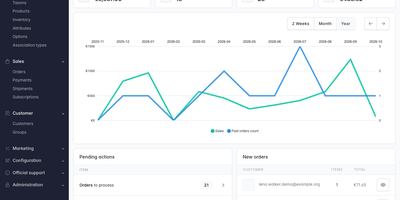
One install, many shops: Sylius runs separate storefronts with their own languages, currencies, and countries from a single admin panel. Products are simple or configurable. Define a size option, generate variants from S through XXL, and track stock per variant. Attributes, translations, and a nested taxon tree keep the catalog organized. Prices are set per channel. Catalog promotions add sale badges and struck-through prices. Cart promotions pair rules, like a minimum item total, with actions, like a fixed order discount, optionally behind coupon codes. Shipping methods carry delivery windows, zone eligibility, and shipping and tax categories. Order pages show items, shipping, taxes, promotions, payment state, and customer details. The dashboard charts sales and paid orders over time and lists pending work. A ready-made storefront covers product pages, a cart, checkout with address, shipping, payment, and review steps, customer accounts with order history, and product reviews. Custom frontends talk to separate shop and admin REST APIs, documented in OpenAPI. Every enabled locale adds a translation section to products, taxons, shipping methods, and promotions. Running on a dedicated VPS on RepoCloud with guaranteed CPU, RAM, and SSD, full root SSH access, and a browser serial console. MIT licensed.
Thelia
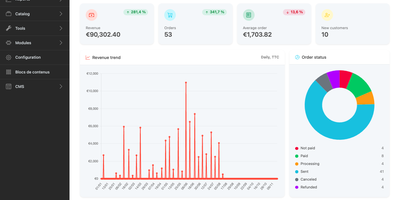
From the first product page to the last parcel out the door, Thelia runs an online shop on your own server, with catalog, checkout, orders, and shipments in a single back office. Products come with variants, each carrying its own reference, stock, price, sale price, weight, GTIN, and manufacturer part number, and category pages filter by color, brand, material, availability, and price. Orders move through Not paid, Paid, Processing, Sent, Canceled, and Refunded, with invoice and delivery slip PDFs on every row and bulk status changes across a selection. An order can leave in several parcels, each with its own carrier and tracking number. Sale units let one install sell from several domains or pick-up points, each with separate prices, stock, and orders. Promotions cover coupon codes for a percentage or a fixed amount, scheduled sales with start and end dates, catalog price rules, and a newsletter list. Customers can carry a percentage discount, a reseller flag, and company and VAT numbers. CMS pages move from draft to scheduled to published in several languages, alongside menus, forms, and a media library. Stripe, PayPal, and PayPlug payments plus Chronopost, DPD, Colissimo, and Mondial Relay delivery arrive as modules, and a REST API links the shop to ERP, PIM, and CRM systems. Running on a dedicated VPS on RepoCloud with guaranteed CPU, RAM, and SSD, full root SSH access, and a browser serial console. GPL-3.0 licensed.
AbanteCart
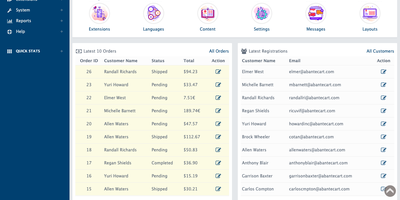
Selling online without a platform skimming every order is the idea behind AbanteCart, a free self-hosted shopping cart that ships with a storefront and a full back office. Products carry unlimited options and attributes with stock tracked per combination, plus image galleries, videos, digital downloads, reviews with approval, wishlists, and spreadsheet import and export for bulk updates. One admin can run several stores, each with its own theme, catalog, and payment methods, and a visual layout manager places blocks on each page from the admin. Checkout handles guest orders, coupons, quantity discounts, store credits, multiple languages and currencies, and more than twenty payment gateways, with live shipping rates from USPS, UPS, and FedEx. A built-in CMS and blog, a forms manager, an email template editor, scheduled banners, SEO-friendly URLs, and a content vault that restores earlier versions of descriptions round out the toolkit. Marketplace extensions add payments, tax automation, and more. Boutiques, digital goods sellers, and agencies managing client shops can all start selling from a single install. Running on a dedicated VPS on RepoCloud with guaranteed CPU, RAM, and SSD, full root SSH access, and a browser serial console. OSL-3.0 licensed.