Open Journal Systems
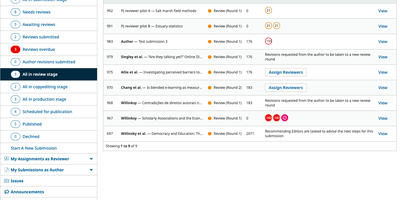
Running a scholarly journal means tracking every manuscript from first submission to published issue, and Open Journal Systems (OJS) keeps that whole journey in one web application. Authors submit through a step-by-step wizard, and editors follow each manuscript on a dashboard with views for submissions that need reviewers, await reviews, are overdue, or sit in copyediting, production, or scheduled stages. Peer review can be double-anonymous, single-anonymous, or open, with due dates, reminders, review forms, and multiple review rounds. Editors assign participants to each submission, request revisions, accept or decline, and manage galleys, the PDF, HTML, or other full-text files readers download, including a JATS XML preview for journals that publish in XML. Articles are grouped into volumes and issues with covers and sections, then published to a mobile-friendly journal website with archives and search. Journal managers pick a theme (Default, Pragma, Manuscript, Classic, Health Sciences, or Immersion) and post announcements. A DOI manager tracks which articles and issues have DOIs and whether they are registered, and indexing support covers Google Scholar, DOAJ, Crossref, DataCite, and PubMed, with OAI-PMH for harvesters. Statistics chart daily or monthly article views by abstract, PDF, and HTML, report editorial trends like days to first decision, and include COUNTER R5 reports. One installation can host several journals, each with its own theme, languages, and roles. Running on a dedicated VPS on RepoCloud with guaranteed CPU, RAM, and SSD, full root SSH access, and a browser serial console. GPL-3.0 licensed.

Open Monograph Press
Monographs and edited volumes reach readers through a searchable catalog once Open Monograph Press (OMP) has carried them through its editorial workflow. Authors drag in chapter files, figures, and tables, and managing editors assign editors and track their assignments. Manuscripts move through Submission, Internal Review, External Review, Copyediting, and Production, with anonymous or open review rounds, due dates, automated reminders, and a flag for overdue reviews. Books publish in whatever formats a press needs: PDF, ePub, HTML, audio, video, datasets, or a printed edition with an ISBN. Files are set to Open Access or Direct Sales, and priced formats get a purchase button. Edited volumes list their chapters with separate contributors and downloadable files. Series with their own editors and nested subject categories organize the catalog, and featured and new-release flags decide which titles lead the home page. Readers search or browse by series or category on a responsive site that a press can restyle with a custom theme. Catalog entries carry ONIX metadata for books and chapters, DOIs, ORCID, and ROR affiliations, with OAI-PMH and Google Scholar support for discovery. Usage charts track catalog-entry and file views over time, a per-monograph table lists abstract, file, PDF, and HTML counts, and COUNTER R5 reports are built in. Configurable roles cover editors, copyeditors, and production assistants. Publication metadata is multilingual. Running on a dedicated VPS on RepoCloud with guaranteed CPU, RAM, and SSD, full root SSH access, and a browser serial console. GPL-3.0 licensed.